
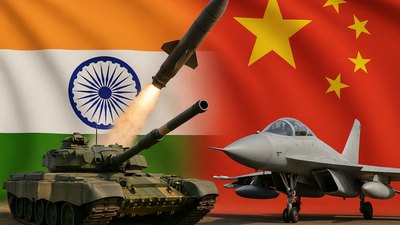
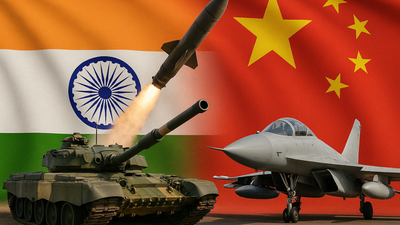
TL;DR: Driving the newsGlobal arms revenues surged to an all-time high of $679 billion in 2024, up 5.9% in real terms, according to the latest SIPRI Top 100 ranking. While Europe and the US drove most of the increase, Asia and Oceania stood out as the only region to post a decline—largely due to a dramatic drop in Chinese arms company revenues, the SIPRI report said. Zoom inIndia, though still far from being a global arms giant, posted a quiet but steady 8.2% increase in combined revenues across its three Top 100 companies. In sharp contrast, Chinese arms revenues fell 10%, a setback tied to a wave of high-profile corruption scandals and major contract delays that rattled Beijing’s defense establishment.India’s steady climbIndia’s three Top 100 firms-Hindustan Aeronautics Ltd (HAL), Bharat Electronics Ltd (BEL), and Mazagon Dock Shipbuilders-together pulled in $7.5 billion in arms revenue in 2024, up from $6.9 billion in 2023.BEL led the growth with a 24% revenue jump, hitting $2.47 billion. The boost came from domestic orders, particularly in radar systems and electronic warfare equipment, both prioritized in India’s military modernization drive.HAL, India’s top-ranked defense firm at rank 44 globally, earned $3.81 billion, a marginal 0.3% decrease from the previous year. The company faced delivery lags, but remained a cornerstone supplier to the Indian Air Force and Navy.Mazagon Dock, focused on naval shipbuilding, recorded $1.23 billion in arms revenue, with a 9.8% year-on-year increase, thanks to continued submarine and destroyer production.Why it mattersIndia is pressing ahead with its “Atmanirbhar Bharat” (self-reliant India) campaign in defense production. While not grabbing global headlines, its incremental gains highlight an emerging industrial base that could challenge traditional suppliers over time.“The combined arms revenues of the three Indian companies in the Top 100 increased by 8.2 per cent to $7.5 billion on the back of domestic orders,” the SIPRI report said.China’s disrupted marchXi’s purge tableThe picture in China couldn’t be more different. For the first time in years, China’s eight arms producers in the SIPRI Top 100-previously hailed as key enablers of President Xi Jinping’s military modernization push-lost major ground.Combined revenues fell by 10% to $88.3 billionThe steepest fall came from NORINCO, China’s primary land systems manufacturer, which saw its revenue plunge 31% due to corruption scandals and leadership upheaval.CASC, China’s aerospace and missile systems leader, dropped 16% following delays in military satellite programs and the removal of its president amid graft allegations.Even AVIC, the country’s biggest defense company, slipped 1.3%, hampered by delays in aircraft deliveries.“A host of corruption allegations in Chinese arms procurement led to major arms contracts being postponed or cancelled in 2024,” said Nan Tian, director of the SIPRI military expenditure and arms production programme.Between the linesChina’s top-down, state-controlled defense sector may be big-but its opacity leaves it vulnerable to internal shocks. Political purges tied to Xi’s sweeping anti-corruption campaign disrupted procurement and leadership pipelines across several top defense firms.Only two of China’s eight arms producers recorded revenue growth-CSSC, the shipbuilding powerhouse, was one, rising 8.7%, aligned with China’s naval buildup in the South China Sea. India’s slow, state-driven growth might lack flash, but it also avoids the internal disarray seen in Beijing. Its procurement is transparent, aligned to strategic plans, and largely free of major political scandal.China, meanwhile, is still far ahead in sheer scale but vulnerable to top-level instability.The big picture: Asia’s arms balance shiftsWhile China dragged down the region’s total, other Asian powers picked up slack:South Korean arms producers rose 31% to $14.1 billion, driven by booming exports.Japan posted the largest jump in Asia: a 40% increase in arms revenues across five firms, reaching $13.3 billion, reflecting Tokyo’s shift toward proactive defense spending amid regional tensions. Global context: Arms race acceleratingUS firms remain the backbone of the global arms industry. The 39 American companies in the Top 100 generated $334 billion in arms revenues in 2024, a 3.8 per cent increase that leaves them with just under half of global Top 100 sales. Lockheed Martin alone booked $64.7 billion, while RTX, Northrop Grumman and General Dynamics each sat comfortably above $30 billion.Yet the American giant is struggling to turn money into timely capability. Programmes such as the F-35 fighter, the Columbia-class nuclear submarine and the Sentinel ICBM are all running late and over budget. Lockheed’s F-35 deliveries in 2024 were delayed by an average of 238 days per aircraft, and the programme’s projected sustainment costs have ballooned towards $1.6 trillion over its life. Northrop’s Sentinel programme has breached US cost-growth thresholds by around 80 per cent versus its original estimate. SIPRI’s Xiao Liang warns that “The delays and rising costs will inevitably impact US military planning and military spending… This could have knock-on effects on the US government’s efforts to cut excessive military spending and improve budget efficiency.” In plain terms, even as the US spends more, it risks getting less capability per dollar.European producers surged by 13%, reaching $151 billion, as countries rearm in response to Russia’s war in Ukraine.Russia and the Middle East: War economies and new hubsRussia’s corporate footprint in the SIPRI Top 100 remains surprisingly small—just two entities, Rostec and United Shipbuilding Corporation—but their combined arms revenues jumped 23 per cent in 2024 to an estimated $31.2 billion. Domestic demand linked to the Ukraine war more than offset shrinking exports. Russian plants have ramped up output of artillery shells, missiles and armoured vehicles; SIPRI cites reports of 1.3 million 152-mm shells produced in 2024, a more than fivefold increase over 2022.Where Russia is constrained, the Middle East is expanding. For the first time, nine companies from the region appear in the Top 100, with combined arms revenues of $31.0 billion, up 14 per cent where comparable data exist. Israeli firms alone generated $16.2 billion, a 16 per cent increase, fuelled both by the Gaza war and strong demand for uncrewed systems and missile defence worldwide.What’s nextFor India:Expect a continued push for domestic procurement and local manufacturing under the Defence Acquisition Procedure (DAP).India may look to expand exports, especially to Africa and Southeast Asia, but lacks the global competitiveness of Korean or Israeli systems.For China:Beijing still accounts for around 13 per cent of total Top 100 arms revenues, and its shipyards and missile producers have been central to the rapid expansion of the PLA Navy and rocket forces over the past decade.But the 2024 rankings hint at a temporary pause or re-ordering in its modernisation drive just as tensions over Taiwan and in the South China Sea remain high.Recovery will depend on restoring procurement integrity, managing talent loss, and containing political fallout.For Asia:The regional arms race is far from over.The pivot from importing to building continues—but success will depend on supply chain resilience, governance, and geopolitical alignment.The bottom lineIndia is climbing slowly, but surely-fueled by trust in institutions, steady demand, and political will.China, long considered an unstoppable defense juggernaut, now faces turbulence not from outside threats, but from within.In the evolving landscape of Asian defense, discipline may matter more than dominance. And for now, India is playing the long game.







Leave a Reply