


NEW DELHI: Supreme Court order for pan-India CBI probe into ‘digital arrest’ cases, while signifying the threat from digital scamsters, is important also because the opposition-governed states had withdrawn “general consent” to CBI to probe crimes in their territories.Keeping two other forms of cyber-crime – investment scams and part-time job scams – on the back burner, the bench said CBI shall investigate digital arrest scam cases, and the court will consider whether the other two forms of cyber-crime require court supervision/monitoring. Suspecting assistance to scamsters by banking system insiders, the bench said, “CBI shall have a free hand to investigate bankers under Prevention of Corruption Act when they are suspected to be involved in the opening of ‘mule accounts’ where the fraudsters park their extorted monies.“
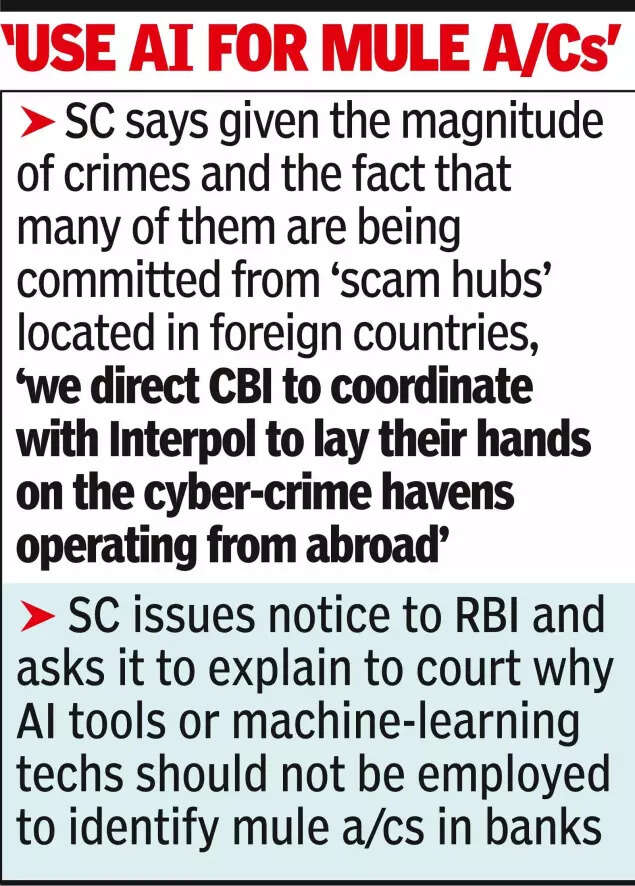
CJI Kant and Justice Bagchi said that given the magnitude of the crimes and the fact that many of them were being committed from ‘scam hubs’ located in foreign countries, “we direct the CBI to coordinate with Interpol to lay their hands on the cyber-crime havens operating from abroad”.The bench also issued notice to RBI and asked it to explain to the court why artificial intelligence tools or machine-learning technologies should not be employed to identify mule accounts in banks and freeze the deposits suspected to be proceeds of crime.The court also directed the IT intermediaries to preserve data relating to phones and equipment used by fraudsters, provide it to CBI and render full assistance to the central agency as and when sought in a particular case or in general.The bench further said that there is widespread breach of norms in issuance of SIM cards. “Facts brought on record so far reveal an alarming negligent and irresponsible approach of telecom service providers while issuing multiple SIM cards in one name. We direct the DoT to submit a proposal for the consideration of SC, which may eventually be required to be implemented to prevent misuse of SIM cards,” it said.SC directed all states and UTs to ensure establishment of regional/state Cyber-Crime Coordination Centres and operationalise them for better coordination with Indian Cyber Crime Coordination Centre (I4C) of MHA so that effective steps could be taken against cyber-crimes, especially digital arrest scam cases.It asked MHA, ministry of finance, DoT, MeitY to submit a detailed plan of action for coordinated steps against digital arrest scam cases. The court adjourned hearing on the case by two weeks to enable CBI to choose experienced hands from state police forces as well as experts in information technology who can assist it in investigating digital arrest cases across India.







Leave a Reply