
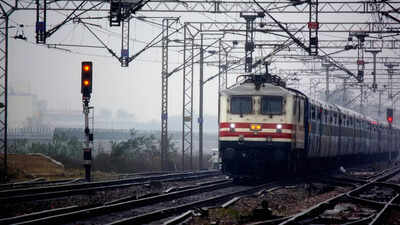
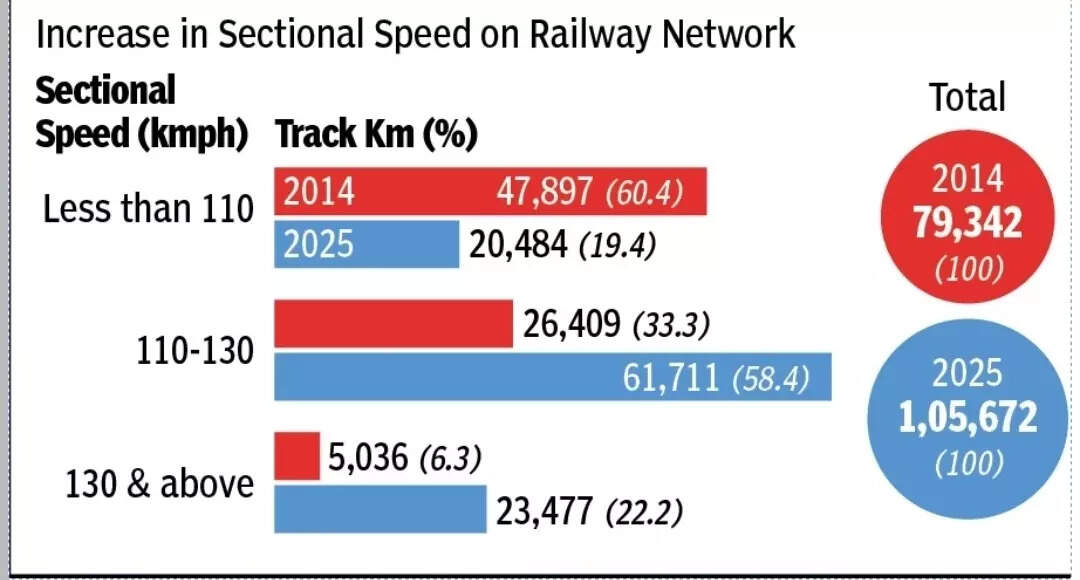
NEW DELHI: The govt informed Parliament in the last sessionthat nearly 81% of railway tracks are ready to allow trains to run at speeds of over 110 kmph, a two-fold increase compared to 2014. One-fifth of the existing tracks allow trains to run at speeds of more than 130 kmph.This is significant since the increase in sectional speeds has happened across the railway network rather than being a limited, corridor-based upgrade. As per govt data, 84,888 km out of the little less than 1.1-lakh-km of railway network has been upgraded to support speeds of 110 kmph and above and 23,477 km of this is capable of train operations at 130 kmph and above.This systemic upgrade is allowing railways to introduce new-age Vande Bharat — both chair car and sleeper trains — and Amrit Bharat trains that can run at faster speeds.
Experts said the upgrade of sectional speeds is also important considering that unlike countries such as China, Japan and France, which achieved higher speeds primarily through the laying of new, passenger-only high-speed rail lines, India has pursued a fundamentally different and more complex path.The Indian approach has focussed on upgrading existing tracks that carry mixed traffic — passenger and freight — which is far more challenging than building segregated high-speed corridors, as it requires strengthening track geometry, signalling, electrification and safety systems without disrupting daily operations.Railway ministry officials said India’s strategy has seen large contiguous stretches of tracks being upgraded progressively from 110 kmph to 130 kmph and further to 160 kmph.“This creates a laddered speed ecosystem rather than a sharp division between ‘slow’ conventional lines and isolated high-speed routes. Such gradation allows trains, crew training and signalling systems to evolve organically, reducing transition risks,” said an official.The speed capability is also spread across all railway zones, including freight-intensive zones such as East Central Railway, South East Central Railway and South Central Railway. “This ensures national uniformity and avoids the creation of elite, passenger-centric corridors disconnected from the rest of the network,” the official said.Railways run some of the world’s longest freight trains, carry over 2.5 crore passengers daily, operate with heavy axle loads of 22.9–25 tonnes, and maintain long welded rails, full electrification and increasingly automated signalling—all on the same tracks. No other railway system has attempted speed upgrades under such constraints at a comparable scale, they added.






Leave a Reply