
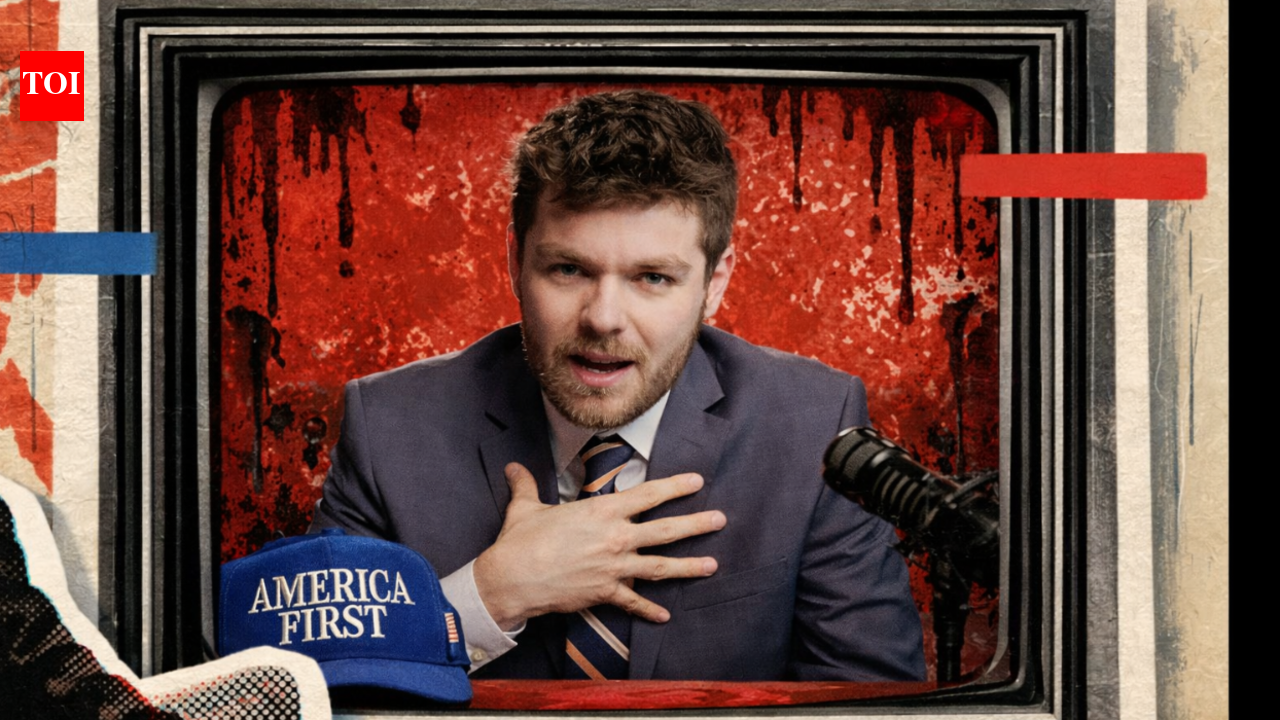
Nick Fuentes is 27 years old and, depending on the source, either a marginal provocateur inflated by spectacle or one of the most disruptive figures in American far-right politics. Over the past decade, he has built a loyal online following, founded parallel political institutions, clashed with mainstream conservatives, appeared alongside former President Donald Trump, and now moves between deplatforming and resurgence in the volatile digital economy.He has attended the 2017 Unite the Right rally in Charlottesville, aligned himself with the “Stop the Steal” movement, dined with Donald Trump at Mar-a-Lago, been banned from major social and payment platforms, courted wealthy benefactors, criticised the MAGA movement from the Right, and built a livestream that at times draws close to one million views per episode on Rumble. His influence remains disproportionate to his formal political power, but it is real enough to provoke sustained scrutiny from both conservative and liberal media.
At the same time, Fuentes has become a rhetorical instrument in wider political battles. Progressive activists and commentators frequently cite him as a distilled example of what they argue is the logical endpoint of right-wing populism, using his rhetoric to characterise the broader conservative movement as extremist. That dynamic, in turn, has made him a liability for Republican leaders eager to distance themselves from explicit white nationalism. For many on the institutional Right, Fuentes is not merely an embarrassment but a strategic problem: a figure whose presence allows opponents to conflate fringe ideology with mainstream conservatism. In that sense, he occupies an uneasy space, rejected by party leadership, criticised by conservative intellectuals, yet repeatedly invoked by the Left as proof of radicalisation within the Right.
From libertarian teen to “America First” broadcaster
Nicholas Joseph Fuentes was born on August 18, 1998, in Illinois and raised in the Chicago suburb of La Grange Park. He grew up Roman Catholic and attended Lyons Township High School, where he served as student council president. He briefly attended Boston University, studying politics and international relations, before dropping out.Part of Fuentes’s appeal to his audience is that, beneath the provocation, he presents himself as someone who has done the reading. He does not frame his politics as purely instinctive grievance but as the product of immersion in conservative and nationalist literature, online debates and talk radio. In interviews, he often sketches a trajectory that begins not with white nationalism but with mainstream libertarian conservatism.OnTucker Carlson’s podcastlast year, Fuentes recalled that in high school he was already “very political,” consuming what he described as the dominant strain of online conservative content in the early 2010s. He said he was reading “a lot of the libertarian stuff, Austrian school, Chicago school, economic type literature,” adding: “If you went online in the mid-early 2010s, that’s all the conservative content there really was.” He characterised that period as the tail end of “the Ron Paul revolution,” referencing activist networks such as Young Americans for Liberty and the influence of PragerU.Founded by conservative radio host Dennis Prager, PragerU had by then become a polished digital hub for young conservatives, delivering bite-sized videos championing free markets, limited government and traditional values, while pushing back against progressive social and cultural trends. Fuentes said he was not just watching from the sidelines. “Oh yeah. I was in the Prager Force,” he said, referring to a Facebook group that distributed the organisation’s videos to high school and college students.He has also pointed to conservative radio host Mark Levin as an early influence, particularly on questions of demography and national identity. Having grown up in a 95% white suburb of Chicago, he said the diversity “had not really reached my corner of Chicago yet,” leaving him insulated from the demographic shifts Levin was describing.On the Carlson podcast, he described listening to Levin in high school and encountering an argument that stayed with him. Levin had asked on air: “America’s becoming a majority non-white country. Does anybody think that’s a good idea?” Fuentes said the comment forced him to consider demographic change in a way he had not previously done. When Carlson pressed him on whether Levin had “radicalised” him on race, Fuentes replied that it was “a real story” and acknowledged: “Yes… he planted the seed at least.”By his own account, Fuentes’s political vocabulary was initially shaped by libertarian economics, Austrian and Chicago school thought, and the post–Ron Paul online Right, a milieu dominated by small-government individualism and mainstream conservative media. His daily consumption of Mark Levin’s show, which he later described as “normie,” reflected what he framed as a conventional entry point into Republican politics rather than fringe ideology. Levin, a staple of talk radio and Fox News, represented the established conservative mainstream.Over time, however, that foundation shifted. What began as free-market libertarianism and talk radio conservatism gradually gave way to a harder nationalist posture, increasingly defined by immigration anxieties and demographic rhetoric. That evolution paralleled the rise of the Alt-Right in the mid-2010s and later intersected with elements of the modern MAGA movement, within which Fuentes carved out a more explicitly racial and nationalist identity distinct from traditional Republican orthodoxy.In February 2017, while still at Boston University, Fuentes debuted America First with Nicholas J. Fuentes on the Right Side Broadcasting Network. That same year he attended the Unite the Right rally in Charlottesville, Virginia, where hundreds of torch-bearing demonstrators chanted “Jews will not replace us.” The rally resulted in three deaths. RSBN subsequently cut ties with him.Fuentes later moved back to the Chicago area, where he began independently livestreaming America First every weeknight. Broadcasting from behind a wooden desk against a greenscreen backdrop, typically dressed in a suit and tie, he delivers commentary on political and cultural events. The show often features extended monologues, at times punctuated by expletive- and slur-laced tirades, marking a shift from campus activism to a self-produced digital platform that would anchor his growing online following.From that point, Fuentes’ online persona had already hardened. He began openly identifying with white nationalist and Christian nationalist themes. He has denied being a “white supremacist,” preferring the term “Christian conservative,” yet he has praised Adolf Hitler, denied aspects of the Holocaust, opposed interracial marriage and promoted the “Great Replacement” theory. He hailed the Supreme Court’s overturning of Roe v. Wade as the advent of a “Catholic Taliban rule – in a good way.”The transformation from libertarian teen activist to white nationalist livestreamer did not happen overnight, but it reoriented his entire project.
The Groypers, January 6 and the machinery of a movement
As Fuentes’ audience grew, his followers began coalescing into what became known as the “Groypers,” named after a variant of the Pepe the Frog meme. The Groyper Army, a relatively young and chronically online base, uses irony, in-jokes and meme culture to disseminate its anti-immigration, antisemitic, anti-feminist and anti-LGBTQ+ positions. Some critics have described elements of the movement as incel hardliners, drawn to its rigid gender politics and ethno-nationalist rhetoric.Extreme statements are frequently delivered in formats that allow for plausible deniability as “just a joke,” enabling the circulation of explicitly nationalist and racial ideas while maintaining a veneer of irony.In 2019, Groypers launched what became known as the first “Groyper War,” attending campus events hosted by Turning Point USA founder the late Charlie Kirk and challenging him with pointed questions, particularly on immigration and US support for Israel. Kirk, a prominent youth conservative activist aligned with mainstream Republican politics, promoted free-market capitalism, strong support for Israel and a broad-based, “inclusive” conservatism aimed at expanding the GOP’s appeal.The confrontations exposed a deeper ideological rift. Fuentes accused Kirk of acting as a “gatekeeper” for the Republican establishment, claiming he used Turning Point USA to sideline more radical nationalist voices and protect donor interests. While Kirk focused on capitalism and legal immigration within the existing political framework, Fuentes pushed a far more hardline, explicitly nationalist and ethnically defined vision, marking a fracture between the dissident right and institutional conservatism.In 2020, Fuentes launched the America First Political Action Conference (AFPAC) as an alternative to CPAC, positioning it as a nationalist counter-gathering. That same year he founded the nonprofit America First Foundation, describing it as an organisation dedicated to “crafting a new vision for the American nation,” emphasising Nationalism, Christianity and Traditionalism.Following Donald Trump’s defeat in the 2020 election, Fuentes became involved in the “Stop the Steal” movement. On January 6, 2021, he attended Trump’s speech in Washington, D.C., and later, near the Capitol, used a bullhorn to urge the crowd forward.Fuentes himself reportedly did not enter the Capitol building and has not been arrested or charged in connection with the attack. Numerous Groypers did enter, and at least seven were later charged and sentenced. In the aftermath, Fuentes publicly distanced himself from some of those arrested, referring to them as “losers” and saying he did not “wish to be associated with” them.The episode cemented his notoriety. It also intensified scrutiny of his movement’s internal culture. Some Groypers, at his urging, had publicly sworn an oath to “r**e, kill, and die for Nicholas J. Fuentes.” Fuentes has described such rhetoric as irony or dark humour, but it became emblematic of the movement’s atmosphere.Participation in the January 6 rally did not lead to immediate legal consequences for Fuentes, though reporting has indicated that he was investigated. Through his attorney, he has denied knowingly being interviewed by federal law enforcement.
Money, deplatforming and the Thiel question
Fuentes’ growth has unfolded alongside repeated deplatforming. He has been banned from YouTube, Facebook, Instagram, Twitch and payment services including Venmo and PayPal. X (formerly Twitter) reinstated his account after Elon Musk’s acquisition of the platform. He has since relied on Rumble, Telegram and his own platform, cozy.tv, as revenue streams.During livestreams, viewers must pay at least $20 to ask questions in Q&A sessions. He sells merchandise and operates a $100-per-month private Telegram channel.One of the most significant financial episodes in his career involved French cryptocurrency investor Laurent Bachelier. In December 2020, Bachelier transferred approximately $522,000 in Bitcoin to various white nationalist activists, with roughly $250,000 going to Fuentes. Hours after making the transfers, Bachelier died by suicide at age 35. Within three months, the Bitcoin donation had roughly doubled in value due to price increases.In early 2021, The Grayzone published what it described as a Department of Justice letter stating that Fuentes’ accounts had been frozen. The same purported records later indicated that the freeze was lifted. Former associate Jaden McNeil later claimed on a livestream that Fuentes had regained access to the funds earlier than he publicly acknowledged, saying: “He’s had that [money] back from the feds for almost a year.” He accused Fuentes of continuing to fundraise under the claim that his assets remained frozen. “He’s a total liar,” McNeil said.Fuentes has also attempted to secure backing from established figures within the Republican donor class. According to multiple former associates and sources familiar with the episode, cited in investigative reporting, he travelled to Florida in January 2022 while exploring a possible relocation of his operation to the Tampa Bay area. During that trip, he is said to have driven several hours to Miami to meet a then-employee of the venture capitalist Peter Thiel, who has financially backed Republican causes, including Donald Trump and then–Senate candidate J. D. Vance.Armed with a prepared presentation, Fuentes pitched Thiel’s employee on providing funding for his livestream and broader political project. Multiple sources familiar with the meeting, speaking on condition of anonymity, said Thiel himself never replied to the request and no funding materialised.In the months that followed, Fuentes launched a series of public attacks not only on Thiel, whom he referred to as “the CIA,” but also on Trump and Vance. He began criticising what he described as the influence of Thiel-backed money within right-wing politics, despite having allegedly sought that same funding. Several former associates, including individuals who spoke to City Journal, have suggested that this episode illustrates a recurring pattern: private attempts to secure elite patronage followed by public denunciations when support does not materialise. Milo Yiannopoulos, a former ally, described an “extraordinary gap between the way he describes himself and presents himself to his followers … and his real life,” adding, “He’s somebody who doesn’t believe in anything at all.”
Break with MAGA and the current moment
Fuentes initially supported Donald Trump, explaining that he backed him because “he’s a winner. He’ll win for our side.” Over time, his stance shifted. By late 2025, he was openly attacking MAGA for insufficient ideological purity.His criticisms include what he describes as failure on immigration, continued legal immigration, support for Israel, alleged subservience to “the Israel Lobby,” corporate influence within the Republican Party, Trump’s personnel choices, and failure to release documents related to Jeffrey Epstein. He has called the movement a “scam” and declared that “MAGA is dead.”He has argued that the movement has become a “cult” prioritising loyalty to Trump over nationalist ideology. At the same time, he has encouraged followers to pressure Trump’s campaign further to the Right, particularly during the second “Groyper War” in 2024.Despite these ruptures, Fuentes has appeared on Tucker Carlson’s podcast in a lengthy and cordial interview, demonstrating that his relationship with mainstream conservative media is not static.Recent coverage in outlets including Chicago Magazine and City Journal has framed him as punching above his weight within right-wing media. His America First livestream sometimes attracts up to one million views per episode, a large audience in political streaming terms, though still a fraction of major entertainment creators.Two days ago, Chicago Magazine ranked him the seventh most influential Chicagoan, placing him one spot below Mayor Brandon Johnson, a juxtaposition that underscored how a livestreamer operating outside formal politics has nonetheless forced his way into civic and national conversations. Across mainstream and liberal media, he is often cited less for policy than for his provocations , capitalising on outrage, courting controversy, and at times embracing rhetoric widely viewed as intolerant and deliberately inflammatory.Fuentes remains a figure of spectacle and controversy. His influence is mediated almost entirely through digital platforms, a loyal online base and recurring factional disputes within the Right. He occupies an unusual position: embraced by a devoted subculture, rejected by most institutional conservatives, and frequently invoked by liberal commentators as a shorthand for youth radicalisation and the outer edge of right-wing politics. In that sense, he functions both as a pariah and as a symbol, cited by critics as evidence of extremism on the Right, and by some on the Right as a destabilising liability. Whether his current visibility marks a peak or merely another phase is unclear. What is certain is that, What is certain is that, at 27, he occupies a distinct space in the American political landscape: neither institutional power broker nor marginal unknown, but a disruptive presence sustained by controversy, audience loyalty and the dynamics of the online attention economy.






Leave a Reply