


Every evening, millions of people sink into their sofas, phones in hand, scrolling through an endless stream of short videos. A recipe. A joke. A news clip. Before they realise it, an hour has vanished — and so, scientists are beginning to warn, may something far more precious: the very brain circuits that allow us to think deeply, focus deliberately, and resist impulse.Aditya Negi, a 21-year-old marketing professional from Delhi, knows this feeling intimately. “Consumption of short-form content has affected my ability to focus on all sorts of work,” he says. “My attention span has decreased so much that even reading 10 pages of a book feels like a marathon and that carries to my office work as well. I find myself yawning a lot more and fidgeting around.”Short-form video — content lasting seconds to about two minutes, served in an infinite algorithmic scroll — is now the dominant form of digital media on earth. Instagram Reels, YouTube Shorts, and Facebook Reels collectively command billions of daily viewers. In India alone, Instagram Reels boasts over 362 million users — the largest national audience for that format anywhere in the world. Globally, Reels are played over 200 billion times every single day across Instagram and Facebook combined. These numbers are not merely a marketing milestone. They represent a scale of habitual, repetitive behaviour that neuroscientists are now scrambling to understand.
Frontal Lobe: Your brain’s chief executive
At the centre of the scientific concern is the prefrontal cortex (PFC) — the region of the brain responsible for what neurologists call executive function: sustained attention, impulse control, decision-making, working memory, and self-regulation. When you choose to keep reading rather than pick up your phone, that is your prefrontal cortex at work. Research has confirmed that the dorsolateral prefrontal cortex (DLPFC) plays a crucial role in these functions.A key neural signal within this region is the theta brainwave — electrical oscillations in the 4–8 Hz frequency range. Theta activity in the prefrontal region rises when the brain needs to sustain focus, suppress distraction, or exercise self-control. When it falls, so does the quality of those functions. It is precisely this theta activity that researchers are now finding is suppressed in heavy users of short-form video.
What the brain scans are showing
A 2024 study published in Frontiers in Human Neuroscience by researchers at Zhejiang University used electroencephalography (EEG) to measure real-time brain activity in 48 adults while they completed the Attention Network Test — a validated cognitive task assessing alerting, orienting, and executive control. The study found a significant negative correlation between short-video addiction scores and prefrontal theta power during executive control tasks (r = −0.395, p = 0.007). In plain terms, the more addicted to short videos a participant was, the weaker their frontal brain activity during tasks requiring focus. The same relationship held for self-control ability (r = −0.320, p = 0.026). Crucially, even after controlling for anxiety, depression, age, and gender, the result remained statistically significant.“An increased tendency toward short video addiction could negatively impact self-control and diminish executive control within attentional functions.” — Yan et al., 2024, Frontiers in Human NeuroscienceNeuroimaging studies reinforce this. A 2025 systematic review published on medRxiv found that the DLPFC and anterior cingulate cortex (ACC) — both central to executive control — showed decreased activation when participants engaged with personalised short-form video content.
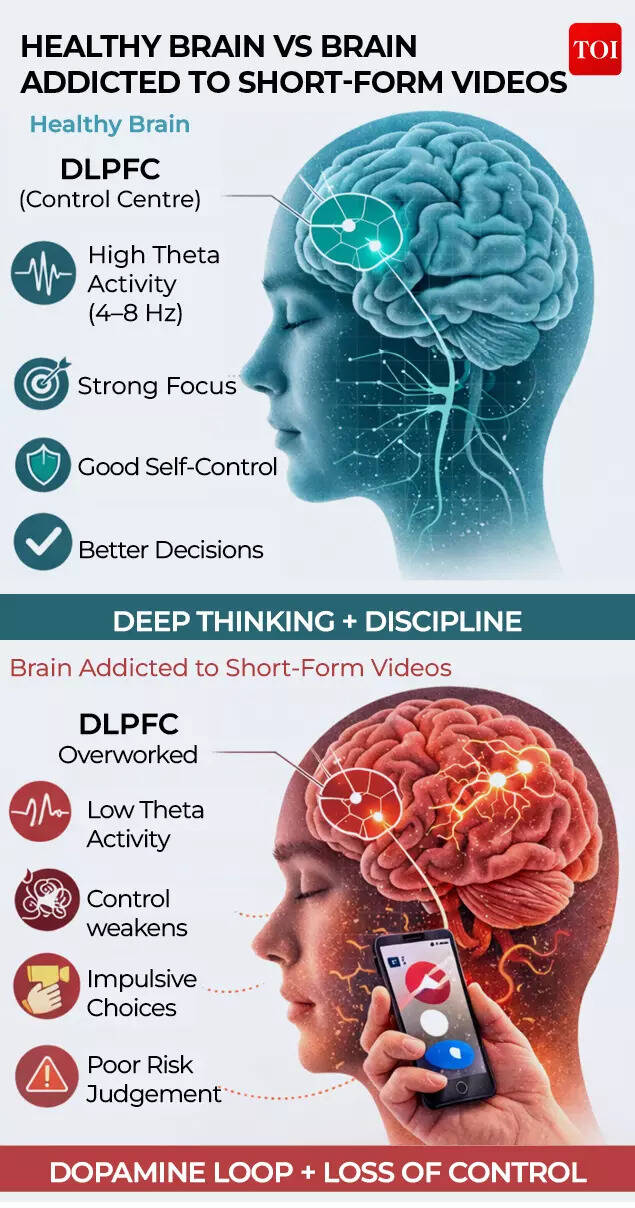
A separate 2024 study in NeuroImage used inter-subject representational similarity analysis and found that addiction symptoms correlated with heightened spontaneous activity in the DLPFC — likely reflecting the brain working harder to maintain control that is becoming progressively more difficult to sustain, not functioning more efficiently. A 2025 fNIRS study in Frontiers in Human Neuroscience further confirmed altered prefrontal responses during risk decision-making in addicted users, consistent with weakened inhibitory control.
Why short videos are so disruptive
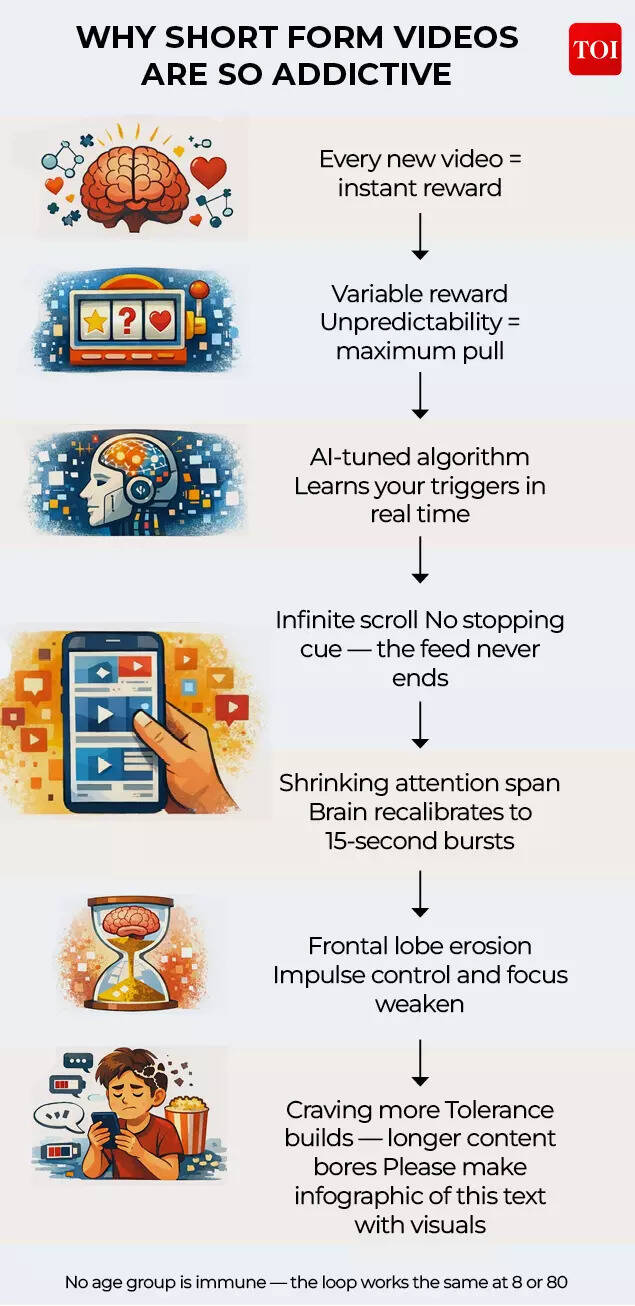
These platforms are not passive entertainment providers. They are sophisticated attention-capture machines built on behavioural psychology. Their algorithms deliver precisely the content most likely to hold each individual viewer, updating in real time based on engagement signals. Every swipe is a feedback loop. The result is a stream calibrated for maximum dopamine response — what psychologists call variable reward reinforcement, the same mechanism that makes gambling compelling.The frontal lobe’s executive functions are slow, effortful, and metabolically expensive — they require sustained cognitive engagement. Short-form video, by design, eliminates the need for any of that. Content is pre-selected; transitions are instantaneous; nothing demands the viewer sustain attention long enough to exercise the neural circuits associated with deep focus. When those circuits go unused at scale and over time, they weaken — a principle consistent with neuroscience’s understanding of synaptic pruning and neural plasticity.
Attention, memory & decision-making: The downstream effects
A comprehensive review published in Psychological Bulletin — the journal of the American Psychological Association — analysed 71 studies involving nearly 100,000 participants and found that heavy short-form video consumption was associated with poorer attention span and impulse control, as well as increased symptoms of depression, anxiety, stress, and loneliness. A separate study by Chen and colleagues, using eye-tracking and the Stroop task, found that addicted users showed more distractions, fragmented eye movements, slower response times, and lower accuracy — the behavioural fingerprint of impaired attention.A 2023 paper by Chiossi and colleagues at the University of Munich found that short-form video specifically impairs prospective memory — the ability to remember to carry out future intentions. The rapid context-switching between unrelated clips disrupts the frontal lobe’s mental housekeeping between tasks, degrading not just present focus but forward planning. A study in NeuroImage found that heavy users were also less sensitive to financial losses during risk tasks, mediated by decreased activity in the precuneus — the brain region involved in self-reflection and caution.“My attention span in general is tampered so much now that sometimes in real life as well I get frustrated when a person talks too much and there’s no fast-forward button,” Aditya admits. “It has affected my social skills indirectly — my patience has definitely gone for a toss, and the people I hang out with, instead of having normal conversations, we end up doom scrolling together, which is really concerning.”
This is not just a young person’s problem
The conversation about short-form video and the brain has disproportionately focused on young adults, but the science offers no comfort to older adults. The prefrontal cortex undergoes natural, gradual decline from middle age onwards. The same executive circuits that short-form video appears to undermine are already under pressure from ageing. For older adults with reduced attentional reserve, compulsive scrolling may compound cognitive decline in ways that urgently deserve more research.The algorithm does not discriminate by age. The dopamine loop functions the same way at 60 as it does at 20. Facebook Reels — whose audience skews meaningfully older than Instagram — has reached hundreds of millions of users who spend significant daily time on short video. Many retired individuals also have more unstructured leisure time and fewer natural interruptions, creating ideal conditions for the prolonged, compulsive use that research most strongly associates with cognitive harm. Age does not confer immunity; it may in fact increase vulnerability.
It’s not the screen, it’s the scroll
Honesty requires acknowledging limitations. As James Jackson, a neuropsychologist at Vanderbilt University Medical Center, has noted, there is a long history of moral panics about new media, from novels to television to video games, and not every warning has proven warranted. Most existing studies are cross-sectional. Jackson himself, however, told NBC News that he believes many of the concerns are justified. The consistency of findings across independent research groups, multiple countries, and varied methodologies — EEG, fMRI, fNIRS, behavioural tasks, eye-tracking, and large-scale surveys — is difficult to dismiss.The key distinction researchers are drawing is not between short video and no video. It is between intentional viewing and compulsive scrolling. Studies using addiction scales — which capture withdrawal-like, compulsive patterns of use — show consistently stronger negative associations with cognitive outcomes than simple measures of hours spent. The concern is not the format but what the addictive pattern of engagement does, over months and years, to the brain’s capacity for sustained thought.
Restoring intentional control matters more than total abstinence. Designating specific times for short-video browsing, rather than using it as a reflexive filler for every idle moment, breaks the compulsive loop. Deliberately engaging with long-form content — books, long articles, films, podcasts — exercises the attentional circuits that short-form video leaves unstimulated. For older adults unfamiliar with platform design, awareness is the first step: infinite scroll, personalised recommendations, and notification systems are deliberately engineered to override deliberate choice.At the platform level, researchers and public health advocates are calling for hard time limits, algorithm transparency, and mandatory session breaks — changes several jurisdictions are beginning to consider legislatively.The human brain spent hundreds of thousands of years developing the capacity for sustained, deliberate thought. The prefrontal cortex did not evolve to be exercised in three-second bursts between algorithmically selected clips. The scroll that dims the mind does not announce itself. It simply continues, endlessly, until something more important becomes harder to do.




Leave a Reply