
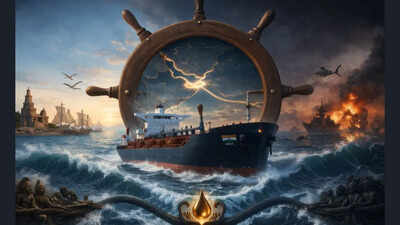
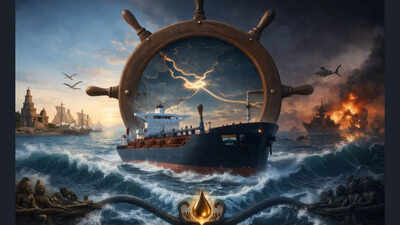
On National Maritime Day, when India pauses to mark the historic voyage of its first modern merchant ship and celebrate a legacy that stretches back to ancient seafarers, the focus is usually on pride. This year, however, it may also be a moment to look harder at the seas that sustain it. In many ways, the turbulence in global sea lanes resembles a modern samudra manthan, a churning of the oceans where both risk (poison) and opportunity (nectar) surface together, testing how nations respond.The churn is no longer distant as the circumstances are edged with urgency. Far from ceremonial speeches and commemorative events, India’s maritime reality is unfolding in some of the world’s most volatile waters, where tankers and cargo ships navigate not just distance but danger! The challenge is not only to shield these lifelines, but to turn this churn into advantage, extracting strategic and economic gains from a crisis that cannot be wished away.On most days, India’s economic heartbeat is invisible. It does not pulse through stock exchanges or policy corridors but across vast, restless waters where ships move quietly between continents. Yet, when conflict erupts in narrow choke points like the Strait of Hormuz, that invisible system becomes the country’s most visible vulnerability.
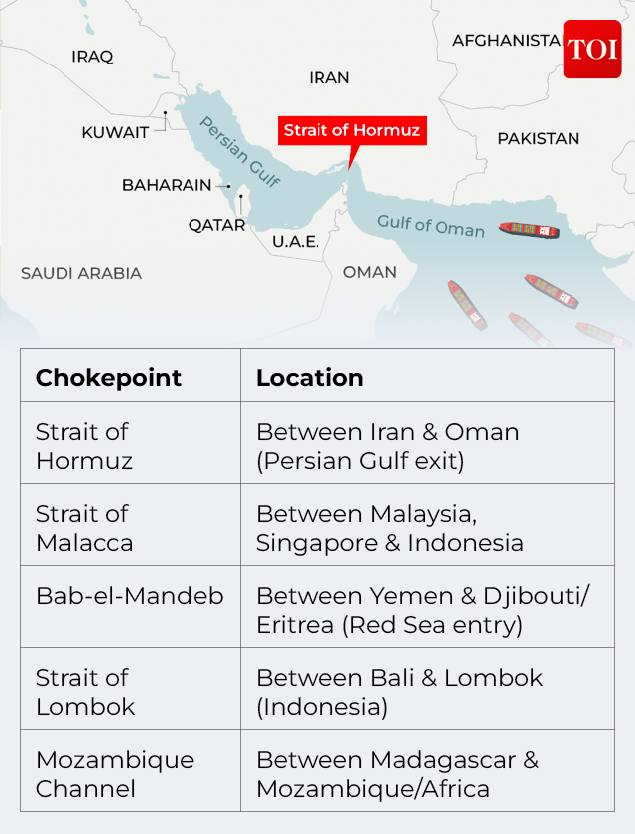
Major chokepoints
The ongoing tensions have done exactly that, forcing India to confront a reality it has long managed but rarely foregrounded.Its growth, its energy security and its strategic autonomy are all tied to sea lanes that run through some of the most volatile regions on the Earth.A narrow strait that powers a giant economyThe Strait of Hormuz is not just another maritime passage. It is the artery through which nearly a fifth of the world’s oil flows, and for India, its importance is even more acute. Around 80 per cent of India’s energy imports pass through this corridor, making it a single point of failure for a country that is among the world’s largest energy consumers. The recent escalation involving Iran, Israel and the United States has demonstrated how quickly this artery can constrict.
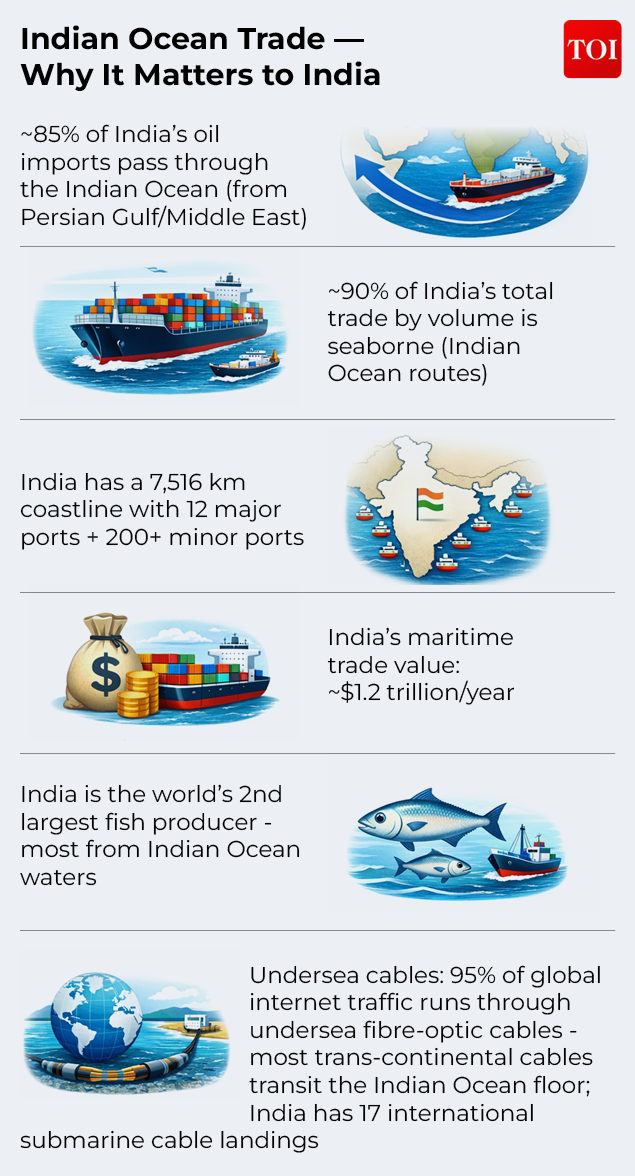
Importance of Indian ocean
Tanker traffic has slowed, vessels have been stranded and insurance costs have surged. For India, this has translated into immediate concerns over supply disruptions, rising crude prices and broader macroeconomic stress.The numbers strikingly reflect the scale of exposure. India imports more than 85 per cent of its crude oil and a significant share of its natural gas. Nearly half of that crude and over 60 per cent of LNG and LPG have historically moved through Hormuz. This is not just an energy issue but a systemic one. When oil flows are disrupted, inflation rises, the rupee weakens and industrial costs climb.Operation Sankalp and the navy’s silent watchAs tensions escalated, India responded not just through diplomacy but through deployment. Under Operation Sankalp, Indian naval warships have been maintaining a constant vigil in the Gulf region, escorting merchant vessels and ensuring safe passage through high-risk waters.At any given moment, dozens of Indian seafarers and vessels operate in and around the Persian Gulf. During the current crisis, several India-bound ships carrying crude oil and LPG were stranded or forced to alter routes. The navy’s role has been to provide a security umbrella, deterring threats ranging from missile strikes to drone attacks.The deployment of advanced warships such as INS Surat reflects a broader shift in India’s maritime posture. The navy is no longer confined to coastal defence. It is increasingly tasked with protecting sea lines of communication that stretch from the Gulf of Aden to the western Pacific.Trade rides the wavesEnergy is only one part of the story. Nearly 95 per cent of India’s trade by volume moves by sea. From crude oil and LNG to coal, fertilisers and electronics, the country’s economic lifeline is maritime.The Strait of Hormuz is central to this network, but it is not the only chokepoint. The Red Sea and the Suez Canal form another critical corridor linking India to Europe. Disruptions in these regions create a double vulnerability, forcing ships to take longer routes around the Cape of Good Hope, increasing costs and delays.
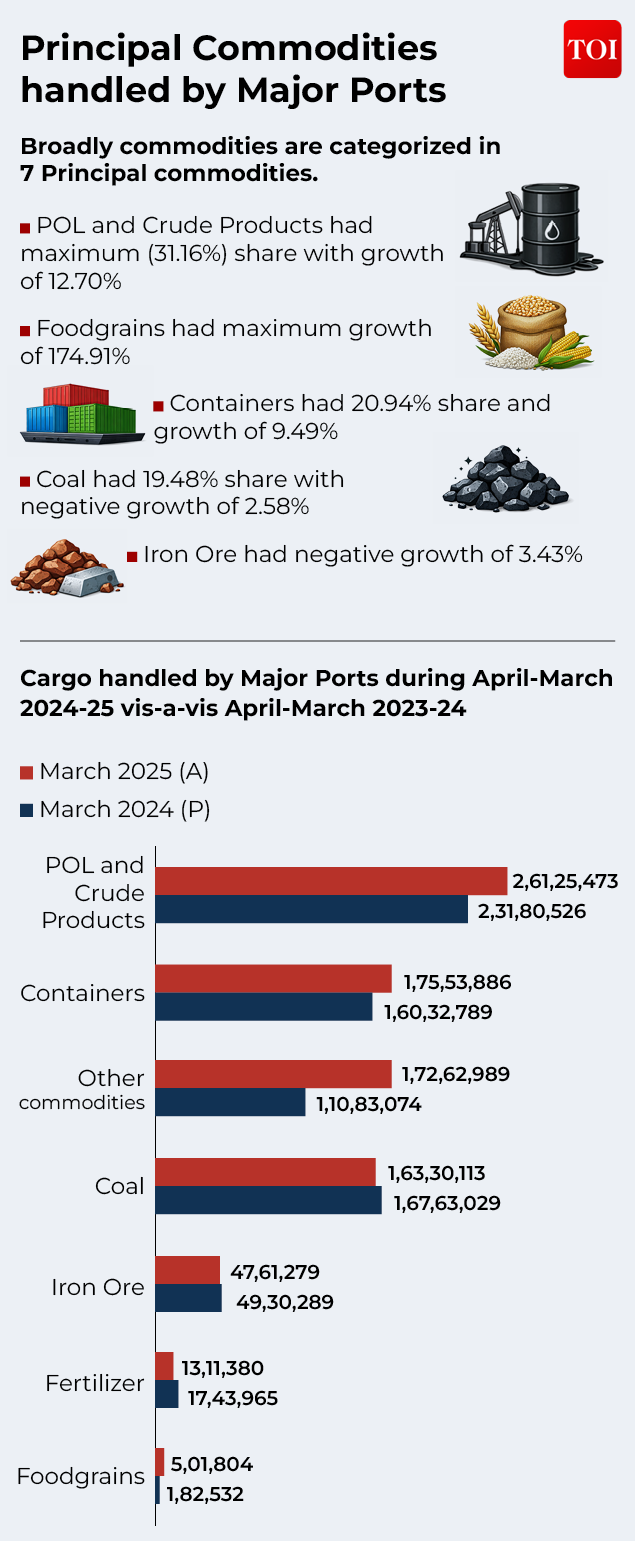
Principal commodities handled by major ports
India’s trade exposure to Gulf economies is also significant. About 16 per cent of its total trade is linked to this region, making any disruption not just an energy crisis but a broader economic challenge.Ports as gateways to prosperityIndia’s coastline stretches over 7,500 kilometres and hosts a network of major and minor ports that serve as gateways to global trade. Ports such as Mumbai, Kandla, Visakhapatnam, Chennai and Kochi handle millions of tonnes of cargo every year.
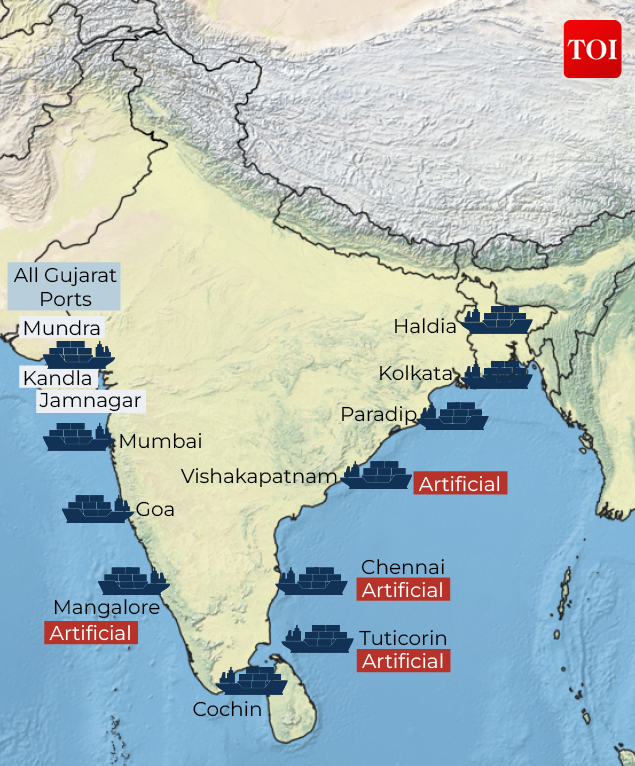
Ports in India
Each port has its own specialisation. Western ports like Kandla and Mumbai handle large volumes of crude oil and petroleum products due to their proximity to the Gulf. Eastern ports such as Paradip and Visakhapatnam are crucial for coal and mineral exports. Southern ports like Chennai and Tuticorin play a key role in container traffic and industrial goods.The principal commodities moving through these ports reflect the structure of India’s economy. Crude oil, LNG, coal, iron ore, fertilisers and containerised goods dominate the cargo mix. This heavy reliance on imported energy and raw materials further amplifies the importance of secure maritime routes.Government initiatives such as Sagarmala aim to modernise ports, improve connectivity and reduce logistics costs. While these efforts enhance efficiency, they do not eliminate the risks posed by external chokepoints like Hormuz.
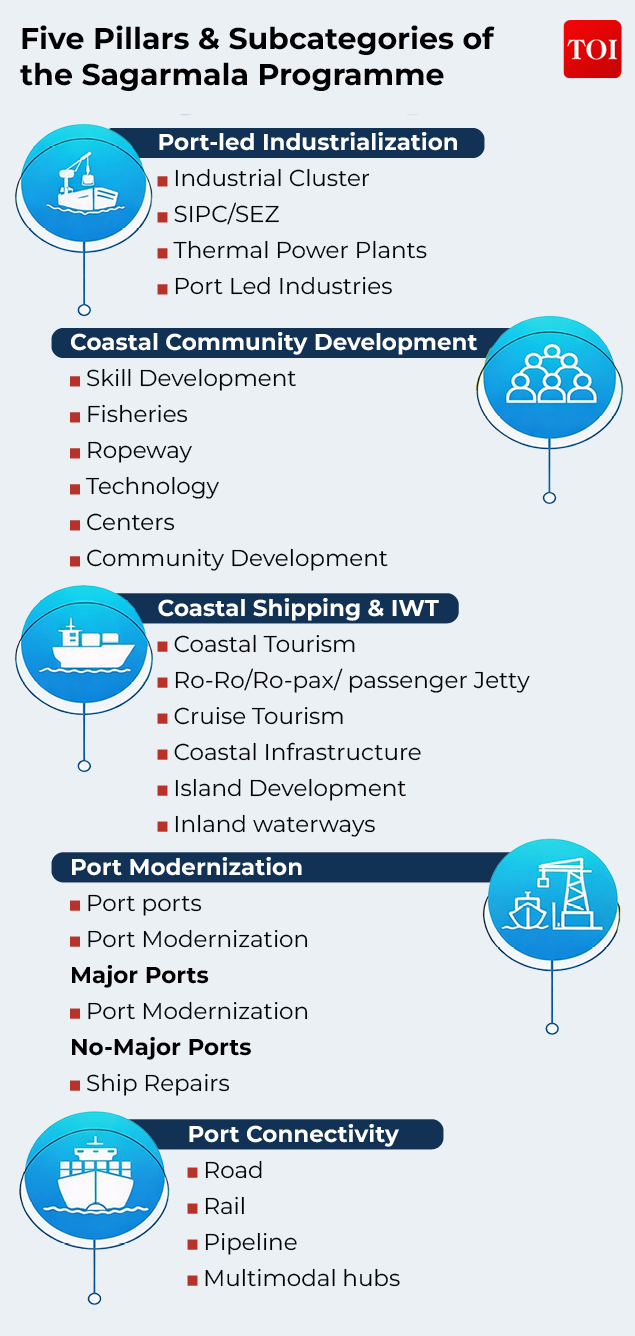
Sagarmala Programme
The IMEC factor and the search for alternativesThe India-Middle-East-Europe Corridor (IMEC) has emerged as a strategic response to some of these vulnerabilities. By combining maritime and overland routes, it aims to create an alternative pathway linking India to Europe through the Middle East.The corridor is significant not just for trade but for geopolitics. It reduces dependence on traditional routes and offers a framework for deeper economic integration with Gulf and European partners. However, it is not a complete substitute for existing sea lanes. Maritime routes will continue to dominate due to their scale and cost efficiency.
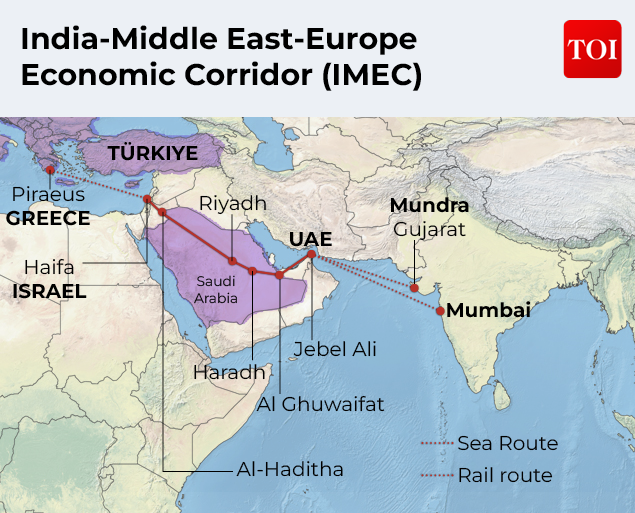
IMEC
What IMEC does offer is redundancy. In a world where chokepoints can be disrupted by conflict, having multiple pathways becomes a strategic necessity rather than a luxury.A legacy written in the wavesIndia’s maritime story did not begin with modern trade or globalisation. It stretches back thousands of years to the Harappan civilisation, where ports like Lothal served as hubs of international commerce.Archaeological evidence shows that Harappan traders navigated the Arabian Sea, exporting goods such as carnelian beads to Mesopotamia. The construction of a sophisticated dockyard at Lothal demonstrates an advanced understanding of tides and maritime engineering.Ancient texts further reinforce this legacy. The Rigveda contains references to ocean voyages and ships with multiple oars. The Arthashastra describes administrative structures for managing maritime trade, including officials responsible for overseeing navigation and taxation.Prime Minister Narendra Modi on Sunday highlighted India’s maritime heritage and lauded the contribution of those associated with the sector on National Maritime Day.In a post on X, Modi said the dedication of people linked to the maritime sector plays a vital role in strengthening the country’s economy, trade and connectivity.“On National Maritime Day, we recall India’s maritime heritage and the invaluable contribution of all those associated with this sector. Their dedication strengthens our economy, trade and connectivity,” he said.Empires that ruled the seasIndia’s maritime prowess continued through successive empires. The Mauryas maintained a structured naval administration, while the Satavahanas facilitated trade with the Roman world. Roman coins found in India testify to the scale of this exchange.The Cholas represent the high point of India’s naval power. Their fleets dominated the Bay of Bengal and extended influence into Southeast Asia, conducting expeditions that were both military and commercial. Their maritime networks connected India to China and beyond, shaping trade and cultural exchange across the region.
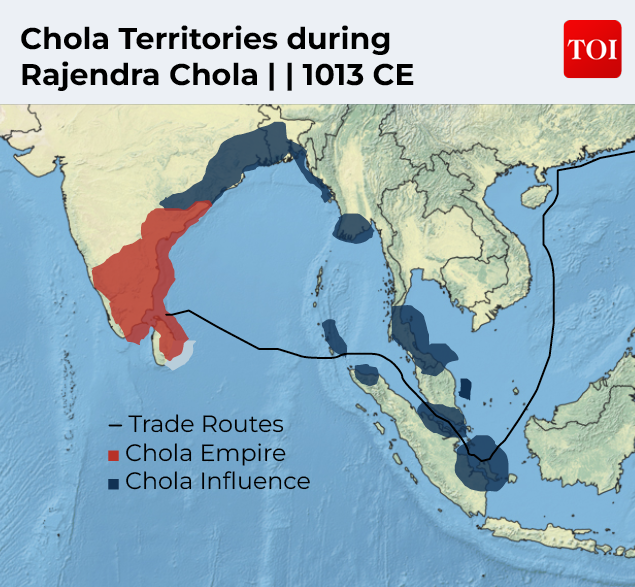
Chola Territories during Rajendra Chola
This long history signifies a crucial point. Maritime activity has always been central to India’s economic and strategic identity. The oceans were not barriers but bridges.From decline to resurgenceIndia’s maritime power declined during the colonial period, as European powers established control over sea routes. Indigenous shipbuilding and naval capabilities were gradually eroded, and India became dependent on foreign-controlled maritime systems.The post-independence period marked a slow but steady resurgence. The Indian Navy evolved into a modern force capable of operating across the Indian Ocean. Anti-piracy missions in the Gulf of Aden and humanitarian operations have reinforced its role as a net security provider in the region.Today, initiatives such as SAGAR and MAHASAGAR reflect a broader strategic vision. They emphasise security, cooperation and sustainable development across the Indian Ocean region, positioning India as a key maritime actor.The new age of maritime riskThe Hormuz crisis has highlighted a fundamental shift in the nature of maritime threats. Unlike piracy, which involves non-state actors, the current risks stem from state-level conflicts involving advanced weaponry such as missiles and drones.This changes the calculus of maritime security. Protecting sea lanes now requires not just naval presence but also intelligence, coordination and international cooperation. It also demands integration with economic and diplomatic strategies.India’s response has already begun to reflect this shift. Enhanced monitoring systems, regulatory measures and multi-agency coordination have been put in place to manage the crisis.Building resilience in uncertain watersThe immediate response to the Hormuz disruption has been diversification. India has expanded its pool of energy suppliers, reducing reliance on a single region. This is a necessary but not sufficient step.Long-term resilience requires a broader strategy. Expanding strategic petroleum reserves can provide a buffer against short-term disruptions. Investing in alternative routes and infrastructure can reduce dependence on chokepoints. Strengthening naval capabilities can enhance the ability to secure sea lanes.Equally important is integrating maritime considerations into economic planning. Energy security, trade policy and foreign relations must all account for the risks associated with maritime routes.National Maritime Day is often seen as a celebration of India’s seafaring heritage. This year, it carries a more urgent message. The seas that have enabled India’s rise are also its most significant vulnerability.The Hormuz crisis is not an isolated event but a glimpse into a future where maritime disruptions may become more frequent. In such a world, the security of sea lanes is not just a naval concern but a national priority.India’s journey from the docks of Lothal to the modern ports of Mumbai and Visakhapatnam reflects a continuity of maritime engagement. The challenge now is to adapt that legacy to a new era of uncertainty.When the oceans are secure, India’s economy flows smoothly. When they are disrupted, the consequences ripple across every sector.In the end, the story of India’s maritime lifeline is not just about ships and routes. It is about resilience, strategy and the ability to navigate a world where the calmest waters can suddenly turn turbulent.




Leave a Reply