
You could blame the bots. Someone’s asking for Rs 6.7 lakh to sell an India-based Instagram account with just 7,000 followers, a description that goes “Rajputi reel uploaded”, and 54 posts made in the one year it has existed.It’s a bit of an outsized ask, but not as preposterous as you might imagine. Social media accounts — entire accounts, not followers — have been bought and sold on grey markets for at least a decade and a half. The influencer economy helped. Once audiences could be monetised, followers and engagement acquired a fairly literal value. But, at the same time, bots made followers cheap and accounts easy to manufacture at scale. People could — and often still can — tell when it’s all fake. They may or may not care, but they can tell.So, when an account looks believable — with the odd little follower base, the awkward posts, and the occasional little viral bump — it is something of a prize.If someone wants the account for legitimate purposes, such as the launch of a new brand, it can shorten the wait to qualify for monetisation and other gated features. And if they want it for absolutely-not-legitimate reasons, such as scams, the account’s history gives them quicker (and easier) credibility.See the difference here.
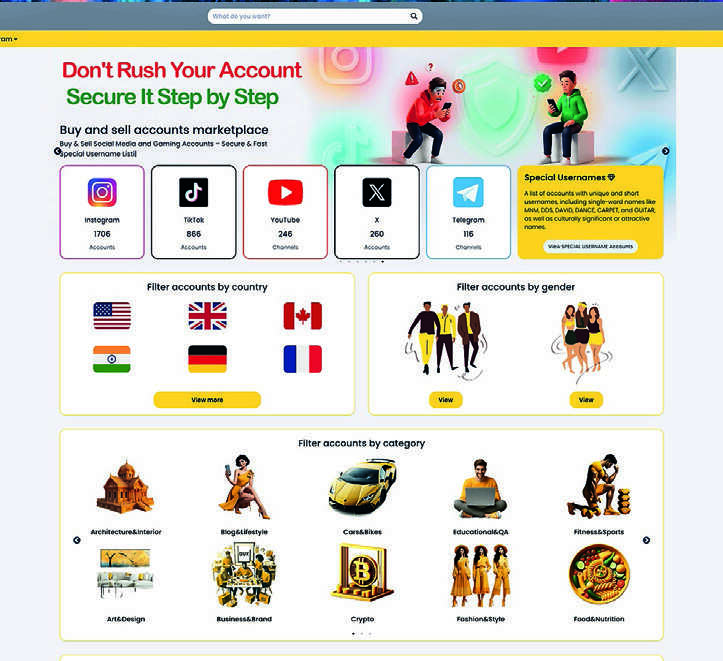
Here a buyer can sort accounts by, among other things, price, follower count, and place of follower concentration.
“I am from Patna, Bihar”, a profile on a marketplace says. And they’re offering a “3M Indian Facebook page for sale” — a Facebook page with 3 million followers. The asking price on the July listing is $4,500 — about Rs 4.3 lakh. It might almost seem like a bargain, given the large-ish following (but there’s also the declining page views whose screenshots the seller has added, perhaps in the spirit of transparency, to consider). It’s some $0.0015, about Re 0.14, per follower.The same seller also offered a “baby”-focused Facebook page with “10k followers organic views”, meaning the reach came without paid promotion, in Aug. The largest following is in India (39%), going by the screenshots posted in the listing, and it offers two valuable things. The first is “content monetisation”, meaning access to Facebook’s system for earning money from eligible content, which a new page would otherwise have to spend time building towards and qualifying for. The other is the ability to run the page “with your desired name”, meaning the page can be renamed and repurposed for a new brand or identity. For this small page, the seller is asking for $150 — a bit under Rs 14,400. This works out to about $0.015, or Rs 1.44, per follower.It’s a neat 10 times the asking price of the larger account, if we go purely by follower count.This means follower count isn’t really what is always being sold. The history, audience, activity, monetisation, and ability to repurpose the account can often matter much more. The original email, for instance, holds value because it can be part of the account-recovery trail, and buyers worry that a previous owner who retains it could later reclaim the account.
A dedicated marketplace
It’s definitely much easier to ‘sell’ your social media account today than it was a decade ago. It’s not all crude or iffy websites and message boards anymore. There are dedicated marketplaces for buying and selling social media accounts that are incredibly organised.SeBuDA, where the Rs 6.7 lakh asking-price Instagram account is listed, is a good example. A buyer can sort accounts by price, follower count, the country and city where followers are concentrated, their gender, the account’s category and age, and whether the original email address comes with it. The listing itself often shows audience demographics, analytics, recent posts, engagement numbers — many of these screenshots — alongside seller history and escrow record. Accounts can even be put on a comparison list.Similarly, Fameswap — which has been around since 2013 and is now one of the biggest dedicated marketplaces for social media accounts — has a price-discovery mechanism. Its market insights data shows that YouTube accounts that put out reviews and how-to videos are priced the highest (a median asking price of more than $60 for every thousand followers). For TikTok accounts, the sweet spot is crypto and NFTs (about $40). And for Instagram accounts, it’s tech and science ($19).
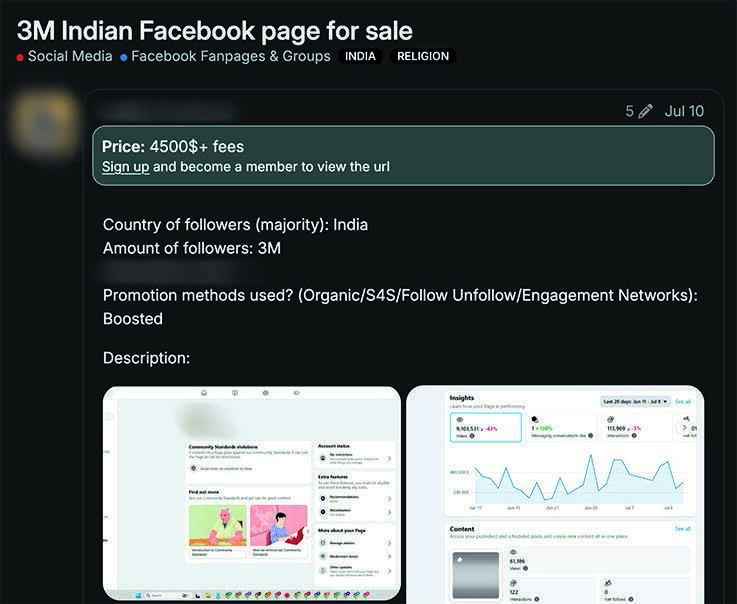
An India-tagged Facebook account with 3 million subscribers on sale, a large market that’s been operating since 2017
Another major market, DealBaron, has an even more formalised process. When a seller lists an account, the site pulls in basic account data and asks them to prove they control it by posting a generated code on that account. Buyers can see seller ratings and deal histories, make binding offers and, once a deal starts, follow a platform-specific handover process inside DealBaron.SWAPD, also a large market that has been operating since 2017, looks more like a forum than these sites, but the transactions are tightly managed — and “under continuous human supervision”, rather than through automated checkouts. SWAPD says it reviews listings before they go live, and that it requires sellers handling qualifying transactions to complete KYC identity checks.As for the money, most of these markets either offer or require escrow, where the buyer’s money is held by the platform or an escrow service until the account has been transferred.The way it works makes it easier for sellers to build inventories and for buyers to shop for exactly the sort of account they want. And, for a buyer, several smaller accounts might presumably make more sense than putting everything into one page with an enormous following: if one is suspended, reclaimed or lost, the entire “investment” doesn’t sink.
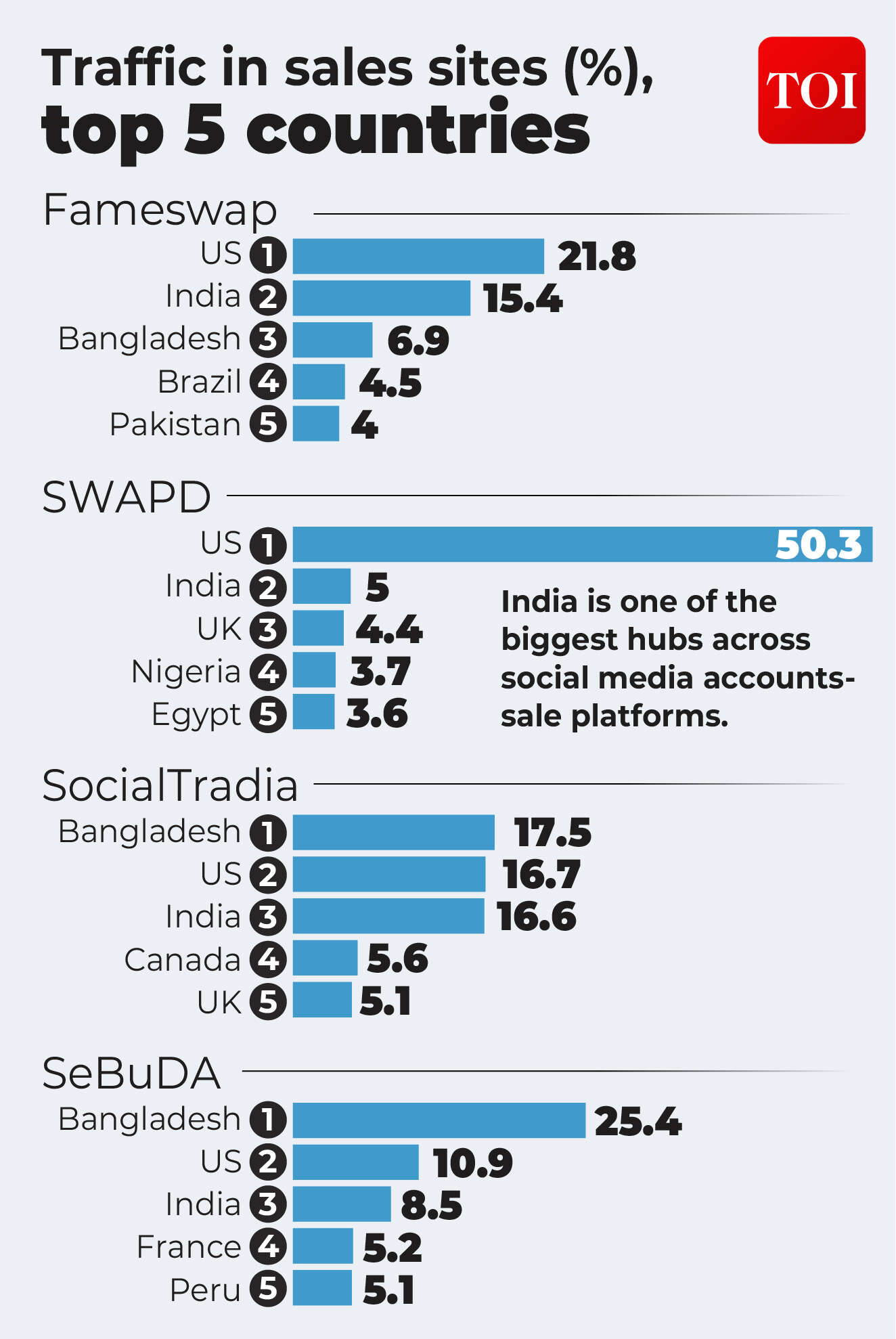
India remains the leading country after US as buyer on the sales sites.
Why does it feel shady?
First, the social media platforms whose accounts are being bought and sold largely don’t allow it. Instagram and X explicitly ban it. TikTok doesn’t allow it without permission, nor does Facebook. YouTube does allow ownership of a brand account to be transferred, but not in quite the same ways as these sales usually go. That doesn’t necessarily make selling an account illegal. It just makes much of this a grey market — the transaction can breach a platform’s rules without itself being a crime, although what buyers or sellers do with the account certainly can be.Which brings us to the second point, that these are clearly not markets populated only by people selling one old account that they don’t use anymore. Many sellers list bundles of multiple accounts (a seller, for instance, announced they had an “unlimited stock” of “active” Instagram accounts for sale at one point). And markets have sometimes actively intervened to block the sale of stolen accounts.The first large-scale academic study of such social media marketplaces, published in 2025, found more than 38,000 accounts advertised for sale across 11 marketplaces, with asking prices adding up to more than $64 million.And it found evidence that “these marketplaces foster fraudulent activities such as bot farming, harvesting accounts for future fraud, and fraudulent engagement”. “The ecosystem of buying and selling social media profiles fosters cybercriminals to operate at scale, making it easy to obtain accounts to launch various cybercrime activities,” it found.Of the nearly 11,500 for-sale accounts the researchers could examine, almost 3,800 had posted scams — with nearly 19,000 posts with crypto scams, phishing, fake products and services, impersonation, and other fraud. And 30% of “sold accounts” they could date had been created before 2020, “leveraging their longevity to evade detection”.The researchers also found signs that accounts were being deliberately built for resale — given plausible names, bios and locations, and grown with enough followers and activity to make them look like genuine and naturally used accounts, rather than obvious fakes. Some sellers seemed to produce these accounts as inventory, replacing listings with new ones as others disappeared.An Aug 2026 study of YouTube accounts sold on a single account marketplace also found that channels weren’t necessarily being bought for what they already were. More than 1,000 of the 4,600-odd channels they tracked — 23% — were repurposed, their handles, titles and descriptions changed into something essentially new.But changing identities, weirdly, didn’t make the audience flee. Over the 12 weeks after repurposing, “subscriber counts increase on average — often substantially”, perhaps because, as the researchers put it, “most users remain unaware of the change and stay subscribed”.FT reported in Aug that the trade has developed its own supply chain, with suppliers sourcing accounts, flippers reselling them and editors helping turn them into something new. In one case, a 3,90,000-follower Instagram account sold for $6,000 and its new owner said it made about $2,000 from sponsorships and sales in its first two weeks alone.
India keeps showing up
The 2025 study had found that of the accounts whose public profiles revealed a location, India was the second-most common country — after the US.When another set of researchers studied the closely related business of selling followers, likes and other engagement in 2024, India was one of the biggest hubs there as well. The researchers found the business was cheap to enter and English-speaking Indian operators could enter the global market easily. Just like those from other “former British colonies” like Bangladesh, Nigeria, Malaysia, or a former US colony like the Philippines.
Share your thoughts in the comments
Be respectful · TOI community guidelines
But they admitted they knew “very little” about the differences between countries.On the major marketplaces, India is a large source of traffic. Data from web analytics platform Semrush for July 2026 shows India accounted for the third highest traffic on SeBuDA and a similar marketplace SocialTradia, and the second highest on SWAPD and Fameswap.Threads on SWAPD, in fact, keep discussing Indian sellers (for instance, how they drive prices down) and buyers (for instance, how they can drive the value of India-heavy accounts up). It can get so India-coded that a Reddit account seller said on a Jan listing: “Indian buyer preferred because payments are just easier with UPI.”SWAPD itself posted in March this year that India was tied with the US for the largest group among its 40 highest-volume operators.India, clearly, is becoming a significant part of this market.







Leave a Reply