
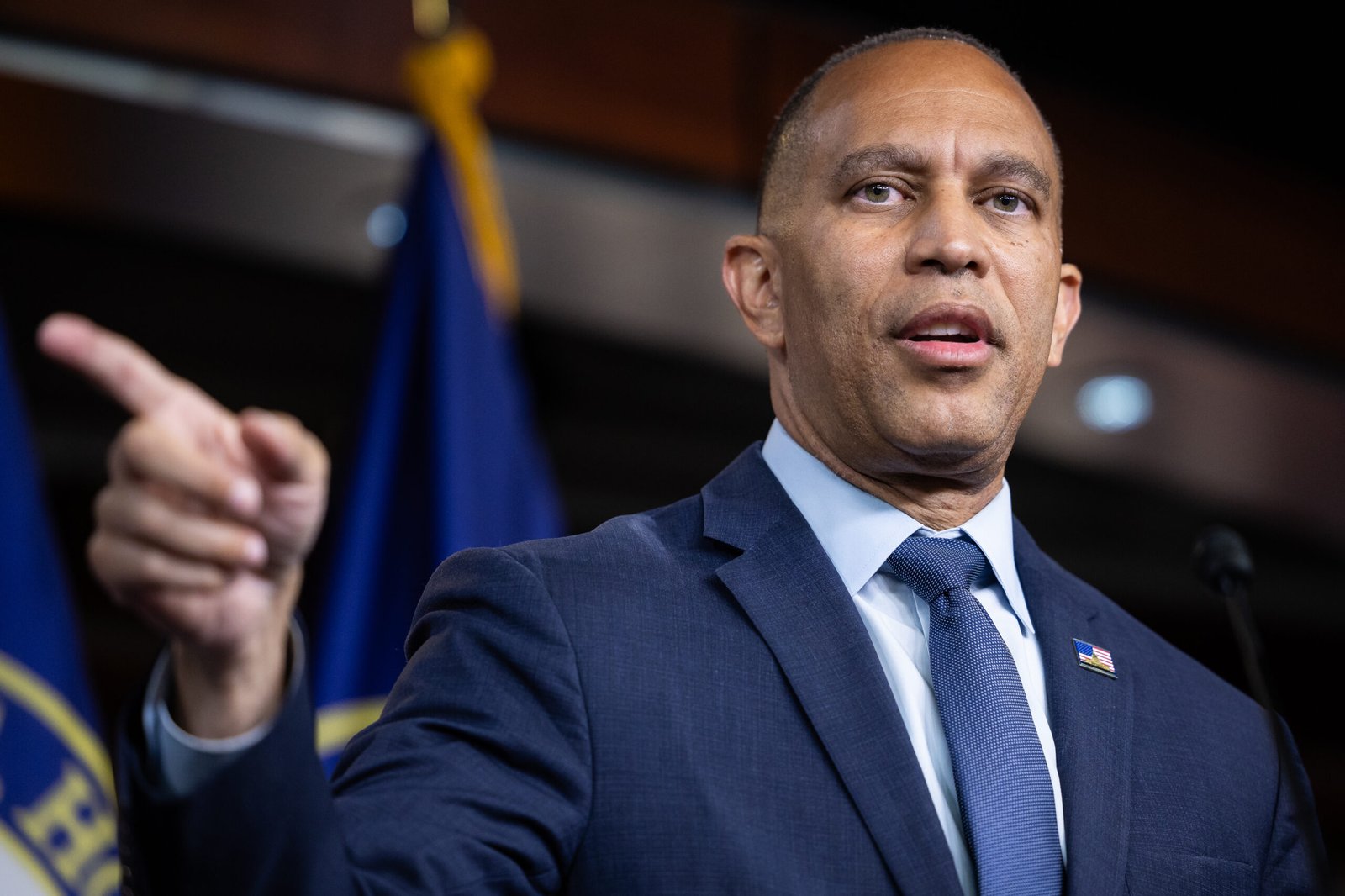

House Minority Leader Hakeem Jeffries called Monday for immediate congressional action to regulate artificial intelligence — his most urgent call to date for guardrails on the rapidly advancing technology amid warnings it could eradicate humanity if left unchecked.
“The explosive growth of artificial intelligence and the challenges that are therein presented — that’s not a hoax,” Jeffries said at his weekly news conference. “It’s very real, despite what Donald Trump has to say about that issue as well, and it requires decisive congressional action immediately, in a manner consistent with what some of the leading AI voices in the country are now saying needs to happen, as it relates to slowing things down to protect the health, the safety and the well-being of the American people.”
Jeffries’ call for regulation comes days after an ex-Anthropic researcher, Jacob Coxon, warned that AI could “kill us all,” prompting calls from the company’s CEO Dario Amodei, OpenAI CEO Sam Altman and xAI CEO Elon Musk for an AI development slowdown. Trump has responded by downplaying the risks and doubling down in his support for accelerating AI breakthroughs to compete with China.
Jeffries urged Speaker Mike Johnson Monday to keep Congress in session “until something is done decisively to protect the safety and the well-being of the American people, in the face of growing concerns being raised by experts within the artificial intelligence industry itself.”
Johnson canceled the last two weeks of session before the midterms, meaning that the House is slated to leave Capitol Hill on Thursday and not return until Nov. 9. The speaker has given no indication he will revisit this plan and has remained noncommittal on whether the chamber will consider AI safety legislation ahead of the elections, if at all.
Jeffries also said the Democrat-only AI commission he convened this Congress could begin rolling out its policy recommendations soon, noting he plans to meet with the group’s three co-chairs this week. And he blamed Johnson for declining to reconstitute a bipartisan AI task force that would have allowed members of both parties to work together on the issue.
“We want to ensure that American entrepreneurs and companies can continue to lead in this space and not be overcome by the Chinese Communist Party,” Jeffries said of what the Democratic-led commission has been working on. “But on the other hand, we’ve got to ensure that the American people actually experience the benefits of artificial intelligence without being subjected to the very real, and very grave and very dangerous downsides.”
But while Jeffries is positioning Democrats as leaders on AI policy — now and in the next Congress — he declined to endorse a proposal from some of his colleagues to create a select AI committee if the party wins the majority in November.
“We’re focused on the substance, not the process,” he said, adding that any select committee discussions would take place after election day.
Jeffries did endorse the Ratepayer Protection Act — a bipartisan bill intended to shield Americans from energy costs associated with the data center boom — which is slated for a vote Tuesday.
“It’s a step forward,” he said. “More clearly needs to be done.”





Leave a Reply