
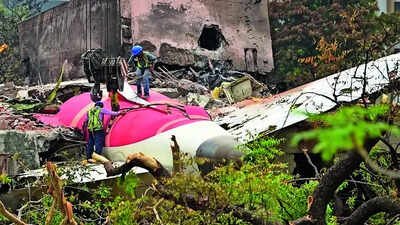
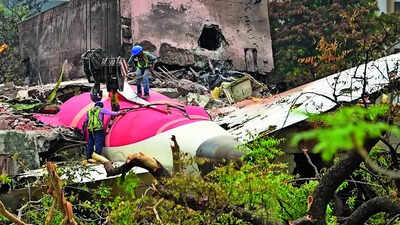
MUMBAI: The Foundation for Aviation Safety (FAS), a US aviation safety group, has written to India’s Aircraft Accident Investigation Bureau (AAIB), questioning why it has not issued interim safety recommendations for the Boeing 787 fleet, despite holding evidence of chronic system failures on the aircraft involved in last year’s Ahmedabad crash, which killed 260 people.Over the past year, FAS said it had received more than 100 non-public documents specific to the crashed Air India 171 aircraft (VT-ANB). FAS sent these documents to AAIB via a UK AAIB expert.“The documents are vital to reconstructing the operational history of the doomed airplane. These documents explicitly detail chronic, systemic aircraft failures involving the airplane’s electrical, electronic, and/or flight computer systems,” said Ed Pierson, FAS executive director, in an email to AAIB director general on Aug 29. “By actively withholding this information from public announcements, the AAIB is failing its primary objective, the prevention of future accidents through timely, transparent safety manager at Boeing’s Renton 737 factory, raised internal warnings about overworked, error-prone production teams that he says went unheeded. He later founded FAS, which came into prominence for its work scrutinising Boeing’s manufacturing and safety practices in the aftermath of the 737 MAX crashes, and disclosures. Most critically, despite being in possession of evidence pointing to chronic and dangerous system failures, AAIB has issued zero interim safety recommendations or warnings to the global aviation community,” it added.Pierson, a former senior manager at Boeing’s Renton 737 factory, raised internal warnings about overworked, error-prone production teams that he says went unheeded. He later founded FAS, which came into prominence for its work scrutinising Boeing’s manufacturing and safety practices in the aftermath of the 737 MAX crashes, and has since been pressing AAIB on the AI171 investigation.In an Aug 21 letter, FAS had asked to be formally recognised as a stakeholder in the investigation and for its technical findings to be included in the investigation record. AAIB’s Aug 26 reply confirmed it received the documents via a UK AAIB expert on June 10 and that its investigation team had examined them, adding that the probe followed fair and impartial practices under the relevant regulations. AAIB did not respond to FAS’s Aug 28 letter, which alleged the agency was suppressing vital B787 safety information.AAIB told TOI, “A common update/report will be published by the AAIB.”AFAS first outlined the documents’ contents in a Jan presentation to the US Senate Permanent Subcommittee on Investigations. Pierson told TOI the crashed aircraft’s records showed recurring failures in its Electrical Wiring Interconnection System (EWIS).It’s the network of all wires, cables and connectors distributing electricity, data and signals through the aircraft. The 787’s EWIS spans over 150 km of wiring, more than 3,500 connectors and 40,000 cable segments. Aircraft wiring was once treated as a minor component, but after the 1996 TWA B747 and 1998 SwissAir MD-11 crashes killed a combined 529 people, EWIS emerged as a distinct, critical aircraft system on a par with engines or fuel systems. The FAA formally codified EWIS regulations in 2007.“What I do know is that VT-ANB had plenty of EWIS failures,” Pierson said, citing the non-public documents. “It also had primary power distribution failures, not just EWIS, but actual power generation, stable, high-quality electrical power. It had lots of problems with that. It had all those other issues: open circuits, short circuits, burning, arcing, fire, etc.” He said problems could arise from wiring routed too close together, chafing against sharp edges, or improper bonding and grounding, leading to electricity going places it’s not supposed to go. “You can have a lot of issues with EWIS. EWIS has been identified as a causal factor in many accidents,” Pierson said.Among the documents sent to AAIB is one detailing a 2022 incident when VT-ANB, flying into Frankfurt, suffered multi-system failures on both sides of the aircraft. On landing, the P100 primary power panel was found burning, producing “12 pages of aircraft system faults”.
Share your thoughts in the comments
Be respectful · TOI community guidelines
“That’s what’s called a compound emergency… What this document shows is that the fleet is susceptible to this kind of failure, because it happened on this plane,” he said.The panel had to be replaced, a repair he compared to accessing “your circuit breaker panel at home… on steroids,” requiring technicians to cut and splice wires and reintegrate them into the system. He said the incident shows that VT-ANB itself had a history of such failures and alleged that the wider 787 fleet “is susceptible to this kind of failure”.







Leave a Reply