
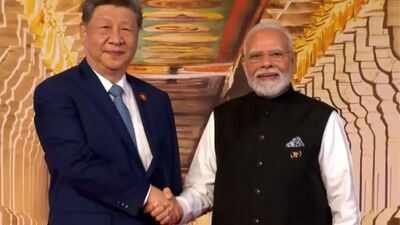
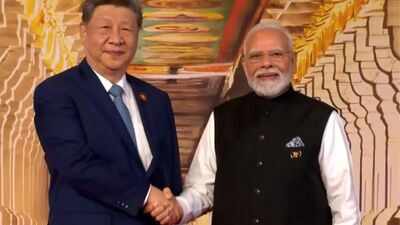
NEW DELHI: PM Narendra Modi raised Indian concerns in ties with China with President Xi Jinping when the two met last week on the sidelines of the Brics summit, saying both sides need to show sensitivity to each other’s core concerns, according to the Indian government.The MEA assertion was in reply to a query about the Chinese readout that quoted Modi as saying India’s position on Tibet and Taiwan had not changed and India doesn’t allow anyone to carry out anti-China activities on its soil.“PM referred to Indian concerns as well and underlined that both sides should show sensitivity to each other’s core concerns,” said Randhir Jaiswal, MEA spokesman.
Border peace must for improving ties, Modi conveyed to Xi
“PM (Modi) underlined both sides be guided by three mutuals, mutual respect, mutual interest and mutual sensitivity,” said MEA spokesman Randhir Jaiswal. Narendra Modi had told Xi Jinping that border peace forms an essential basis for taking the relationship forward.Amid repeated cases of border strife with China, India had stopped publicly articulating its One China policy 16 years ago. However, in practice, India’s position on Tibet and Taiwan has remained unchanged under successive governments.The government maintains its policy on Taiwan is clear and consistent, as it facilitates and promotes interactions in areas of trade, investment, tourism, culture, education and other such people-to-people exchanges.On Tibet, India continues to recognise that Tibet Autonomous Region is part of the territory of the People’s Republic of China, as stated in the Declaration on Principles for Relations and Comprehensive Cooperation signed by then PM Vajpayee and Premier Wen Jiabao in 2003. The declaration also stated that India does not allow Tibetans to engage in anti-China political activities in the country.
Share your thoughts in the comments
Be respectful · TOI community guidelines
According to the Chinese readout, Modi had also told Xi that India followed an independent foreign policy and its approach to China had nothing to do with any third country. The Indian side did not mention Tibet or Taiwan in its readout.Interestingly, India on this occasion dropped China’s “friends, not rivals” formulation that it used in its readout of the Modi-Xi meeting in Tianjin last year.After EAM S Jaishankar’s meeting with his counterpart Wang Yi in Manila in July, China attributed similar remarks to Jaishankar about India respecting China’s sovereignty. MEA later clarified that EAM had told Wang it was India which should be raising sovereignty issues with Beijing.He said India does not violate China’s sovereignty in any manner, but China remained in illegal occupation of J&K and Ladakh since 1963, where India’s right is acknowledged even by China.






Leave a Reply