
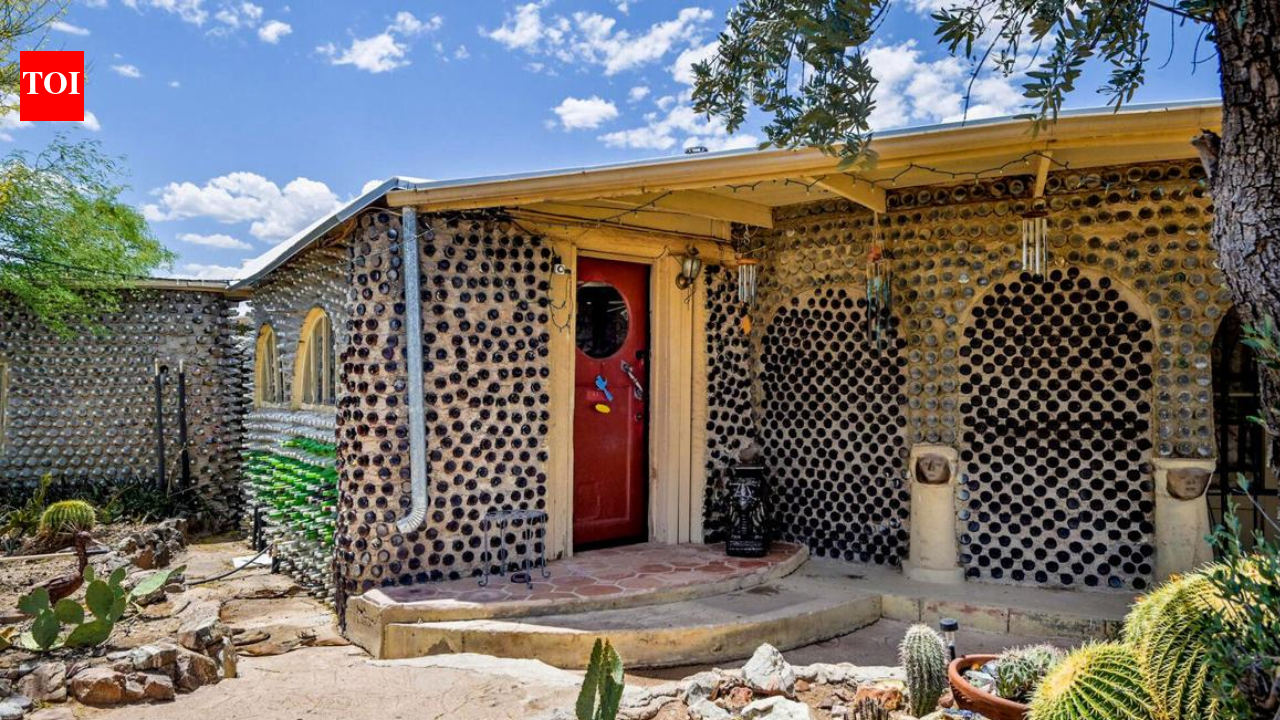
A Tucson couple’s simple plan to build a shelter for a family car in 1964 grew into a 2,700-square-foot home made from tens of thousands of discarded glass bottles. The unusual property has now been put on the market for $432,500 (£342,000). Located in Tucson, Arizona, the hand-built house has thick mortar walls filled with green wine bottles, amber beer bottles and cobalt blue medicine jars collected from local roadsides, bars and landfills. According to the Arizona Daily Star, local residents Howard and Joy Finch built the property over several decades, turning discarded materials into a lasting desert landmark. The property was later owned by artist Kathe B, who maintained the home after the original builders. Architectural Digest reported that sunlight passing through the coloured bottle bases set into the walls creates a natural stained-glass effect inside the house.
Building a home out of roadside waste
In 1964, Howard Finch decided to build a simple covered carport behind his existing home. He used leftover glass bottles set in concrete. After finding that the method was both strong and attractive, the couple expanded their plans and began building a complete custom home on the desert property. For almost two decades, the couple collected unwanted glass across the Tucson basin. According to the Arizona Daily Star, the Finches placed every bottle by hand. They laid the bottles horizontally in thick layers of mortar to create strong outside and inside walls. Friends, family members and local business owners also helped by bringing empty bottles and containers to the site. The couple cleaned each piece of glass before putting it into the mortar. This helped keep the growing walls strong and stable. The finished main house has three bedrooms, two bathrooms and an open-plan artist studio. Architectural Digest noted that green wine bottles, brown beer bottles and blue Milk of Magnesia containers form different decorative patterns throughout the living rooms, kitchen and surrounding courtyards.
Natural cooling in the Sonoran Desert
The unusual building method was not only about appearance. It also served a practical purpose in southern Arizona’s extreme climate. The Sonoran Desert has very hot summers and sharp temperature drops at night. As reported by the Arizona Daily Star, the thick mix of glass and concrete gives the home significant thermal mass. The heavy walls absorb heat during the day, helping keep the rooms cool. They then slowly release that heat back into the house during cold desert nights. The empty space inside each sealed bottle also provides natural insulation. This helped reduce energy use long before modern green building methods became common in homes. The house also contains other recycled materials collected during the mid-20th century. These include salvaged timber beams, decorative ironwork and stone paving blocks taken from regional demolition sites.
Preserving a piece of regional folk architecture
After the Finches’ time at the property, artist Kathe B bought the home and carefully restored it. She worked to protect the original glasswork while updating the plumbing and electrical systems to meet modern building standards. The property listing, handled by local firm Long Realty, offered the 2,700-square-foot home on a multi-acre desert lot. The land has mature saguaro cacti, mesquite trees and views of the Catalina Mountains. The sale also included the main bottle house and a separate workshop built with similar recycled materials. Architectural Digest reported that the property attracted interest from folk art enthusiasts and buyers looking for unusual homes. Several folk-art buildings made from recycled materials exist across North America, but few remain structurally sound or approved for full-time residential use six decades after construction began. The Tucson property remains a fully working example of mid-century American folk architecture. It shows how two local residents turned everyday waste into a permanent home.
Folk art traditions across the American West
The Finch house is part of a wider tradition of unusual desert architecture that developed across the American West during the mid-20th century. During this period, creative builders often experimented with cheap materials such as glass bottles, tin cans and rammed earth to make off-grid shelters. Architectural historians interviewed by the Arizona Daily Star said glass bottle construction dates back to early mining towns in Nevada and California. Timber was scarce in these areas, but empty bottles from saloons were easy to find. Builders in the early 1900s discovered that bottles stacked in mud or mortar could create cheap walls that let light through and could withstand strong desert winds. The Finch house is one of the largest and most complete residential examples of this building style in Arizona. Local preservation groups, including the Tucson Historic Preservation Foundation, have described the property as an irreplaceable cultural resource. They say it captures the independent spirit of post-war Tucson.






Leave a Reply