
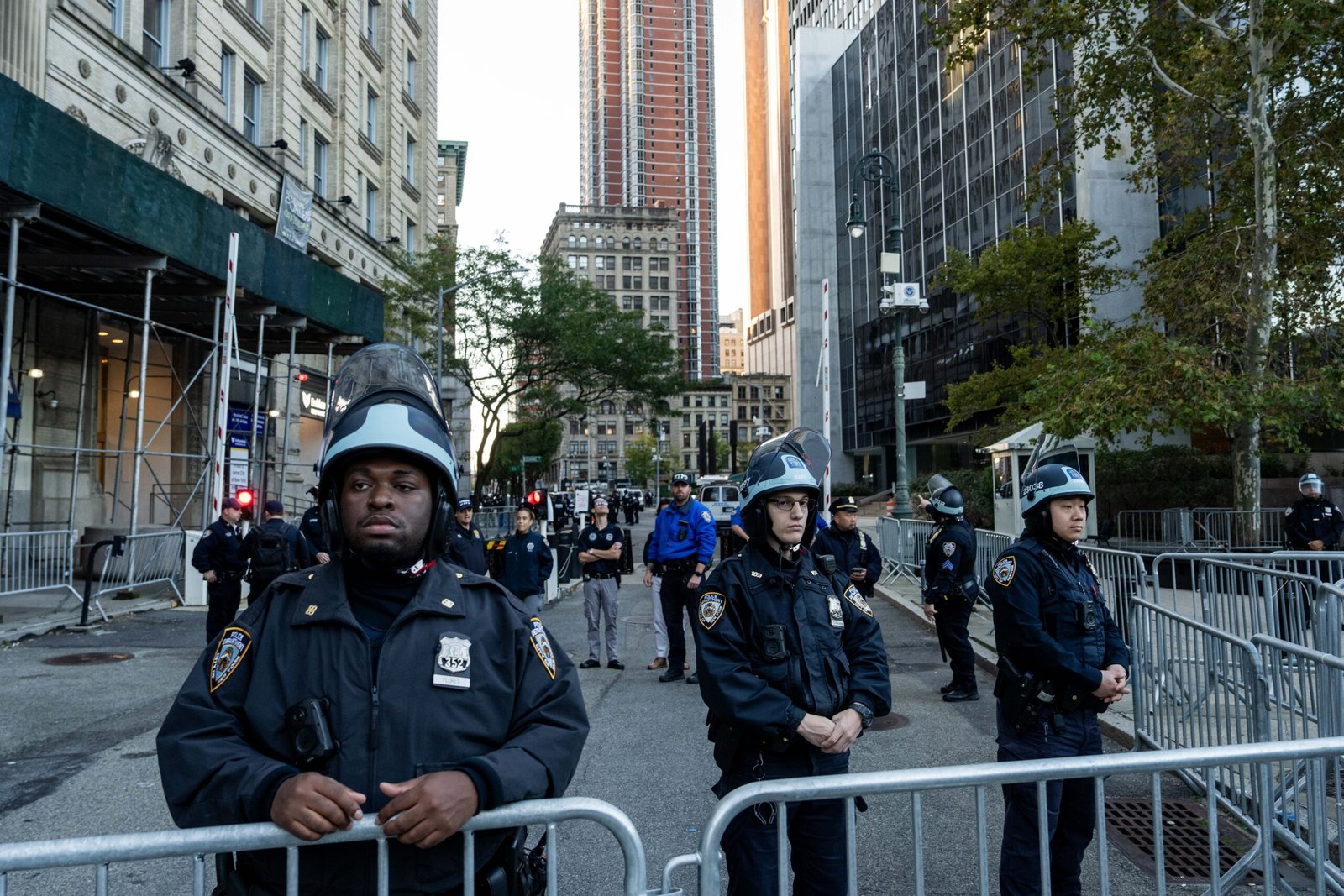

POLICING PROBLEMS: In the early days of his administration, Mayor Zohran Mamdani placed a new requirement on the NYPD: The department would have to secure permission from his office to deploy its Strategic Response Group to make arrests at protests.
The directive, which hasn’t been previously reported, shows Mamdani sought to exert significant influence over a core function of the police department. Its existence also calls into question why the mayor hasn’t more frequently used that authority to stop the SRG from being deployed at protests — since he promised as a candidate to disband the specialized unit.
The unit — which has long weathered criticism for its heavy-handed protest responses — just last week arrested activists protesting Israeli Prime Minister Benjamin Netanyahu’s appearance at the United Nations General Assembly. Several politicians allied with Mamdani were among those put in handcuffs.
When asked about those arrests, an NYPD spokesperson revealed the pre-approval policy to Playbook, confirming that the mayor’s office has the final say whenever the department wants to deploy SRG to detain protesters.
“We communicate with City Hall on this topic as we do on a host of things related to the department,” the spokesperson said.
The police spokesperson declined to comment on when exactly the mayor first instituted the SRG pre-clearance process. But a person familiar with the timing, who was granted anonymity to discuss the sensitive issue, said the policy was put in place during the first few months of Mamdani’s term.
The mayor suggested at a press conference on Monday that he didn’t see a justification for using the SRG in last week’s arrests outside the U.N. “I’ve been clear that my vision is for the disbanding of the SRG,” he told reporters when asked if he thought it was an appropriate use of police resources.
A Mamdani spokesperson declined to comment Tuesday on why the mayor didn’t use his power to call back the SRG last week if he didn’t think its deployment was justified. The spokesperson also would not say if the mayor has ever used his authority to reject a request from the NYPD for SRG intervention.
Amanda Jack, The Legal Aid Society’s policy director for criminal law reform, laced into the Mamdani administration after being informed of the existing policy.
“It is deeply troubling that City Hall has the authority to stop SRG deployments, yet continues to approve them at demonstrations, including at the protests outside the United Nations last week where the mayor himself acknowledged that the deployment was an inappropriate use of police resources,” said Jack, whose group has long advocated for abolishing the SRG. “This further confirms that regulating SRG deployments isn’t the solution. City Hall must finally make good on Mayor Mamdani’s campaign promise to disband SRG for good.”
The future of the SRG is one of several sources of friction between Mamdani and Jessica Tisch, his politically moderate NYPD commissioner. It’s also an issue that the mayor risks disillusioning his leftist base with the longer he keeps dragging his feet on fulfilling his 2025 campaign pledge.
Tisch has defended using the unit, saying it’s a key tool in the department’s network of crime-fighting strategies.
But Mamdani — a democratic socialist who, before launching his 2025 mayoral bid, supported calls to defund the NYPD — has long said the unit should be dismantled. Since taking office, he’s said he’s in active conversations with Tisch about finding a way to break up the unit, but those talks haven’t resulted in any tangible action nine months into his term.
Founded in 2015, the SRG was initially just tasked with counterterrorism work. The group’s responsibilities have since come to include responding to protests that turn chaotic or violent.
In arguing for abolishing the unit, Mamdani and other police reform advocates have pointed to SRG officers racking up disproportionately high rates of misconduct claims while responding to protests.
The SRG was subject to a court settlement in 2023 that put new guardrails around how the unit could be deployed during protests. But Mamdani and like-minded voices have contended that’s not enough and that the SRG should be broken up so it can return squarely to its original counterterrorism function.
In his remarks on Monday, Mamdani reaffirmed that view.
“I have made that promise, I will fulfill that promise,” he said. “The only question is the timeline of it.” — Chris Sommerfeldt
MARK YOUR CALENDAR: Join POLITICO’s New York Outlook: Affordability, Industry & The Economy on Oct. 14 for live conversations about the business and policy decisions being made today — from City Hall to the State Capitol — that will shape the city’s economic future. The lineup includes New York City Council Speaker Julie Menin, New York City Economic Development Corp. CEO Anthony Shorris, Partnership for NYC CEO Steven Fulop, Citizens Budget Commission President Andrew Rein, Charles H. Revson Foundation President Maria Torres-Springer, and more. Register now to attend in person or watch the livestream.
From the Capitol

CORNELL UNDER FIRE: Gov. Kathy Hochul is calling for an independent review of Cornell University’s response to a 2024 gang rape case, as the case draws national attention and the school faces mounting criticism.
The Tompkins County district attorney said his office is reopening a criminal probe into an alleged gang rape at a Cornell fraternity house, following a civil lawsuit filed by the plaintiff in mid-September.
The plaintiff, a former Cornell student referred to as Jane Doe, alleges in the lawsuit that several men raped her at the Chi Phi house after she was coerced into consuming drugs. The lawsuit names Cornell, several Chi Phi organizations, the former president of Cornell’s Chi Phi chapter, a local bar and unnamed individuals as defendants.
The governor called for outside counsel to conduct a “transparent, independent” review of the university’s response to determine whether Cornell “met every obligation to protect its students and pursue justice.”
“I support the district attorney’s decision to reopen the criminal investigation,” she said in a statement. “But there are also serious questions about Cornell’s campus culture and its systems for prevention, reporting, and response.”
She called the allegations in the case “nothing short of horrifying.”
“For any student to come forward after an experience like this takes extraordinary courage,” Hochul said. “No student should ever be left wondering whether the institutions meant to protect them will listen and act.”
Rebecca Valli, a Cornell spokesperson, told Playbook the school plans to work with the governor and other state officials.
“Cornell shares Governor Hochul’s commitment to addressing campus culture issues, which affect universities across the nation and New York,” Valli said in a statement. “We are committed to continuing to work with state officials to advance student safety and wellbeing.” — Madina Touré
EYES ON AI: When it comes to who’s getting involved in addressing the rapid rise of artificial intelligence, Hochul offered a straightforward perspective today: the more the merrier.
Speaking to reporters after a meeting of her FutureWorks Commission, which is set to deliver recommendations by the end of the year regarding AI and the workforce, Hochul welcomed the City Council’s recently announced moves to regulate AI.
“This is an area where we need an all-hands-on-deck approach,” she said in response to a question regarding whether the Council’s proposals might overlap with the state’s. “I applaud the City Council for getting more information. … If they come up with an idea that would make sense at the state level, we’ll embrace it. We have an idea at the state level, it already covers the city. So this is an area, we’re on the same team in terms of making sure we get this right, because the risks are too high.”
Hochul said the commission is looking to address how AI is reshaping jobs, the best ways to train workers on the technology, protecting those vulnerable to job cuts and “the best ways to harness the benefits of AI for everyday New Yorkers.” Tom Perez, the co-chair of the commission and former U.S. secretary of labor, said there are “more questions than answers at this point” but he has “great optimism that we can tackle this challenge.” — Madison Fernandez
FROM THE CAMPAIGN TRAIL

SUPER PAC SURGE: Super PACs backing Hochul have reported $4.8 million in contributions since yesterday, giving the governor a comfortable advantage over Republican Bruce Blakeman in the outside spending arms race.
Greater Empire State, a committee run by the Democratic Governors Association, received $1 million from the Greater New York Hospital Association – a perennial top spender in New York politics that gave the state Democratic Committee $1.5 million in June.
The DGA group also received $500,000 from former gas company CEO John Hess. It reported a dozen four- or five-figure donations from pediatricians and other healthcare groups as well. At least 10 of those have connections to the physician network Somos Community Care, a longtime Hochul benefactor.
Additionally, the landlord-backed New York Apartment Association gave $3 million to Leadership for New York, a pro-Hochul super PAC launched by former NYAA official Jay Martin. That committee subsequently transferred $1 million of its money to the one run by DGA. — Bill Mahoney
BROOKLYN BATTLE: The state Supreme Court’s appellate division ruled in favor of a group of self-described reformers who were looking to unseat Rodneyse Bichotte Hermelyn as chair of the Brooklyn Democratic Party.
The decision comes just hours before the executive committee is scheduled to meet to vote on the next party chair. Julio Peña III, the district leader put forth by reformers to unseat Bichotte Hermelyn, has been locked in a legal battle over Bichotte Hermelyn’s move to change the makeup of the executive committee — a maneuver she claimed would promote inclusivity, but one her opponents insisted was only carried out to pad her support before the leadership election.
A state Supreme Court judge ruled that the vote on the expansion was invalid, but Bichotte Hermelyn appealed the decision. Today’s appellate division ruling voids the expansion — seemingly a win for Peña, who has said he has enough support to win the leadership election under the unchanged structure.
But there’s still plenty up in the air. Last night, Bichotte Hermelyn said she decided not to run for another term as chair. After her announcement, City & State reported that she is backing state Assemblymember Nikki Lucas, who had not been actively running for the position.
Reformers are in court today looking to prevent this evening’s meeting from happening in light of last week’s chaotic organizational meeting. — Madison Fernandez
FROM CITY HALL

COMBAT READY: Mamdani released a highly anticipated blueprint to combat rising antisemitism today amid ongoing criticisms that he’s fueled the problem.
Under his plan, the Mayor’s Office to Combat Antisemitism will weigh in on $26 million that was allocated in this year’s budget to the Mayor’s Office for the Prevention of Hate Crimes, which has a broader mandate to fight all forms of hate.
The cash infusion will mean more money for organizations already engaged in combating antisemitism online and for supporting victims of antisemitic incidents. In particular, the city has doubled the investment in groups doing this work to $6.4 million and has earmarked $1 million for physical security at sensitive sites like synagogues. And it will work to increase visits to the Museum of Jewish Heritage for middle schoolers.
“We hold a responsibility to sustain and protect our Jewish neighbors — a responsibility that belongs to each of us,” Mamdani said in a video message accompanying the report. “That is the work we are undertaking at City Hall, and I am asking every New Yorker to join us.”
While the report generated plaudits from across the political spectrum, several prominent Jewish organizations said the mayor failed to define antisemitism and to acknowledge that some of his own rhetoric is to blame.
“While the Mayor’s plan has a number of positive elements, including some increased security funding for Jewish institutions and expanding proven programs, it fails to address a central issue that the Mayor himself has perpetuated: rhetoric that demonizes and delegitimizes Israel inevitably leads to the targeting of Jewish New Yorkers,” the UJA-Federation of New York, JCRC-NY, AJC New York and New York Board of Rabbis wrote in a joint statement.
Read more from POLITICO’s Joe Anuta here.
BRIDGE TO HOME: NYC Health + Hospitals is opening a second site for the “Bridge to Home” program, an initiative by former Mayor Eric Adams to provide a place for homeless patients to continue healing after a hospital stay.
Patients will be able to stay as long as 12 months at the new Crown Heights site in Brooklyn, where they will have 24/7 medical support from Woodhull Hospital providers and get help applying for permanent housing.
“Bridge to Home is a bridge between getting well in the hospital and building a life in the community,” Omar Fattal, NYC Health + Hospitals’ chief behavioral health officer, said during a press conference this afternoon. “And for someone like me who spent many years working in inpatient psychiatry, it means that when we ask, ‘Where does this person go next?’, we finally have a better answer.”
Since the first “Bridge to Home” site opened in Midtown Manhattan in September 2025, 18 participants have moved into permanent housing, according to NYC Health + Hospitals.
The first resident of the Crown Heights site, which has capacity for roughly 50 program participants, moves in next week. — Maya Kaufman
IN OTHER NEWS
INFLUENCER ARMY: A group of influencers under instruction from City Hall are reportedly planning a campaign against top New York CEOs, a claim Mamdani’s administration denies. (New York Post)
ENERGY FUTURE: A flurry of new energy-intensive projects are underway in upstate New York. (Times Union)
FRUIT FUMES: Bureaucracy and politics have led to the unraveling of a years-in-the-works plan to modernize a diesel-spewing produce market in the South Bronx. (Gothamist)
Missed this morning’s New York Playbook? We forgive you. Read it here.



Leave a Reply