
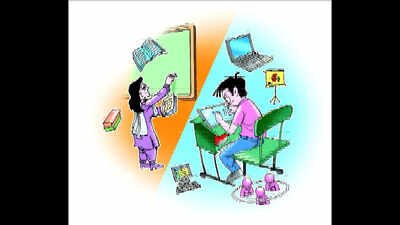

Classrooms in parts of India are quietly grappling with an underlying problem that no curriculum revision can easily fix. Students raised on on-demand food delivery, constant social media reels and instant AI answers are finding it harder to sustain attention, tolerate boredom, or work toward rewards that don’t arrive at once.Teachers, as a result, are increasingly engaging a generation that is much less attentive than before. A recent nationwide survey by the National Council of CBSE Schools found that almost 70% of teachers across the country have observed a sharp decline in their students’ focus and classroom attention.The survey, which covered around 6.3 lakh respondents — teachers, under 18 students and their parents — also found that 74% of students spend more than two hours a day on screen for non-academic purposes. And teachers reported rising anxiety, irritability and reduced face-to-face interaction among children.Parmeshwar Dattarao Bhurke, a teacher, says the trend is evident in everyday classroom experiences. “Many children no longer have the focus needed to sit through an hour-long lesson or read a passage without their minds wandering,” he said. This has prompted many teachers to experiment with newer learning methods, he added. “Earlier, one student could read a chapter aloud while the rest of the class listened. That no longer works... The idea now is to keep their minds actively engaged through the session.”Priya, another middle school teacher, says she has noticed a decline in students’ retention levels. “Even when children appear to be listening, their minds are elsewhere. They are also less willing to struggle through any difficult task. This affects their performance in school as well as their behaviour, as they become averse to any kind of challenges or discomfort.”For 15-year-old student Chinmayee Sonna, the shift is visible in the way her classmates now study. “Instead of sitting with textbooks or working through ideas, many of my classmates look for the easier option, whether that is AI-generated summaries or explainer videos. They are able to retain less through this method but it helps revise quickly and saves time,” she said.Psychologists say such habits reflect a behavioural shift driven by constant access to instant rewards. “They trigger dopamine, giving us a brief rush of joy that reinforces the behaviour and makes us want to repeat it. This is different from the real-life feats, where satisfaction comes only after much effort and patience,” Rashi Bhatnagar, a psychologist, said.It is these consequences that extend into the classroom. “When rewards come with almost no effort, the brain begins to prefer them. Like an unused muscle, our ability to wait, tolerate boredom and sustain attention gradually weakens, leaving us restless when tasks demand patience,” Bhatnagar said.This is why there is a downside to schools trying to make every lesson entertaining, she adds. “Education cannot always provide instant pleasure if it is to encourage deep thinking. Schools need to consciously create opportunities for children to reflect and generate new ideas.”The habit of expecting immediate outcomes also affects resilience. “Because children have not developed the ability to wait for results, many give up too quickly. We need to teach them not to quit at the first sign of difficulty,” Bhatnagar said.Psychiatrist Nisha Singla, talking about the digital ecosystem, says it is deliberately designed to reinforce instant gratification. “Social media apps, notifications and quick commerce applications are addictive and the brain begins to crave them. Reading or learning something new also gives us a sense of achievement, but the reward is delayed. That is where all the difference lies.”Rebuilding patience, she says, begins with allowing children to slow down. “We need to let them get bored… There is a tendency to fill every moment of their day with something or the other, but boredom is equally important. Parents and schools should consciously encourage delayed gratification.”
Share your thoughts in the comments
Be respectful · TOI community guidelines
Another challenge to consider in adapting classrooms is large class sizes and poor teacher-student ratios. “This leaves little room for us to nurture each child’s curiosity and individual learning needs. At the same time, schools remain under pressure to deliver high marks and pass percentages, leaving us focused on examination outcomes rather than redesigning learning around children’s changing needs,” Priya said.As educators wait for the national mental health and well-being policy for schools, they say it should help students find meaning in a learning process whose greatest rewards cannot be a sprint and a quick fix.







Leave a Reply