
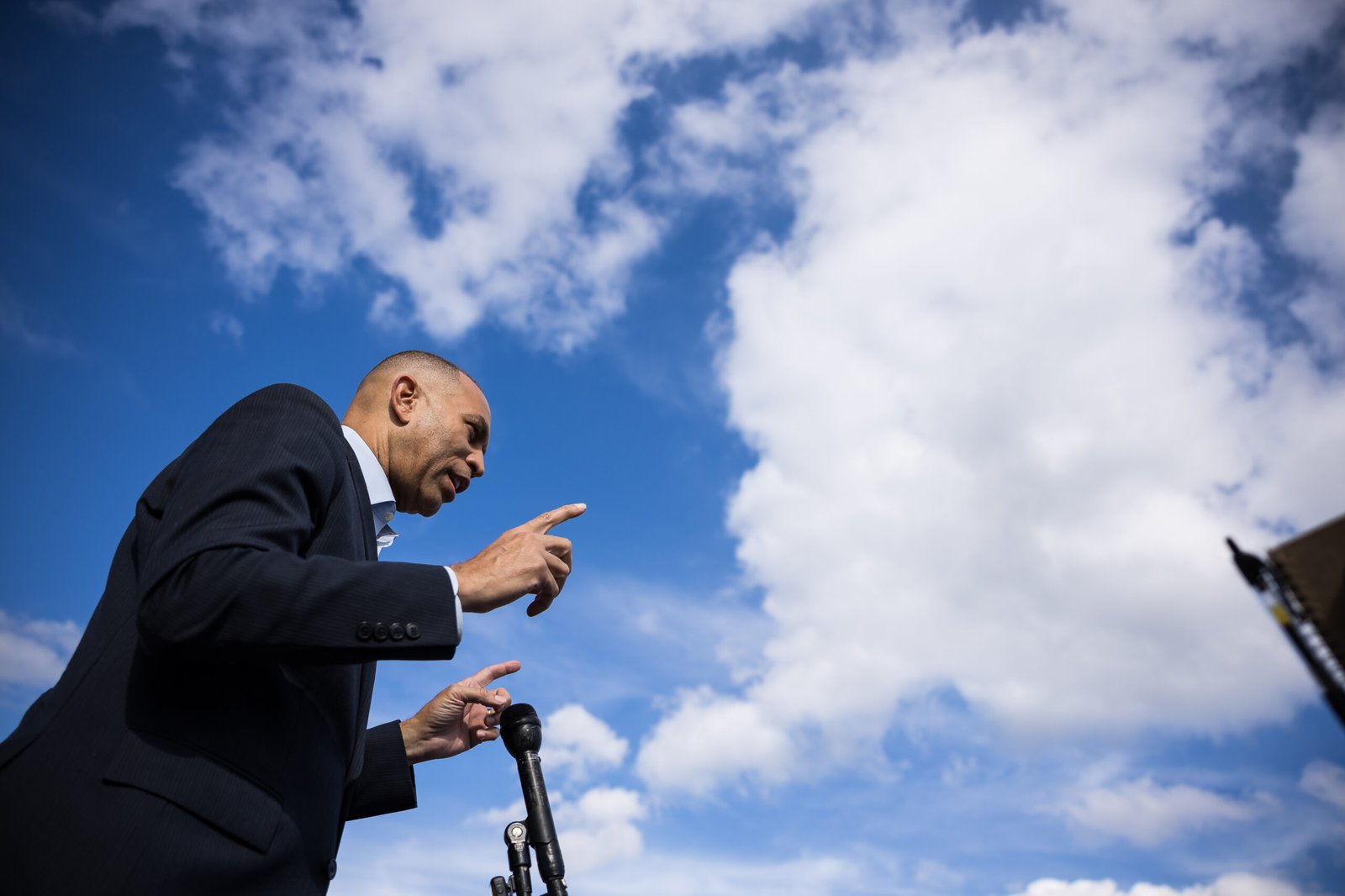
Democrats are making moves to try to secure a big enough House majority to sideline blocs of both progressive and moderate holdouts who could cause constant headaches for Hakeem Jeffries if he becomes speaker next year.
Democrats are investing in deep-red districts that could pad a future majority, banking on what appears to be a strong political environment to not just win but win big. That would strengthen Jeffries’ hand.
“Another five-or-so-seat buffer would be a game-changer,” said one senior House Democrat, who like others in this report was granted anonymity to discuss internal party dynamics. That lawmaker added it would help Jeffries “rise above some of the incoming bullshit he’s going to have to deal with.”
Every extra seat they pick up will make it easier for Jeffries to secure the speaker’s gavel without having to make concessions. That would let him ensure they can’t “hold Hakeem hostage” on legislation, as another senior House Democrat put it.
The spending reflects these ambitions.
Since the start of August, Democratic-aligned groups and candidates have spent or committed more than $73 million in ad dollars to GOP-held districts that Trump won by at least 10 points in 2024. In eight of those districts, Democrats have spent or reserved upwards of $3 million apiece, according to a POLITICO review of data from AdImpact, which tracks political advertising.
That includes $13 million in total spending and reservations to target scandal-plagued Rep. Max Miller (R-Ohio) in a district Trump won by 11 points in 2024 and more than $10 million to boost Tejano singer Bobby Pulido against Rep. Monica De La Cruz (R-Texas) in a district Trump won by nearly 18 points.
The NewDem Action Fund, the political arm of the centrist New Democrat Coalition, is spending in some even redder districts. Rep. Greg Stanton (D-Ariz.), the chair of the fund, said all of the candidates the group has endorsed have committed to backing Jeffries.
“Every single endorsed candidate supports Hakeem Jeffries for speaker of the House,” Stanton said in an interview. “We will be a strong governing partner with Hakeem Jeffries to make sure that his speakership is as successful as possible.”

Tight majorities are misery-makers for speakers. Former Speaker Kevin McCarthy gave numerous concessions to his party’s right flank in order to assume the role — only to later be ousted by those same lawmakers.
Speaker Mike Johnson has had to navigate a treacherous majority of only three votes, sometimes less depending on the day, giving ample power to the GOP’s right flank. And former Speaker Nancy Pelosi had to cut a deal with moderates to secure her post in 2018 by promising to serve only two more terms in leadership.
Even with the gavel secured, a speaker has more flexibility to manage the floor if he or she can let some party colleagues peel off on tough votes.
As one Democratic strategist put it, “The larger the majority, the more freebies you can hand off.”
Progressive challengers ousted a handful of Democratic incumbents in primaries this year, and they could adopt tactics from the ultraconservative House Freedom Caucus if Democrats win just a narrow majority.
They aren’t the only potential concern. Newly elected moderates, particularly from rural districts that swung heavily for Trump in 2024, could end up as a bigger problem — as they were for Pelosi when she was speaker.
A hint of that came last month, when moderate Reps. Marie Gluesenkamp Perez (D-Wash.) and Jared Golden (D-Maine) twice sided with Republicans to advance slates of GOP bills and forced Jeffries to decry a “significant breach of trust.”
“A Blue Dog in a Trump plus 15 district has a different series of challenges than a progressive from a safe Democratic seat,” said Ian Russell, a Democratic ad maker and former deputy executive director of the DCCC. “The progressive from a safe Democratic seat has voters who want the Democratic Party to be successful. So they have an incentive to be constructive, even in their criticism of leadership, to be constructive, to be team players. So I think it’s unfair to the progressives to just assume that they’re going to be headaches.”
Asked by POLITICO during a news conference Wednesday what a bigger margin would mean should he be elected speaker, Jeffries said he is focused on “working incredibly hard to win control of the House of Representatives and then to win as many seats as possible on top of that.”
A spokesperson for Jeffries declined to comment except to refer to Jeffries’ comments at the news conference. House Majority PAC, House Democrats’ main super PAC, declined to comment.
In a statement, DCCC spokesperson Viet Shelton said the committee’s mission “is to win the majority, and win the largest majority possible.”
Jeffries and top Democrats are facing wariness from some Democrats who want to make sure they don’t overextend their limited war chest in their quest to secure a large majority — and risk not winning a majority at all.
“Don’t waste resources just because,” a third House Democrat cautioned. “Expand the battlefield where it’s smart to do so and causes the other side to spend more on defense.”
Jeffries is already working to make inroads with candidates who could complicate his potential speakership, regardless of the margin.
Melat Kiros, a Democratic socialist-affiliated candidate who waged a successful progressive challenge to Rep. Diana DeGette in Colorado, has not committed to backing Jeffries, but said in an interview in September they had a “wonderful” call.
“It’s a big tent,” she said of the party, “and we all have the same goal of taking back the House and making sure that we can demonstrate to the American people that it’s our party that can actually deliver those results.”






Leave a Reply