
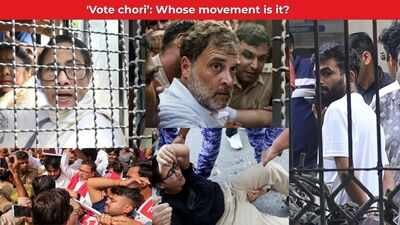
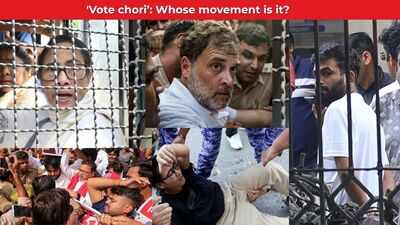
NEW DELHI: “All the protests are one protest,” Rahul Gandhi said when asked about the parallel demonstrations against Chief Election Commissioner Gyanesh Kumar. Yet, despite their common demands, the Congress leader and the Cockroach Janta Party (CJP) leadership have not shared a stage.Congress and other INDIA bloc leaders on Monday marched towards the Supreme Court over alleged electoral irregularities, while CJP continued its own campaign against the Election Commission.The two groups had also followed separate courses during the October 10 protests. CJP founder Abhijeet Dipke, TMC chief Mamata Banerjee, AAP leader Arvind Kejriwal and Left leaders were among those detained by Delhi Police. Rahul Gandhi, meanwhile, was in Chennai, though he condemned the police action.Rahul Gandhi made “vote chori” a central political slogan of the opposition. CJP has also adopted it in its street demonstrations. But despite their overlapping demands, the two sides have largely pursued separate protest programmes.This has raised a political question: Why is Congress maintaining a distance from a movement that shares one of its biggest political demands?
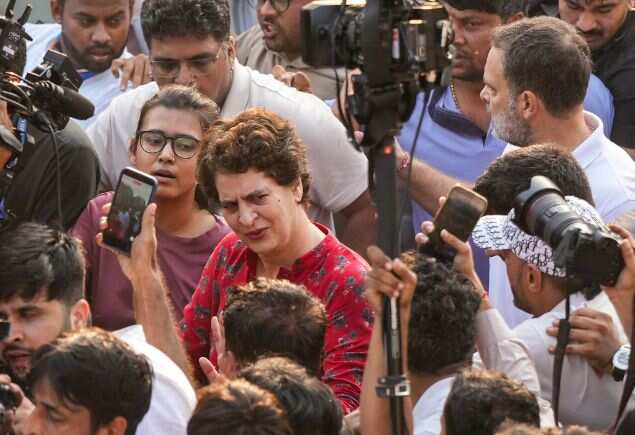
Neha Bora joins Congress protest march to Supreme Court
A fight for political space?
CJP’s agitation against the Election Commission fits into a larger political battle that Congress has already made central to its opposition strategy.Rahul Gandhi’s “vote chori” campaign has targeted alleged electoral irregularities in Karnataka, Haryana, Maharashtra and Bihar.The slogan “Vote Chor, Gaddi Chhod”, frequently heard at CJP protests, also draws on the political language popularised by Rahul Gandhi.Former Congress national spokesperson Sanjay Jha, however, rejects the suggestion that the two sides are competing for political space.“I don’t think the battle is between the CJP and the Congress. All members of civil society, students, political parties, intellectuals, authors, activists, NGOs, everyone who’s concerned about Indian democracy, are fighting both independently and collectively,” he said.Describing CJP as a successful student movement, Jha credited it with bringing the issue to the forefront after investigations by The Indian Express.
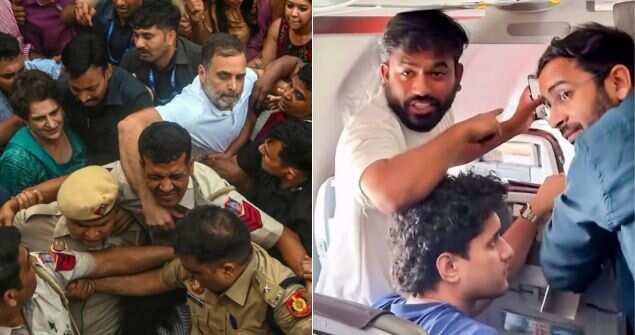
Anti-CEC protest on two different days (left) Rahul, Priyanka getting detained on October 7; (right) CJP’s Dipke, Das and Ranka getting detained on October 10
“To say that there is any competition between the two is BJP propaganda, and we should not fall for that,” he said.His argument is that the two groups can pursue the same demands without necessarily working together.However, their separate mobilisation has also brought attention to differences in their political approach and relationships with other opposition parties.The BJP and Election Commission, meanwhile, have rejected allegations of electoral manipulation, with the poll body maintaining that revisions are intended to identify ineligible entries and ensure the accuracy of electoral rolls.
NEET protests showed similar pattern
The relationship between Congress and CJP is not simply one of competing claims. Their responses to the NEET-UG controversy in 2026 showed that they could support the same cause while maintaining separate political programmes.CJP emerged as a youth-led citizens’ movement amid the controversy over alleged examination irregularities. It demanded accountability, education-system reforms and the resignation of then education minister Dharmendra Pradhan.On July 20, CJP organised a “Chalo Sansad” march from Jantar Mantar towards Parliament. Delhi Police stopped the march, citing violations of prohibitory orders and violence, while CJP alleged that police used excessive force against peaceful demonstrators.
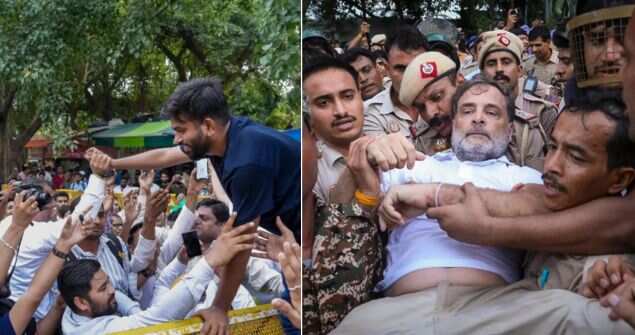
(Left) NEET protest on July 20 by CJP; (right) anti-paper leak protest by Congress July 21
The following day, Congress organised a separate protest outside Prime Minister Narendra Modi’s residence, led by Rahul Gandhi, Mallikarjun Kharge and Priyanka Gandhi Vadra.The party demanded Pradhan’s resignation, a parliamentary discussion on paper leaks and education reforms, and an apology to students over the police action.Congress had been raising concerns over examination irregularities before CJP’s march. Rahul Gandhi had met students in Kota and Dehradun, while he and Priyanka Gandhi Vadra visited injured students at Ram Manohar Lohia Hospital after the police action.The two sides supported similar demands but organised their programmes independently.That pattern is now visible again in the demonstrations against Gyanesh Kumar.
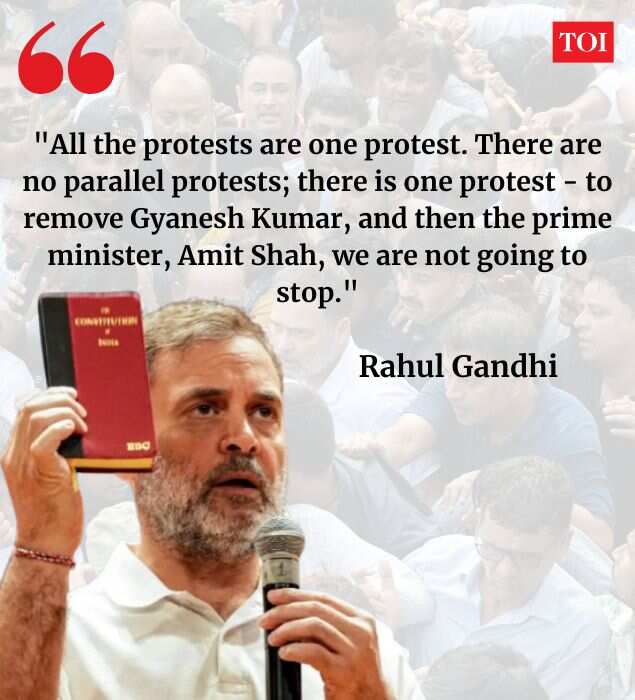
Rahul Gandhi said there are ‘no parallel protests’
Assam episode brings differences into focus
The differences became more visible after CJP’s recent outreach in Assam.Congress spokesperson Reetam Singh alleged that CJP co-convenor Ashutosh Ranka had refused a courtesy meeting with Congress leaders, including Assam Congress president Gaurav Gogoi, despite Congress workers helping secure the release of detained CJP members.Singh claimed Ranka had declined to engage because the outreach was considered an AAP initiative.“Aam Aadmi Party is known for piggy riding and hijacking issues of others,” Singh alleged, accusing AAP of attempting to associate itself with movements led by others.These are Congress’s allegations, and do not independently establish why CJP representatives declined the meeting.CJP co-convenor Saurav Das had also criticised what he described as a “self-declared liberal” ecosystem that believed “saving India” and the “Constitution” was its exclusive responsibility.The reference was politically significant because “Save the Constitution” has been a prominent part of Rahul Gandhi’s campaign.Ranka also accused sections of that ecosystem of targeting CJP founder Abhijeet Dipke as the movement gained traction.Neither named Congress directly in the posts cited, but the subsequent exchange with Singh brought differences between the two sides into focus.Singh, however, argued that CJP should not be treated as any party’s property.“Let us keep it civil and issue centric. The cause is bigger than a political party,” he said.The exchange suggested disagreements over political associations and coordination, even as both sides continued to raise similar demands.
Why did the Left, TMC and AAP join?
The October 10 protest made the difference in political positioning more visible. Mamata Banerjee publicly backed CJP before the demonstration, saying, “We are fully supporting the Cockroach (Janta) Party and all the young generation and students. And my humble request, please stop these atrocities.”She later joined the protest in Delhi, pasting a band-aid over her mouth before being detained alongside TMC leaders. Kejriwal announced that he would attend with his family, while senior Left leaders backed the agitation and challenged restrictions imposed ahead of the demonstration.
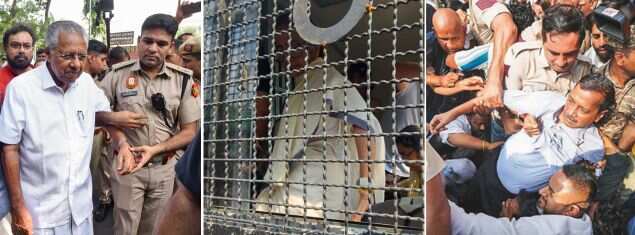
Pinarayi Vijayan, Mamata Banerjee, Arvind Kejriwal getting detained during October 10 protest
Congress had not announced participation in the same manner. But Rahul Gandhi’s absence from Jantar Mantar did not mean silence on the police action. He condemned the mass detentions, accusing Delhi Police of “thuggery” and alleging that the government was encouraging violence against women and young protesters. He also announced plans for Congress and INDIA bloc leaders to meet the Chief Justice of India.Congress, therefore, continued to challenge the government while pursuing its own political mobilisation and institutional interventions. The distinction is between supporting a cause and joining a particular protest platform.CJP legal head Ratna Singh said the invitation remained open to all parties.“If the Congress is willing to come forward and join the protests, it is most welcome. Not just the Congress, but other parties too. Everyone should come together,” she said.“This is not the time to look at different groups protesting separately. We must see this as a unit, as a team effort, with people raising their voices against the wrongs happening in this country,” she added.Her appeal raises a question that extends beyond Congress: What does solidarity mean when parties agree on an issue but differ over how a protest should be organised, represented and politically sustained?
The Anna Hazare lesson
The tensions around CJP have echoes of the 2011 India Against Corruption movement. The BJP publicly backed Anna Hazare’s anti-corruption agitation against the Congress-led UPA government. Congress later accused the BJP and RSS of exploiting the movement to undermine its government.
Share your thoughts in the comments
Be respectful · TOI community guidelines
The movement’s political afterlife was significant. Arvind Kejriwal, one of its prominent figures, went on to form the Aam Aadmi Party in 2012.
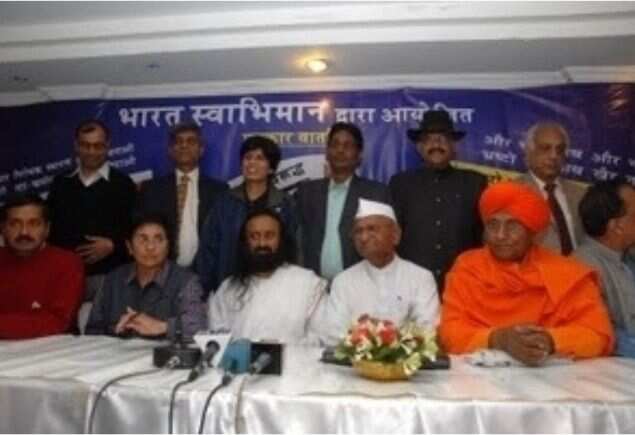
Anna Hazare, Arvind Kejriwal, Kiran Bedi during India Against Andolan movement, 2011
The parallel is relevant to the present Congress-CJP friction. Congress spokesperson Reetam Singh has alleged that CJP’s Assam outreach was viewed as an AAP initiative, accusing the party of “piggy riding and hijacking issues of others”.The allegation raises a question about whether Congress sees CJP not simply as a citizens’ movement, but as a platform whose political associations and future trajectory matter.



Leave a Reply