
A New Jersey family home bought in 1929 has survived generations of change, but rising flood risks eventually forced its owner to rethink how it could be preserved. Located on Cedar Bonnet Island beside Barnegat Bay, the house narrowly escaped damage during Superstorm Sandy in 2012 because it had been temporarily raised for construction work. That unexpected escape prompted Amanda Devecka-Rinear to take a closer look at the building’s vulnerability. Rather than risk losing a property filled with family memories, she decided to raise it permanently.
Why raising the New Jersey family home became essential
According to NPR’s report, Devecka-Rinear’s great-grandfather bought the house in 1929. It later passed to her grandmother, making the property an important link between generations of the family.The house stood close to the ground, leaving it vulnerable to flooding in the coastal community. For Devecka-Rinear, however, it was not simply a building that could be replaced. Its history and personal significance made preserving it a priority.Superstorm Sandy in 2012 brought that concern into sharp focus. The house escaped flooding because it happened to be lifted on supports while construction work was taking place. The temporary elevation kept it above the water that damaged properties elsewhere.The experience showed Devecka-Rinear what a difference height could make. When she moved into her grandmother’s house in 2013, she began considering how to protect it against future storms.
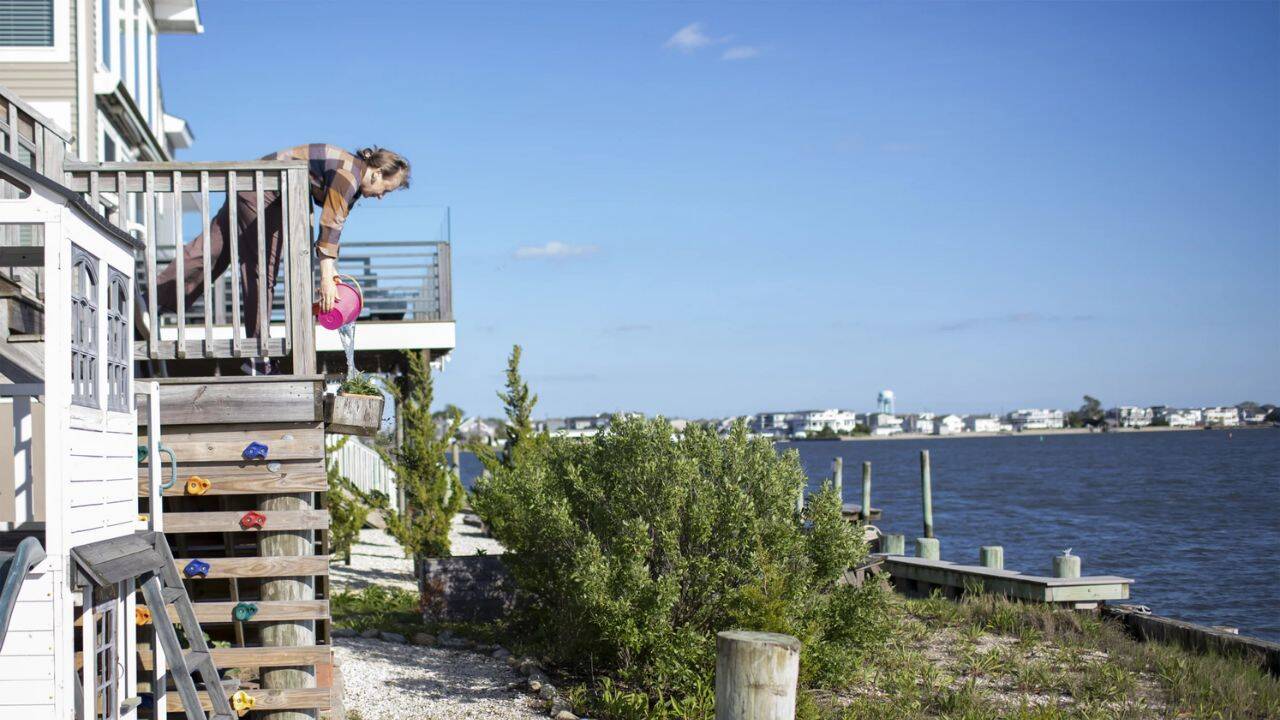
Image Credit: Ryan Kellman/NPR
How Superstorm Sandy changed the family’s plans
Sandy caused extensive damage along the Jersey Shore, leaving many homeowners facing expensive repairs or the loss of their properties. Devecka-Rinear saw the consequences close to home when her father’s neighbouring house was damaged so severely that it had to be demolished and rebuilt, NPR reported.The contrast between the two houses strengthened her resolve to act. She wanted to avoid waiting for another disaster before making the family property safer.Permanently elevating the house offered a way to reduce the risk without abandoning the island. The decision also reflected a wider effort across coastal New Jersey to help homeowners adapt to flooding rather than automatically relocate.
The financial challenge of lifting the house
According to NPR, raising Devecka-Rinear’s home to nearly 13 feet above sea level eventually cost more than $140,000. The work required substantial financial planning, and securing assistance did not mean that the project would be easy to afford.In 2017, Stafford Township received funding from the Federal Emergency Management Agency to help residents elevate their houses. However, the programme covered only 12 households. Devecka-Rinear had to arrange the money upfront and wait for reimbursement, creating additional pressure.She borrowed from family members to cover expenses and needed somewhere else to stay while the construction was under way.Her experience highlighted a problem with assistance programmes that reimburse homeowners after work has been completed. Even when people qualify for financial support, they may not have enough savings or access to credit to begin expensive projects.
Individual homes cannot solve the flooding problem
Climate change is adding to the risks facing coastal New Jersey. Rising sea levels, heavier rainfall and powerful storms can increase the likelihood of flooding, while sinking land makes the problem more serious in some locations.Research from Rutgers University cited in the report found that sea levels along the Jersey Shore had risen by about 1.5 feet since the early 1900s, more than twice the global average.New Jersey has pursued several measures to reduce flood damage since Sandy. These include strengthening dunes and buying properties in particularly vulnerable areas. Stafford Township, however, has encouraged residents to elevate their houses because the community’s position beside the bay offers limited natural protection.Lifting a house can reduce the likelihood of floodwater entering the building, but it cannot protect everything around it. Roads, electricity supplies, sewers and other essential services can still be damaged. Residents may find themselves unable to reach their homes or live comfortably in them if the surrounding infrastructure fails.The township has therefore considered broader improvements, including raising vulnerable roads and replacing sewer systems. A road elsewhere on the island had already been elevated to help residents travel without driving through floodwater.
Preserving a family legacy for the future
For Devecka-Rinear, the project was about protecting more than the structure itself. NPR reported that her grandmother had specified in her will that the house should belong to her granddaughter permanently, reinforcing the family’s wish to keep the property.Devecka-Rinear later became involved with the New Jersey Organizing Project, a nonprofit that advocates for people affected by storms. Her experience helped shape her interest in making disaster recovery and home-protection assistance more accessible.Nearly a century after her great-grandfather bought the property, the house remains part of the family. Raising it has given Devecka-Rinear a practical way to protect that inheritance while continuing to live in a place filled with memories of her grandmother.







Leave a Reply