
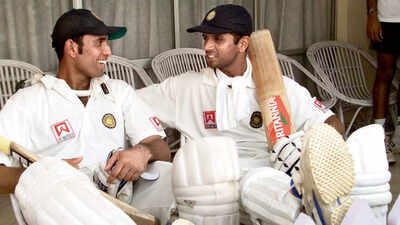
Rahul Dravid and VVS Laxman forged a series-defining partnership in the Eden Gardens Test to script one of the greatest turnarounds in cricket. Talking to TOI, the former India captain reflects on the tactical calls, the marathon stand and how the victory proved to be a turning point for Indian cricket.Go Beyond The Boundary with our YouTube channel. SUBSCRIBE NOW!How was your form leading up to the Eden Test?It was patchy, to be honest. I had scored runs in the series against Zimbabwe leading into this Australia series. In domestic cricket, I got some runs. So, from that perspective, I was feeling quite good. In the first Test in Mumbai, I batted for a long time in the second innings but got out to Shane Warne. The same happened in the first innings at Eden. But in the context of the series, there was so much hype and noise around it that it almost felt like I was really out of form. In reality, I hadn’t made runs in three innings.Considering all of that, was it extra special that the hundred came off Warne’s bowling?Warne was a phenomenal bowler and an absolute legend of the game. There were times I felt that he had the wood over me because I hadn’t really put up a big score against him. Against bowlers like him, you want to get a big score, so it felt good to be able to score runs and to be able to play him as well as I did.What was your reaction when you were told that you would have to bat at No.6 in the second innings?It was John Wright and Sourav Ganguly’s decision. They came to me and asked for my thoughts about it. It seemed pretty reasonable because Laxman had batted beautifully in the first innings. It made sense to put the guy who was in form up ahead of me at that stage. It did feel a bit odd because it had just been a couple of low-scoring innings for me, so it did cross my mind whether we were overreacting. But the conversation was about putting a bit of pressure back on the Aussies and I realised that maybe that is the best thing to do. And it worked out brilliantly.
You have had some amazing partnerships with Laxman.I’ve always really enjoyed batting alongside Laxman because, firstly, he’s a fantastic player and a great batsman to watch. So, you’ve got a really good seat in the house. He did not get frazzled or hassled by too many things. We played a lot of cricket together for the South Zone and some junior cricket as well. We’d communicate a little bit, but we’re not like out-and-out big talkers in the middle. So that suited my game as well. He was one of those players who had skills to play all around the wicket and it didn’t feel like there was any kind of bowling that could trouble him. So, when you bat alongside a player like him, it gives you confidence and belief.You batted for 446 minutes with Laxman. What was the one routine you followed?I had a personal routine that I followed before each delivery, which was just two taps of the bat while moving my feet in a particular way. I took a couple of breaths and sometimes said to myself, ‘Watch the ball.’ Laxman had his own routine and he liked to draw a lot of lines on the pitch and tap the bat. I would pull his leg at times and not put my bat out for him to tap and he would get a bit grumpy about it.Was your reaction after getting the ton directed towards anyone in the press box? People never saw you react that way before…That’s been blown out of proportion a little bit. I think in some ways, there was a lot of pressure on me. You can’t really react to everything people say. I understand that better now because I’m a bit wiser, more mature and have seen a fair bit of life in 25 years. But I genuinely felt that there was a lot of negativity around the team and a lot of criticism, which was a little bit uncalled for at that stage. Also, some of that criticism directed towards me was a bit unjustified. I’d only gone three innings without scoring runs. I was young and feeling the pressure. As a young man fighting for your place in the side — for your career and the team — you don’t always have the maturity to fully understand the situation. I’m happy enough to admit 25 years later that maybe I did let things get to me, which I should not have. But it wasn’t meant for anyone in particular. It was a relief and a sort of outlet for the pressure I was feeling. Whatever may be my reputation, so to speak, I have always been human.What was the chat in the dressing room after each session?It was about continuing to put pressure back on them. Just being in the moment and not trying to think too far ahead. Until the last session of Day Five, we weren’t even thinking about winning. In fact, we had to bat for a while the next day, and we bowled them out. The runs we piled up in the second innings (657/7 decl.) in some ways were a backhanded compliment to the Australians because they were such a strong team that we believed that we had to put up so many runs on the board.Did the declaration come late?People felt that way. There can always be different opinions on that. But the thinking in the team was to put them under pressure so that they had to defend rather than attack and never force us to push fielders back. Having men around the bat all the time created constant pressure and, in turn, chances. If we had given them even a sliver of an opportunity to attack, the game could have looked very different.What was the belief on Day 5?There was a certain sense of belief because we knew the ball was keeping low and the wicket was turning. Harbhajan Singh bowled beautifully and was at the top of his game.While you, Laxman and Harbhajan were the headline acts, there were other heroes too…Some people made a really incredible impact. Sachin’s wickets were absolutely critical after tea on Day Five. We don’t get those wickets often, and especially getting Adam Gilchrist out was a huge one. Venky’s (Venkatesh Prasad) 42-run stand with Laxman in the first innings, (Sadagopan) Ramesh’s catches, were all crucial. Also, really good captaincy by Sourav. He also got a crucial 48 in the second innings. It felt like a total team effort. But of course, when you have a couple of big performances like that, then people tend to recognise and remember only thoseDid the Eden Test make captains wary of enforcing the follow-on?I think that’s true. In some ways, I was not surprised that Australia gave us a follow-on. After the Eden Test, I think in some ways, you started seeing teams being more circumspect about giving the follow-on. Teams were a bit more wary of enforcing the follow-on, especially in subcontinental conditions. I think we started doing that less. I think as an Indian team, we started recognising that there’s probably no need to enforce the follow-on that much when you have so much time left in the game. Time is a crucial factor in these things. I think people have looked at the follow-on differently after that Test.What did the Eden Test do to Indian cricket?It did a lot, because it gave us a certain stability. John Wright was our first foreign coach and there were some doubts and criticism about whether that would work and what might happen. If we hadn’t won the series, I couldn’t answer what might have happened. But certainly, the pressure would have been on the whole team. But the fact that we were able to go on to win that series and play some very good cricket, it gave us as a group a little bit of breathing space. It also allowed us to build from there and steer the team in a certain direction. Even without that win, I believe Indian cricket would eventually have reached where it needed to. But it might have taken a little longer. That victory also triggered a phase when we began winning the odd Test and series abroad.Have you retained any souvenirs from that Test?I have the bat tucked in somewhere and a couple of other souvenirs.Twenty-five years, does it feel like a lifetime?People keep reminding me of the innings. I always cherish it because I think in some ways people remember what they were doing then. For me, that’s really nice because it gives me a feeling that I was able to be a part of someone’s memory for doing something that I’m expected to do, which is just part of my job.Where would you rate the win in your career?I’ve probably batted better in other tougher situations, and there have been other knocks that have been better in terms of just pure batting satisfaction. But, in the context of everything that happened and what it did for Indian cricket, and to so many of our careers, I’d certainly say that it’s high up there.
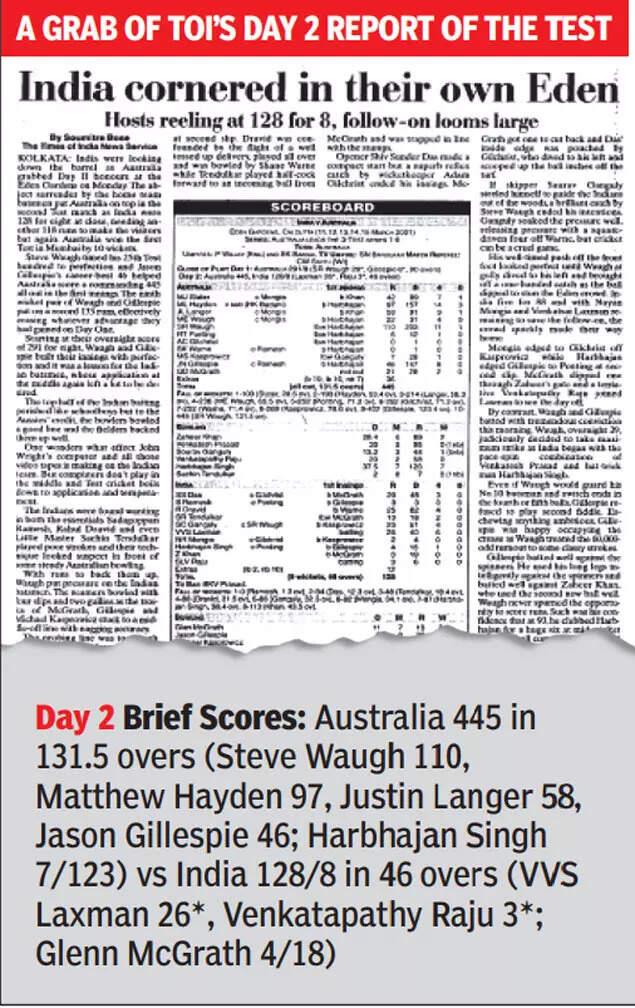
| At the start of Day 2, Australia were 291/8. But Steve Waugh and Jason Gillespie frustrated India with a big partnership, adding 133 runs for the 9th wicket. After Waugh’s dismissal for 110, Gillespie and Glenn McGrath shared 43 runs for the final wicket. The last two wickets contributed 176, taking Australia from 269/8 to 445. |







Leave a Reply