
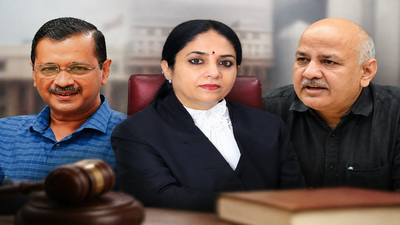
NEW DELHI: The legal battle over the Delhi excise policy case has taken an unusual turn, with Aam Aadmi Party leaders Arvind Kejriwal and Manish Sisodia refusing to appear before the Delhi high court bench of Justice Swarana Kanta Sharma. The controversy erupted after the court rejected Kejriwal’s plea seeking the judge’s recusal from hearing the matter.In a detailed order, the Delhi high court strongly defended judicial independence and held that allegations against the judge were unsupported by evidence. The court said recusal cannot be granted merely on perceptions, doubts or suspicions, warning that such pleas could damage public faith in the justice system.Also read – ‘Hope of getting justice shattered’: Arvind Kejriwal refuses to appear before court, writes to Justice Swarana Kanta
Delhi high court rejects recusal plea
Justice Swarana Kanta Sharma dismissed Arvind Kejriwal’s application seeking her recusal from the Delhi excise policy case. The court held that the plea failed to meet the legal threshold required to establish a reasonable apprehension of bias. It said the allegations were “based on conjectures and insinuations” rather than concrete material.The judgment stated that recusal cannot be sought simply because one party believes a judge may not rule in its favour. The court noted that such pleas must be backed by objective facts. It further warned that allowing unsupported recusal requests would undermine the institutional credibility of courts.Also read – After Arvind Kejriwal, now Manish Sisodia ‘recuses’ himself from liquor case hearing before Delhi high court judge Swarna Kanta Sharma
Court says no proof of bias
The high court examined the allegations raised by Kejriwal and found no evidence of bias. It stressed that judges are presumed impartial unless proven otherwise through clear and compelling material. The order said personal apprehensions or subjective fears cannot substitute for legal proof.Justice Sharma observed that “The application did not arrive with evidence; it came with aspersions, insinuations and doubts cast on my integrity, fairness and impartiality.” The court said accepting such claims without evidence would create a dangerous precedent. It also made clear that criticism of prior judicial orders or dissatisfaction with proceedings cannot be treated as proof of prejudice.
AAP objects to judge’s family links claim
Kejriwal and later Sisodia alleged a conflict of interest, claiming that Justice Sharma’s children are empanelled as lawyers for the central government. They argued that because the Union government is involved through the CBI and represented by Solicitor General Tushar Mehta, the situation created apprehensions about fairness.The high court rejected this argument and said no direct connection or “nexus” had been shown between the judge’s family members and the present case. The court held that judges’ family members cannot be barred from pursuing legal careers merely because of their relationship to a judge.
Role of bar events also questioned
Another objection raised by Kejriwal related to Justice Sharma’s participation in events organised by the Akhil Bharatiya Adhivakta Parishad. The AAP leader cited this as part of his concern over ideological neutrality in the matter.The court rejected the allegation and clarified that judges routinely attend legal, academic and professional programmes organised by multiple associations. It said participation in such events cannot automatically be equated with political affiliation or bias. Justice Sharma noted that no political statement, conduct or adjudicatory action had been cited to support claims of ideological prejudice.
Kejriwal refuses to appear before bench
After losing the recusal plea, Arvind Kejriwal announced that he would neither appear personally nor through legal counsel before Justice Sharma in the excise policy proceedings. In a public statement, he said his “hope of receiving justice… has been shattered.”Kejriwal said he had reached a “clear conclusion” that the principle that justice must not only be done but also be seen to be done was not being met in the case. He added, “My hope of receiving justice… has been shattered. Listening to my conscience and adhering to the principles of Mahatma Gandhi, I have decided not to appear before her in this case.” He also said he retained full faith in the judiciary as an institution and could approach the Supreme Court against the recusal order.
Sisodia follows with similar boycott
A day after Kejriwal’s announcement, former deputy chief minister Manish Sisodia wrote to the court stating that neither he nor any lawyer would appear on his behalf before the same bench. This escalated the confrontation between AAP leaders and the high court.In his letter, Sisodia repeated concerns about the judge’s family links to the central government legal panel. He said the “future of your children lies in the hands of” Tushar Mehta and added that he had “no hope for justice.” Sisodia further said he would instead follow the path of Satyagraha.
Court warns against forum shopping
The high court’s order strongly cautioned against attempts by litigants to seek a preferred bench by raising unsupported allegations against judges. It said such practices could encourage delays and distort the judicial process.Justice Sharma observed that accepting pleas based on unverified suspicions would open the “floodgates” to forum shopping. The court also said “A litigant cannot be allowed to put the judiciary on trial.” It stressed that if parties were allowed to engineer recusals through accusations, judicial proceedings would become vulnerable to manipulation.Also read – ‘You put judiciary on trial’: Delhi high court judge Swarana Kanta Sharma’s sharp words while junking Arvind Kejriwal’s recusal plea
Prior orders cannot justify recusal
Kejriwal had also cited earlier orders passed by Justice Sharma in connected excise policy matters, arguing that these decisions showed a pattern against the accused. The court rejected this submission.The high court said adverse judicial rulings cannot form the basis for recusal. It noted that if a party believes an order is legally wrong, the remedy lies in appeal before a higher court, not in seeking transfer of the case to another judge. The judgment underscored that judges routinely decide contentious matters and one side’s dissatisfaction with earlier outcomes cannot be treated as evidence of partiality.
Political reactions sharpen dispute
The legal confrontation quickly spilled into the political arena. Kejriwal, who was campaigning in Tamil Nadu with Chief Minister M. K. Stalin, initially said he had not read the detailed high court order and declined to comment extensively.The BJP, however, launched a sharp attack on the AAP chief. Party leaders accused Kejriwal of attempting to pressure the judiciary and turning a court process into a political spectacle. The episode has intensified partisan exchanges, with AAP framing it as a matter of fairness and BJP presenting it as an attack on institutions. The controversy is likely to remain politically charged as the case progresses.
What is Excise policy case?
The dispute stems from the now-scrapped Delhi Excise Policy 2021-22, which has been investigated by the Central Bureau of Investigation and the Enforcement Directorate. The case has led to arrests, resignations and prolonged litigation involving top AAP leaders.A trial court had earlier discharged Kejriwal, Sisodia and others in the alleged corruption case. The CBI challenged that decision before the Delhi high court, bringing the matter before Justice Sharma’s bench. With the recusal plea dismissed and the boycott announced by the AAP leaders, the high court is expected to decide how proceedings move forward.





Leave a Reply