
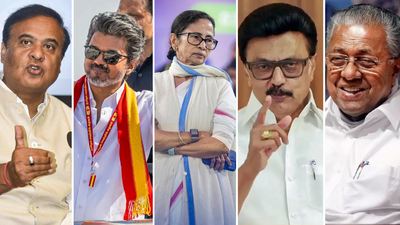
NEW DELHI: The tradition of exit polls is not new to election seasons, and once again it came into sharp focus this time when five legislative assemblies went to the polls in April, including West Bengal, Tamil Nadu, Kerala, Assam and the Union Territory of Puducherry. Based on surveys, sampling and field assessments, pollsters attempted to map the possible strength of incumbents as well as the prospects of opposition parties across these diverse political battlegrounds.However, when D-Day arrived on May 4, Monday and the high-stakes contest shifted from projections to results, a slightly different picture began to emerge.
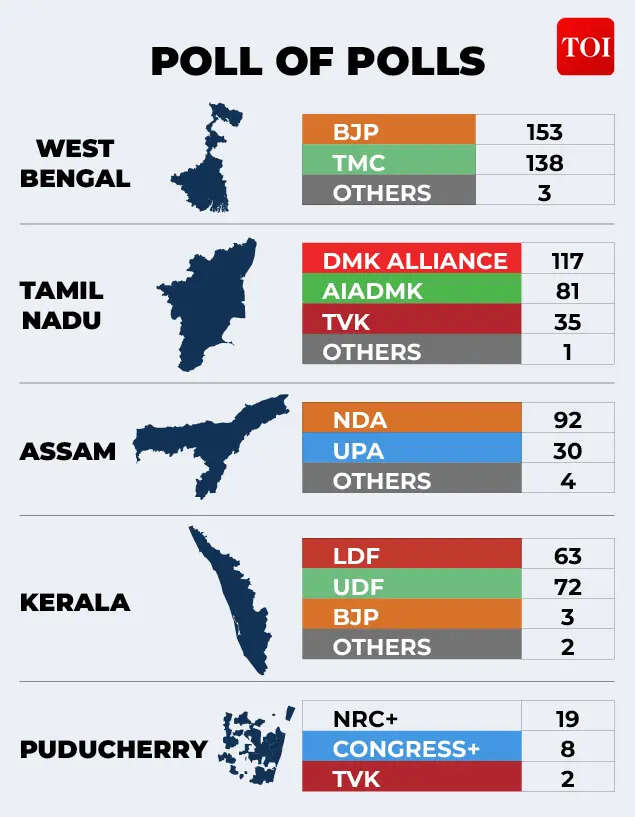
If anything, the outcome once again reinforced a familiar lesson of electoral politics: exit polls offer a snapshot of possibilities, not a perfect forecast of reality.
West Bengal
In country’s second-largest assembly, West Bengal witnessed a high-voltage electoral battle. Chief minister Mamata Banerjee’s deep-rooted grassroots influence was once again tested against a strongly mobilised BJP campaign led by the national leadership.Most exit polls had leaned towards a competitive race, with several projecting a slight advantage for the BJP, citing anti-incumbency sentiment and an exceptionally high voter turnout that crossed the 90 percent mark. While individual exit polls differed in their readings, the broader trend pointed to a sharply polarised electorate, split almost down the middle between the TMC and the Bharatiya Janata Party. The saffron camp, in particular, mounted an aggressive campaign and left no stone unturned in its bid to dent Mamata’s formidable citadel.If exit polls were to be believed, the BJP, once a peripheral force in West Bengal, appeared to have consolidated its position as the principal challenger, steadily eroding the dominance of the ruling TMC. At the same time, the TMC’s ability to retain parity in these projections suggested that the incumbent still commanded major grassroots support, particularly in key districts that recorded high voter turnout.Districts such as Purba Bardhaman, Hooghly, Nadia and Howrah witnessed robust voter participation, reflecting how deeply the electoral battle resonated on the ground across regions. In closely fought contests, such high turnout often injects an added layer of suspense, making outcomes harder to read and turning even near-even projections into uncertain verdicts.However, the final outcome painted a far more dramatic picture than expected. The BJP made significant inroads in the state, registering a historic breakthrough and ending what had been a long-standing political dominance. Mamata Banerjee’s camp suffered a major setback, with results showing a steep decline in its seat share.The saffron party surged well past the majority mark, while the ruling camp was reduced to a significantly smaller presence than anticipated. What exit polls had predicted as a narrow contest turned into a decisive mandate, reshaping West Bengal’s political landscape.
Tamil Nadu
Tamil Nadu unfolded as one of the most intriguing political stories of the cycle.A relatively new political outfit led by superstar Vijay, Tamilaga Vettri Kazhagam (TVK), emerged as a disruptive force, challenging the long-standing dominance of DMK and AIADMK, two parties that have traditionally defined the state’s political framework for decades. In Tamil Nadu, the electoral story unfolded in a more nuanced manner, with a bold projection by Axis My India drawing attention. Most exit polls indicated that the DMK-led alliance under chief minister M K Stalin was on course to retain power, albeit with a reduced margin compared to its 2021 performance. This marked a significant political moment in a state long defined by alternating mandates between the two Dravidian majors. A consecutive term in office would have signalled a rare degree of stability and voter endorsement in a landscape where incumbency has often struggled to endure.At the same time, the emergence of Tamilaga Vettri Kazhagam (TVK), led by actor-politician Vijay, introduced a fresh and unpredictable dimension to what had traditionally been a bipolar contest, subtly reshaping the contours of the electoral battle.However, the actual results shifted the narrative sharply. TVK delivered a stunning performance, securing a strong presence in triple digits and majorly altering the traditional two-party balance. Both DMK and AIADMK were pushed into a much weaker position than expected, reflecting a major political churn in the state.
Kerala
Kerala proved to be another closely watched contest, where most projections had hinted at a possible shift in power dynamics.Exit polls suggested a setback for the CPM-led Left Democratic Front (LDF) and a resurgence for the Congress-led United Democratic Front (UDF).While the poll of polls indicated a slight edge for the UDF with around 72 seats in the 140-member assembly, the LDF was projected to be not far behind at approximately 63 seats, pointing to a narrow margin that could easily shift depending on constituency-level variations. At the same time, divergent projections from agencies such as Axis My India and PMARQ specified the uncertainty embedded in the Kerala contest. While Axis My India pointed to a wider gap in favour of the UDF, PMARQ projected a majority for the ruling LDF, keeping the final outcome finely poised and far from settled.On counting day, that trend appeared to hold. The UDF emerged stronger than expected, overtaking the LDF and positioning itself as the leading force in the state, signalling a notable shift in voter preference.
Assam
Assam, in contrast, was seen as a more predictable contest in most projections.Exit polls from multiple agencies converged on a decisive outcome, indicating a sweep for the BJP under CM Himanta Sarma. The poll of polls suggested that the party was likely to secure around 90 seats, placing it comfortably ahead of the Congress, which was projected to remain near the 30-seat mark, while other parties were expected to account for only a small share of the assembly.The projections suggested a comfortable majority for the BJP-led alliance, reflecting continued support for the incumbent government. Early trends indicated a strong showing once again, with Sarma poised to extend his tenure in office on the back of a robust electoral performance.
Puducherry
In the Union Territory of Puducherry, exit polls pointed towards continuity rather than change.Chief minister N Rangaswamy’s position appeared stable, with projections indicating that the existing political arrangement was likely to remain intact.The overall picture suggested a continuation of the status quo, with no major disruption in the balance of power.







Leave a Reply