
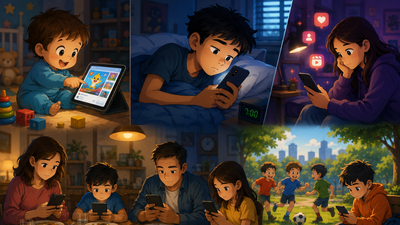
A toddler swipes across a screen before learning to hold a pencil properly. A teenager wakes up and reaches for Instagram before even getting out of bed. At dinner tables, family members sit together, but each is absorbed in a different digital world. Childhood, friendship, boredom, validation, many of life’s earliest experiences are now unfolding through a screen.Social media is no longer just an app on a phone. It has quietly become a parallel world where trends are born overnight, confidence is measured in likes and algorithms increasingly shape how young people think, feel and interact. A January 2026 report by research firm DataReportal showed that India now has nearly 500 million social media users, reflecting just how deeply digital platforms have woven themselves into everyday life.For a generation growing up online, the internet is not separate from reality — it is reality. Toddlers are glued to YouTube videos before they can properly speak, teenagers endlessly scroll through Instagram and Snapchat, and young adults remain constantly plugged into updates, trends and online validation. In many homes, screens have quietly replaced outdoor play, long conversations and moments of stillness.But while young users spend hours consuming content online, concerns are growing that social media, in many ways, is also consuming them in return.The concern has become serious enough for even the government to formally acknowledge it. India’s Economic Survey 2025-26 flagged digital addiction among children and young adults as an emerging challenge, warning that compulsive use of smartphones, social media, gaming and streaming platforms is affecting focus, sleep, academic performance and mental well-being.The survey linked excessive social media use among those aged 15-24 with anxiety, depression, low self-esteem and cyberbullying stress, while also warning about compulsive scrolling, social comparison and gaming disorders among adolescents. It also highlighted measures including CBSE guidelines on safe internet use, the Tele-MANAS mental health helpline, and the Online Gaming (Regulation) Act, 2025.So, how did a world designed to keep everyone connected become one of the biggest behavioural concerns of the digital age? Here’s a look through the experiences and insights shared by psychologists, parents and young users talking to TOI.
Childhood begins on a screen
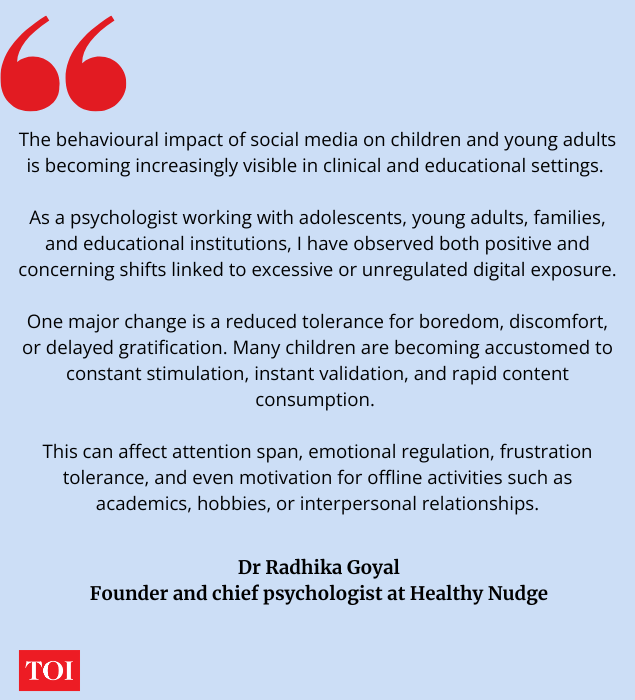
For many parents today, in busy routines and hectic schedules, phones and tablets often become an easy way to calm or distract restless children, helping parents manage daily tasks while kids are occupied.Children are learning to swipe before they learn to write. Nursery-age kids can navigate YouTube with ease, recognise logos and skip ads, but may struggle with sustained attention or direct communication.“The behavioural impact of social media on children and young adults is becoming increasingly visible in clinical and educational settings,” said Dr Radhika Goyal, founder and chief psychologist of Healthy Nudge.“One major change is a reduced tolerance for boredom, discomfort, or delayed gratification. Many children are becoming accustomed to constant stimulation, instant validation, and rapid content consumption,” she said, adding that this can affect attention span, emotional regulation and motivation for offline activities.
Parents, too, say these behavioural shifts are becoming noticeable at increasingly younger ages.Dr Ankita Ojha, who has a three-year-old son, said she has already noticed shorter attention spans, increased screen dependency and imitation of online behaviour because of YouTube and Instagram content. “It concerns me because early overexposure may affect emotional regulation, communication, focus and healthy social development,” she said.To note here is that, the concern is not simply screen time, but what it is replacing which is physical play, face-to-face interaction and opportunities for emotional learning.
Shrinking attention span
One of the most visible behavioural changes linked to social media is declining attention span.Short-form videos and endless scrolling have altered how young people consume information. Content arrives in rapid bursts. A joke in seconds, a dance trend in under a minute, breaking news condensed into a reel. Over time, constant stimulation can make slower activities such as reading, studying or long conversations feel less engaging.According to Dr Sapare Rohit, consultant psychiatrist, SPARSH Hospital, Yelahanka, Bangalore, shorter attention spans, fear of missing out, sleep disruption, irritability and a growing need for instant validation are now commonly observed among children and teenagers.“The most concerning part is not the use of social media itself, but unsupervised and emotionally dependent use,” he said.“When self-worth, behaviour, academics, sleep and real-life relationships start getting affected through online approval, it becomes a serious concern,” he added.Dr Rohit also pointed out that many teenagers begin imitating online trends, creators and behaviour patterns without fully understanding their consequences, especially when repeated exposure makes such behaviour appear normal or rewarding.Many teenagers themselves acknowledge how deeply online trends shape their interests and routines.15-year-old Rubal admitted, “Definitely social media influences my style and interests a lot. I like trying new ideas and outfits after watching creative reels.”
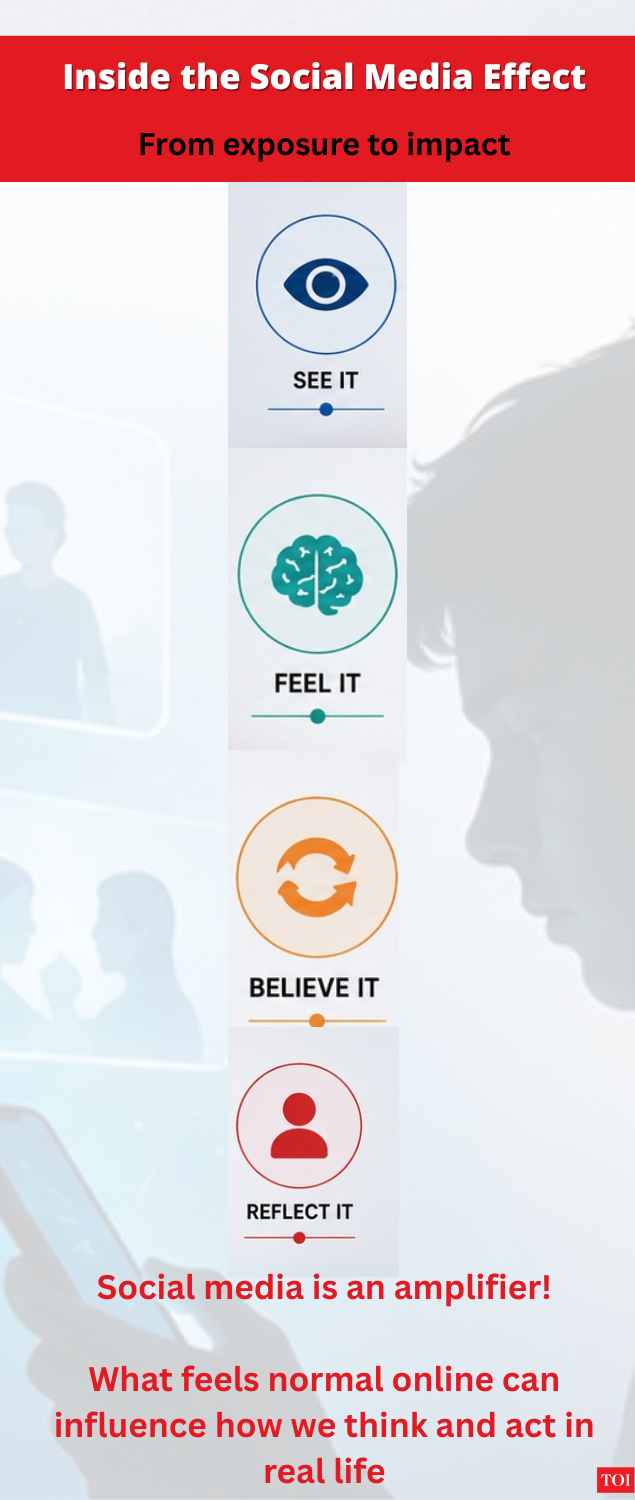
Anger, irritation and emotional dependency
Many parents describe a familiar scene: a child becoming angry or restless the moment a device is taken away.Excessive social media use can gradually turn screens into a coping mechanism for boredom, loneliness or stress. Over time, young users may become more irritable, impatient or emotionally reactive when disconnected.Dr Rohit said emotional dependency on screens often develops slowly, with social media gradually becoming a source of comfort, distraction and emotional validation for many young users.Teenagers also face constant comparison online. Appearance, popularity, lifestyle and achievements are displayed in curated form, often creating pressure to fit in or seek validation through likes and comments.Dr Goyal said adolescents today are constantly exposed to “curated lifestyles, beauty standards, achievement culture and influencer-driven narratives”, which can contribute to anxiety, low self-esteem, body image concerns and feelings of inadequacy.
A generation connected, yet isolated
Ironically, even as social media promises connection, many believe it is weakening real-world social interaction.Families often sit together while each member scrolls through separate screens. Friends meet physically but remain mentally occupied online. Conversations are shorter, attention is divided and silence is quickly filled by a phone.Digital interaction cannot fully replace emotional learning that comes through real experiences, including eye contact, empathy and face-to-face communication.For many teenagers and young adults, the impact is less about screen time alone and more about the constant awareness of what others are doing online.As 19-year-old Garv Chhabra put it, “At this age we get easily distracted by what others are doing on social media because it constantly gives updates about people’s daily lives.”At the same time, many young users also feel adults often overlook the benefits social media brings.As Dr Goyal noted, many young people today are growing up in a world where online and offline life are “deeply intertwined”, making it unrealistic to completely separate the two. “At the same time, social media is not entirely harmful. It can provide connection, creativity, educational access, peer support and mental health awareness,” she said.For many teenagers, online spaces also become places of belonging and expression, especially when offline support systems feel limited.
Darker side
While social media has its use, the risks extend beyond behavioural changes, raising questions around influence to extreme and even criminal behaviour.Cyberbullying, exposure to violent or inappropriate content, online harassment and dangerous internet trends have become major concerns for parents and educators. Young users are often exposed to information or influences they may not yet be emotionally equipped to process.“There is some truth to concerns around online content influencing extreme behaviour, but it is not the full picture,” Dr Rohit said.
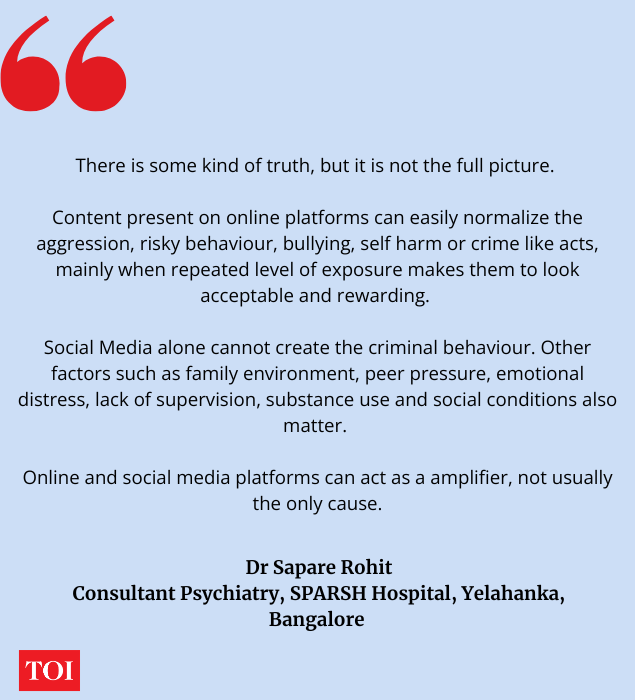
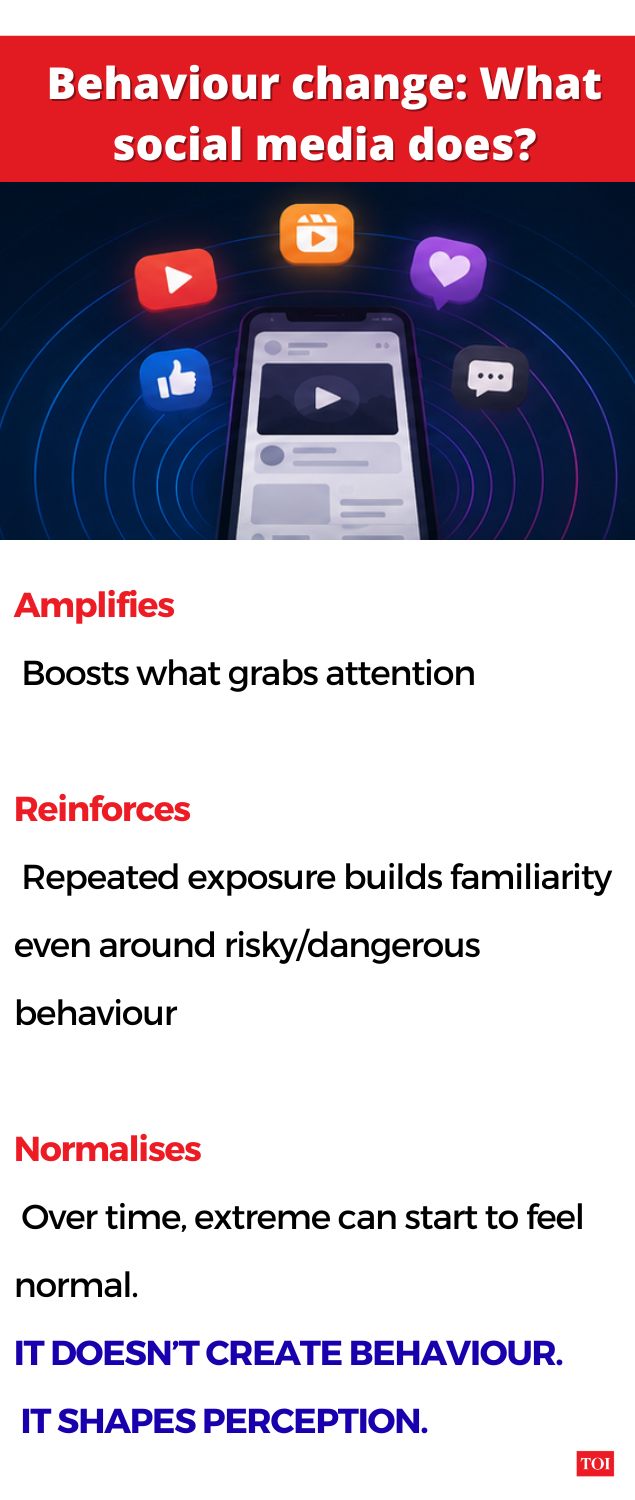
He said repeated exposure to aggression, bullying, risky behaviour or harmful trends online can gradually normalise such behaviour, especially among emotionally vulnerable teenagers.“Social media alone cannot create criminal behaviour. Other factors such as family environment, peer pressure, emotional distress, lack of supervision, substance use and social conditions also matter. Online platforms can act as an amplifier, not usually the only cause,” he added.Mental health professionals warn that emotional dependency can become more intense when algorithms continuously reinforce similar content.According to Dr Goyal, adolescents remain particularly vulnerable because emotional regulation, impulse control and long-term decision-making abilities are still developing during teenage years.She further warned that algorithms can reinforce emotions quickly, pushing vulnerable users towards aggressive ideologies, harmful coping mechanisms or unhealthy online communities.Kashish, 22, said social media often creates emotional pressure and self-doubt among young users. “People have become overly focused on likes, views and followers which is increasing dependency on validation from others,” she said, adding, “Often people feel mentally stressed or lonely but still pretend everything is normal online.”
Parents’ role
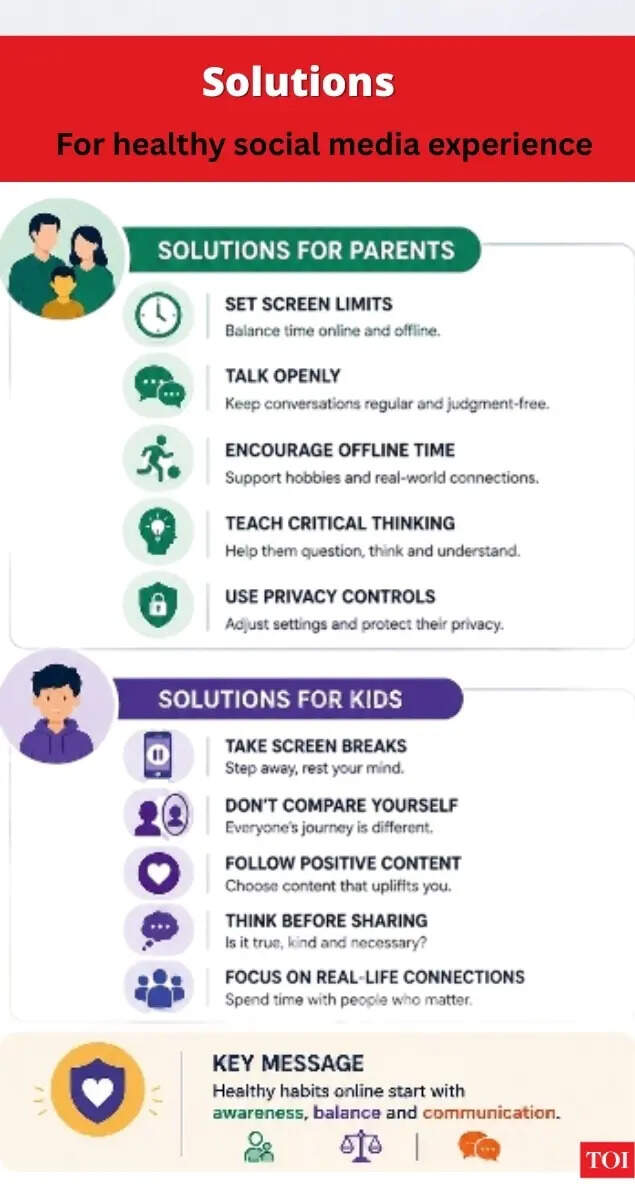
The solution is not simply banning phones or deleting apps. Technology is now deeply embedded in education, communication and modern life. The challenge lies in creating balance.And that balance often begins at home.Parents are increasingly being advised to monitor not just their children’s screen habits, but their own. Children tend to imitate adult behaviour. A household where parents are constantly on devices makes digital boundaries harder to enforce.“Children learn more from observation than instruction,” Dr Goyal said, stressing that parents need to model healthier screen habits themselves.Several parents said the impact of social media at home often feels mixed rather than entirely negative.One parent, with a 19-year-old son, said social media had positively influenced his dressing sense and health awareness through fitness content online.However, she also pointed to reduced attention span, irritability, sleep disturbance and reduced physical activity as growing concerns.Dr Rohit said, “Constant use of phones should be avoided by adults in front of children,” while emphasising simple habits such as phone-free meals, limited screen time before bed, outdoor activities and regular family conversations.
Communication over control
Children and teenagers are more likely to discuss online problems, including bullying, disturbing content or peer pressure, when they feel safe from immediate punishment or judgement.Dr Goyal said parents need to move from “surveillance-based parenting to relationship-based parenting”.Open conversations around internet safety, emotional impact, online validation and critical thinking, she said, are becoming essential in modern parenting.Some parents say staying involved works better than strict restrictions.Alpana, parent of a 15-year old, said, “I have not restricted her use of social media but clearly set boundaries,” she said, adding that she often stays involved in what her daughter watches online to help keep her feed safer and positive.Schools, Dr Goyal added, also have a major role to play. Beyond academics, digital literacy, emotional regulation, cyber safety and media awareness are increasingly being seen as necessary life skills.Dr Rohit similarly stressed that children should be taught mindful usage habits early, including limiting notifications, avoiding late-night scrolling and learning to recognise harmful or manipulative online behaviour.
Reclaiming time away from screens
Sports, music, reading, art, outdoor play and hobbies not only reduce screen dependence but also improve emotional and cognitive development. For younger children in particular, delaying unnecessary exposure to personal devices for as long as possible can help build healthier habits early on.However, parents say maintaining those boundaries consistently, however, is often easier said than done.Shuchi Mahajan, mother of a 13-year-old, described managing screen time as “a constant battle”. “I try to set a one-hour limit to screen time. However, kids these days have access to multiple screens,” she said.“I am not always successful, but I try to stay actively involved in her day-to-day life and always make sure I am available whenever she has an emotional meltdown,” she added.Mental health professionals say balance, rather than complete restriction, remains the key.Dr Rohit said young users should be encouraged to follow positive content, maintain healthy offline relationships and actively engage in hobbies and outdoor activities alongside digital engagement.“The goal is well-guided, mindful use, not complete disconnection,” he added.
More than an app, but not all bad
Social media is not disappearing. It has transformed communication, entertainment and even education. For many, it is also a space to learn, express themselves, discover opportunities and stay connected with friends and communities.From educational videos and skill-based content to support groups and creative platforms, social media can offer young users exposure, awareness and access that earlier generations did not have.For teenagers especially, it often becomes a place to build friendships, share experiences and feel part of a wider world.But as its role in everyday life grows, so do concerns over how deeply it shapes behaviour, attention, emotions and self-worth.“The goal should not be complete disconnection, but healthier and more conscious engagement,” Dr Goyal said.Dr Rohit similarly stressed that the focus should remain on guided and balanced usage rather than fear-driven restrictions, particularly because social media is now deeply integrated into communication, education and everyday social life.Thus, for parents, it’s key to understand, the answer lies not in fear or blanket bans, but in awareness, communication and balance. Encouraging offline activities, setting healthy boundaries, talking openly about online experiences and leading by example can help children develop a healthier relationship with technology.Because in a world increasingly shaped by algorithms, it’s important to ensure screens do not replace childhood itself.







Leave a Reply