
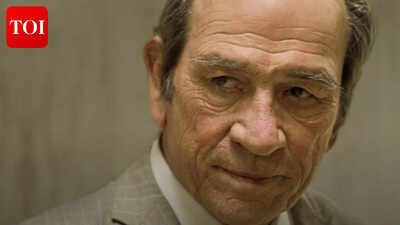
Tommy Lee Jones didn’t just become an actor. He became a craftsman. From ‘Coal Miner’s Daughter’ to ‘The Fugitive’ to ‘No Country for Old Men’ to ‘Lincoln’ to ‘Men in Black.’ He has been in some of the most celebrated and enduring films in American cinema. He won the Academy Award. He was nominated for the Golden Globe. He has been one of the most respected and quietly formidable presences in Hollywood for five decades. He did Westerns. He did thrillers. He did drama. He did action. He transitioned from actor to director without announcing it to the world, without a press campaign, without fanfare. He simply did it, and he did it well. He studied his craft not in a classroom but on set, watching, absorbing, learning from every director who ever hired him. And through all of it, he arrived at a piece of wisdom so practical and so clean it almost sounds too simple. Thus, he once said, “I’ve seen 50 different sets of mistakes and 50 different ways of achieving. You just leave the bad part out.”
Quote of the day by Tommy Lee Jones
“I’ve seen 50 different sets of mistakes and 50 different ways of achieving. You just leave the bad part out.”Tommy Lee Jones said this during a print interview with The Daily Telegraph, given to promote the UK release of ‘The Three Burials of Melquiades Estrada,’ his theatrical directorial debut. This wasn’t a reflection on acting. This was Tommy Lee Jones explaining, with characteristic economy of words, how a man becomes a director without ever going to film school. His education, he said, came from paying attention. From spending decades on movie sets alongside more than fifty different directors and watching all of them closely. The good choices and the bad ones. The inspired decisions and the costly errors. All of it filed away. All of it studied. And when his own moment came to step behind the camera, he knew exactly what to take with him and exactly what to leave behind. The full quote makes the thinking even clearer: “I’ve worked with more than 50 directors and I’ve paid attention since day one. That’s pretty much been my education, apart from studying art history and shooting with my own cameras. I’ve seen 50 different sets of mistakes and 50 different ways of achieving. You just leave the bad part out.”
What does it actually mean?
Tommy Lee Jones is describing one of the most underrated forms of education that exists. Learning by watching. Most people think of learning as something that happens in a formal setting. A classroom. A course. A structured programme with a teacher standing at the front and a syllabus telling you what comes next. But Jones is pointing to something older and in many ways more powerful than any of that. The kind of learning that happens when you are genuinely present, genuinely paying attention, and genuinely curious about how the person in front of you is doing what they are doing.He didn’t just show up to sets and do his job and go home. He watched. He studied every director he worked with as if they were a text he needed to understand. Not just what they got right, but what they got wrong. Because both are instructive. In some ways, the mistakes are more instructive than the successes. A success can happen for many reasons, some of them accidental. But a mistake reveals something precise. It shows you exactly where a decision broke down, exactly where judgment failed, exactly what not to do when you are standing in that same position.The line “you just leave the bad part out” is the most Tommy Lee Jones sentence imaginable. Blunt. Efficient. No decoration. No self-congratulation. Just the plain truth of how mastery actually works. You accumulate. You observe. You filter. You keep what serves you and you discard what doesn’t. That’s it. That’s the whole method.What makes this especially remarkable is the patience it required. He wasn’t in a hurry to direct. He spent decades in the passenger seat, learning the road, before he decided to drive. And when he did, ‘The Three Burials of Melquiades Estrada’ won the Best Actor prize for its lead and the Best Screenplay prize at the Cannes Film Festival. The education worked.
Who is Tommy Lee Jones?
Tommy Lee Jones was born on September 15, 1946, in San Saba, Texas, and grew up to become one of the most distinctive and decorated actors in the history of American film. He studied at Harvard University, where he was roommates with Al Gore and played on the university’s football team, graduating with a degree in English in 1969. He moved to New York after graduation to pursue acting, building his early career on stage and in television before breaking into film.His film career spans an extraordinary range. He appeared in ‘Coal Miner’s Daughter,’ ‘Eyes of Laura Mars,’ and ‘The Executioner’s Song’ before his profile rose sharply through the 1990s. He won the Academy Award for Best Supporting Actor for his role as US Marshal Samuel Gerard in ‘The Fugitive’ in 1993, a performance of controlled intensity that became one of the defining roles of that decade. He went on to star in ‘Natural Born Killers,’ ‘Batman Forever,’ ‘Men in Black’ and its sequels, ‘No Country for Old Men,’ ‘In the Valley of Elah,’ ‘Lincoln,’ and ‘The Homesman,’ which he also directed.He made his theatrical directorial debut with ‘The Three Burials of Melquiades Estrada’ in 2005, a film he also starred in, which earned widespread critical acclaim and major prizes at Cannes. It was proof that all those decades of watching had amounted to something. Not a shortcut. Not luck. Just attention, patience, and the discipline to leave the bad part out.






Leave a Reply