
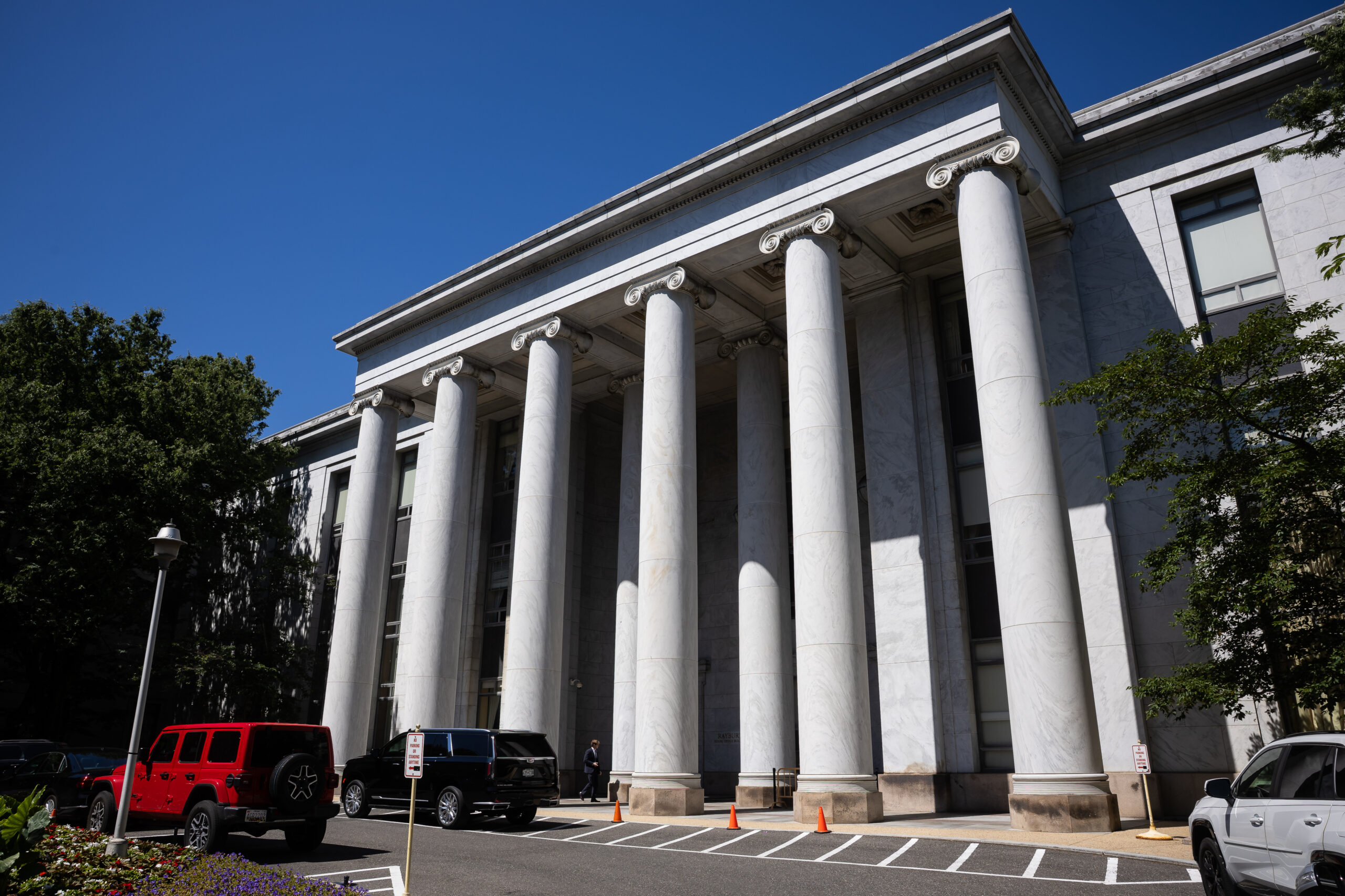

There’s a 2.4-million-square-foot ticking time bomb on Capitol Hill, and lawmakers are dithering over how to deal with it as anxieties rise over the massive costs and disruptions involved.
The Rayburn House Office Building has never undergone a full renovation since it opened in 1965, and as plans for a massive revamp of Congress’s largest office complex keep getting pushed off, key systems are routinely failing and expensive piecemeal repairs are weighing on the legislative branch budget.
Architect of the Capitol Thomas Austin has been warning lawmakers about the risk of “catastrophic system failures” in the hulking Rayburn building — home to nearly 200 member offices, committee hearing rooms, secure information facilities, a police firing range and some 1,600 parking spaces.
“As these facilities age and kind of reach this tipping point, we start having an increasing number of failures as all these systems age out and we start having series of failures on top of each other,” he told the House Administration Committee at a hearing Wednesday.
Austin’s agency is estimating a total overhaul of the building could approach $9 billion and require more than a decade of work — the largest project ever undertaken by the Architect of the Capitol and nearly an order of magnitude bigger than any previous renovation project on the Hill.
House Administration Chair Bryan Steil (R-Wis.) called the cost estimate “eye-popping” as Austin laid out the case for the project. The price tag far outstrips even the cost of the newest NFL stadiums.
The topline number is only one reason why lawmakers involved at this early stage are growing nervous. The renovation would require much of the building to be vacated, and officials insist it can’t be done wing by wing. That’s how the Cannon House Office Building down the block was recently renovated in a nearly $1 billion project that took nearly a decade and upended congressional operations.
Among other things, redoing Rayburn means finding — or building — space for scores of member offices and committees to set up shop. The working timelines for the project are so long — approaching 20 years — that many lawmakers simply assume they won’t be around to enjoy the finished project, or even a groundbreaking.
House appropriators so far are wary of providing the cash needed even for the early planning stages.
Austin has only been in the job for a year, but his agency has a long track record of construction projects going over budget. The Cannon renovation went nearly $200 million over its estimated cost, and the post-9/11 construction of the Capitol Visitors’ Center ultimately cost double what was planned.
“We’re not going to go blow $8 or $10 billion of taxpayer money without our own proper understanding of the evidence and making our own conclusion,” Rep. Nick LaLota (R-N.Y.), a member of the appropriations subcommittee which oversees funding for the legislative branch, , said in a Wednesday interview. ”We won’t be a rubber stamp for the AOC.”
The staggering price tag is driven by a host of factors, including that Rayburn is nearly three times the size of Cannon and there is a need for vast remediation of toxic materials. Austin told lawmakers Wednesday that the postwar era of Rayburn’s initial construction “was kind of that sweet spot where we’re using both asbestos and lead in our buildings.”
But the costs of waiting are also substantial. In the past year 16 major water leaks impacted member offices, committee offices, storage areas and hallways — each costing millions of dollars to remedy. In some cases, the leaks displaced lawmakers and staff for months.
“We all know that the longer you put off those repairs that you need to deal with at your home or your business or anywhere, the more expensive they get and then more profound those problems become,” New York Rep. Joe Morelle, the top Democrat on the House Administration Committee, said Wednesday. “Unless Congress acts, we will continue pouring millions of taxpayer dollars into temporary fixes instead of addressing the underlying problem.”
Austin told the panel he was sensitive to the cost concerns but said the five-phase approach to the Cannon renovation was “inefficient and disruptive” and should not be replicated with Rayburn. He also said it should be harder to change renovation plans once the project gets underway, something that plagued the Cannon project.
“We have to use every little bit of experience from Cannon to make sure that the same — I won’t say disaster, but the same cost overruns — don’t occur with Rayburn,” Rep. Greg Murphy (R-N.C.) warned Austin at Wednesday’s hearing.
The Architect of the Capitol’s proposal for displaced Rayburn occupants involves building a new permanent structure that could be used for “swing space” then for other purposes once the renovation is complete.
Republicans on the House Appropriations Committee provided some funding for planning of the Rayburn renewal project but not for design of “swing space” that will be critical for the project to move forward.
“I think there’s a lot of questions about that, and members don’t feel like they signed off,” House Appropriations Chair Tom Cole (R-Okla.) said in an interview. “I expect to not be in Congress by the time this happens so I’m not terribly worried about it.”
As for where that new building may sit, Austin said he is waiting for its eventual users to weigh in.
“We’ll put it where Congress tells us to put it,” he told the panel Wednesday. “We’re still waiting for Congress’s decision and consensus guidance on that.”
Rep. Barry Loudermilk (R-Ga.) made clear Austin shouldn’t hold his breath, saying it “may happen in the next month, maybe the next 250 years, before we get to it.”





![‘Dhamaal 4’ box office collection Day 15 [LIVE]: Can Ajay Devgn and Arshad Warsi’s slapstick comedy film cross Rs 140 crore this third weekend? | Hindi Movie News](https://onlinechhattisgarh.com/wp-content/uploads/2026/07/dhamaal-4-day-15-box-office-collection-image-credits-imdb.jpg)

Leave a Reply