
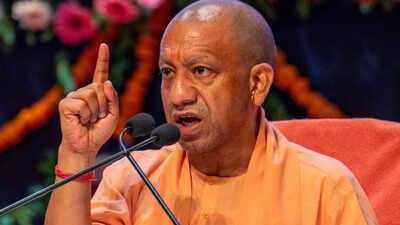
For Yogi Adityanath, law and order was never merely governance. It has always been central to his political image. The imagery of a saffron-clad monk governing India’s most populous state with an iron administrative grip has remained one of the defining motifs of contemporary Uttar Pradesh politics.The “Bulldozer Baba” image, once used derisively by the opposition, has since been appropriated by the UP administration as a badge of honour. It carries a simple message: the state intends to project zero tolerance towards criminality and illegal activity. But political rhetoric often travels far ahead of official evidence.
The politics of law and order
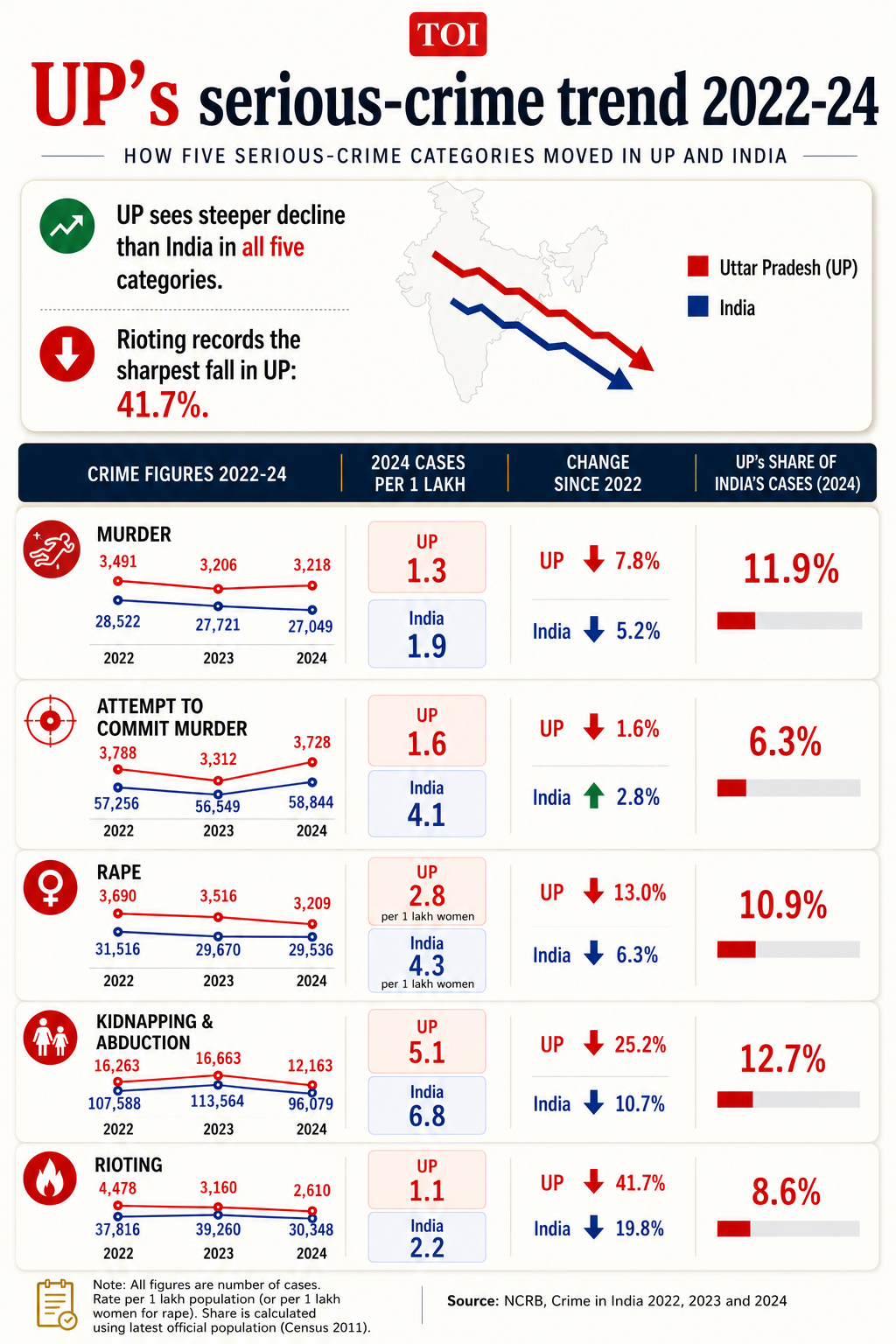
So a TOI analysis of five selected categories from National Crime Records Bureau violent-crime tables was undertaken to examine how Uttar Pradesh has performed on some of the most sensitive crime indicators. The categories examined were murder, attempt to commit murder, rape, kidnapping and abduction, and rioting.The result is emphatic.
.
The data shows UP outperformed the national trend in all five categories between 2022 and 2024. In four categories, the decline was sharp and consistent. In the fifth, attempt to murder, the decline was modest, though India as a whole recorded an increase during the same period.
The NCRB caveat
However, every NCRB dataset comes with an important caveat. NCRB numbers reflect police-recorded crime, not the total incidence of crime. Better registration can push numbers upward. Underreporting can pull them downward.There is also a 2024-specific caveat. NCRB notes that after the new criminal laws came into force from July 1, 2024, its data formats were revised to collect IPC and BNS cases separately, while police and court disposal were tabulated collectively for comparability. It also says some shifts in overall numbers may reflect legal reclassification. So the trend is useful, but it should not be read as a pure policing outcome without allowing for changes in reporting and classification.Even with those caveats, the broad direction of the UP trend is difficult to miss.
Rioting sees the sharpest fall
The sharpest decline among the five categories comes in rioting. UP recorded 4,478 rioting cases in 2022. The number fell to 3,160 in 2023 and then further to 2,610 in 2024. That represents a 41.7% decline in two years. Nationally, rioting cases declined from 37,816 to 30,348, a smaller fall of roughly 19.8%.Few crime categories carry as much symbolic weight in Uttar Pradesh as rioting. Memories of communal violence in places like Muzaffarnagar in 2013 still shape political narrative in the state. Governments in UP have long been judged through the prism of curfews, communal flare-ups, caste clashes, street violence and administrative paralysis.Adityanath’s government has repeatedly projected itself as the regime that restored fear of the law. Critics, meanwhile, describe the same policing style as selective, aggressive and deeply intertwined with muscular majoritarian politics.Kidnapping and abduction, the largest category in this basket, also shows a steep decline. UP’s count rose slightly from 16,263 in 2022 to 16,663 in 2023 before falling sharply to 12,163 in 2024. That marks a 25.2% decline from 2022. Nationally, kidnapping and abduction cases fell 10.7% during the same period.The category itself is broader than its popular image. NCRB classifications include cases linked to elopement and marriage disputes, not merely violent abductions. Even so, the downward movement remains politically significant because kidnapping is among the crimes that shape public fear most directly.
Decoding the rape numbers
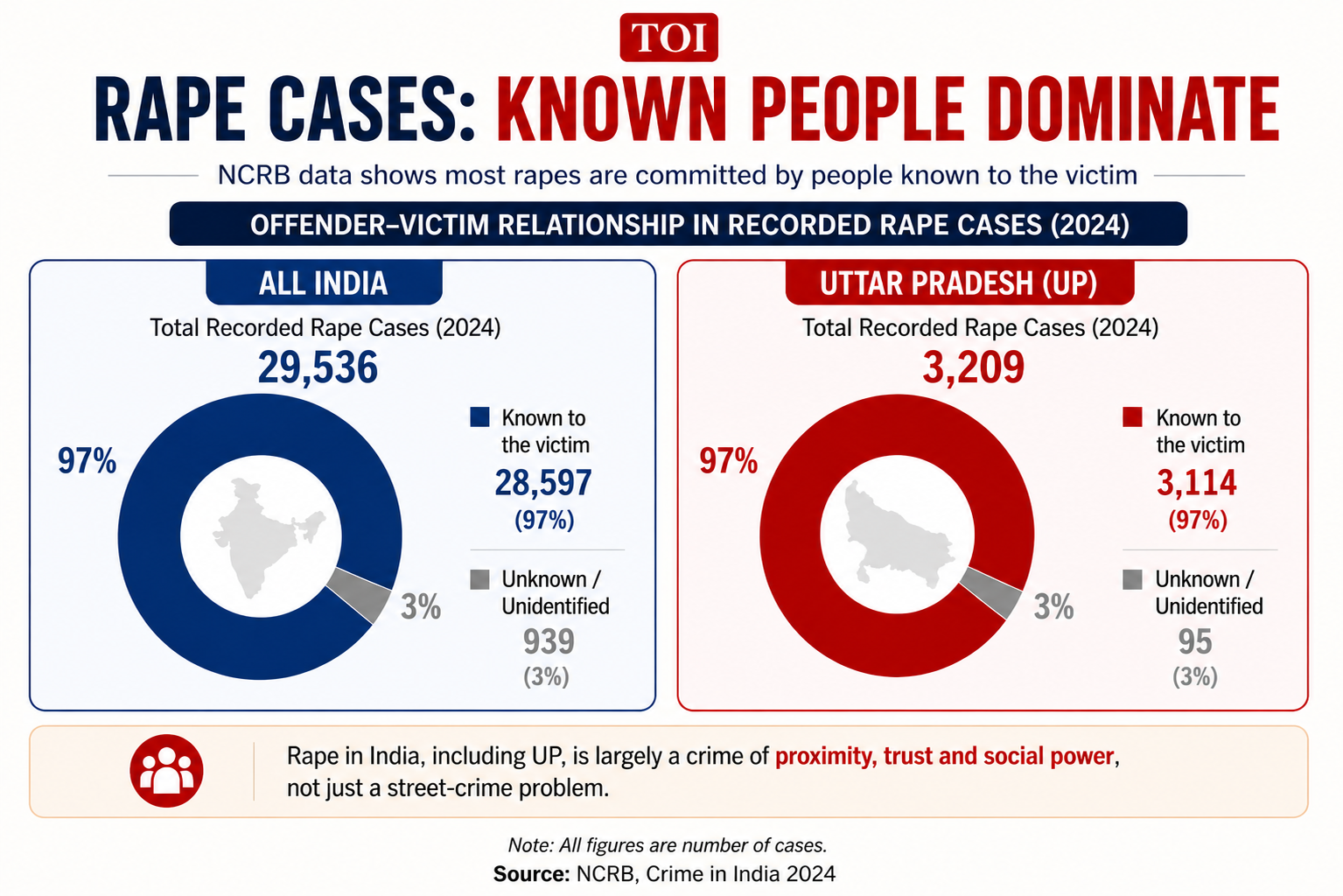
The rape figures tell a more layered story.UP recorded 3,690 rape cases in 2022, 3,516 in 2023 and 3,209 in 2024. That is a decline of 13%. Nationally, recorded rape cases fell 6.3%, from 31,516 to 29,536.At first glance, the numbers appear reassuring. But the deeper NCRB tables reveal a darker pattern that extends far beyond Uttar Pradesh.In 2024, of UP’s 3,209 recorded rape cases, the accused was known to the victim in 3,114 cases. Unknown or unidentified offenders accounted for only 95 cases. Nationally too, NCRB data shows the same pattern. Of India’s 29,536 rape cases, offenders were known to the victim in 28,597 cases.
.
The dominant public image of sexual violence still revolves around the stranger lurking outside. NCRB’s tables tell a very different story. In most recorded cases, the violence comes not from strangers, but from familiarity.Which means a decline in recorded rape cases cannot automatically be read as a complete resolution of women’s safety concerns.
The weak link
Murder presents a steadier pattern.UP recorded 3,491 murder cases in 2022, 3,206 in 2023 and 3,218 in 2024. The figure rose slightly last year, but still remained 7.8% below the 2022 count. Nationally, murder cases declined 5.2% during the same period. Murder data is often treated as relatively more reliable because homicide leaves behind physical evidence and is harder to conceal entirely from official records.Attempt to commit murder remains the state’s weakest category among the five examined.UP recorded 3,788 such cases in 2022, 3,312 in 2023 and 3,728 in 2024. That still leaves the state 1.6% below its 2022 count. India, meanwhile, recorded a 2.8% rise, from 57,256 to 58,844.So while UP still performs better than the national trend, the category does not show the same clean downward trajectory visible in rioting or kidnapping.Uttar Pradesh is India’s most populous state. Absolute numbers alone can distort perception. According to NCRB’s 2024 projections, UP had a population of roughly 2,388.8 lakh against India’s 14,049.1 lakh, or around 17% of the country’s total population.Yet in all five selected categories, UP’s share of national cases remained below that population share. UP accounted for 11.9% of murders, 6.3% of attempt-to-murder cases, 10.9% of rape cases, 12.7% of kidnapping and abduction cases, and 8.6% of rioting cases.The rate comparison also favours the state. In 2024, UP recorded 1.3 murders per lakh population against India’s 1.9. Attempt to murder stood at 1.6 against roughly 4.1 nationally. Kidnapping and abduction was 5.1 against India’s 6.8. Rioting stood at 1.1 against 2.2 nationally. Rape, calculated per lakh women population, stood at 2.8 against India’s 4.3.
Politics versus perception
DGP Rajeev Krishna has cited the 2024 NCRB figures as evidence that UP’s policing model is working. The government has increasingly leaned on NCRB statistics to counter the opposition’s attacks.The opposition remains unconvinced.Samajwadi Party chief Akhilesh Yadav has repeatedly accused the BJP government of masking insecurity behind spectacle. His critique focuses less on NCRB trendlines and more on police encounters, selective enforcement, women’s safety and whether state power is applied evenly across communities and political affiliations.Both readings find resonance because crime data is not only about dry numbers. It is also about how a citizen feels.Yet one trend remains difficult to ignore. Across five major categories, UP’s recorded serious-crime trajectory has outperformed the national curve between 2022 and 2024. That gives the Yogi government substantial political ammunition.However, NCRB figures remain, ultimately, a measure of recorded crime, not the complete geography of fear. That gap between statistics and lived experience is where the political battle over law and order in Uttar Pradesh will continue to unfold.







Leave a Reply