

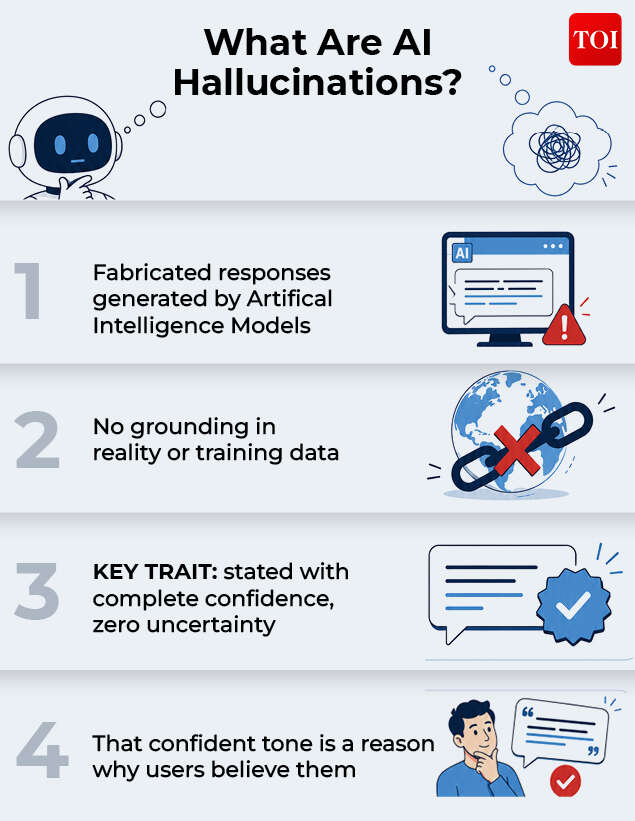
Hallucinations have recently been used to refer to a typical behavioral pattern that Generative Artificial Intelligence (AI) models exhibit.AI hallucinations occur when a model generates a completely fabricated response. The plausible yet false answers have no ground in reality, or training data.The most peculiar aspect of these hallucinations is the tone: the response, though misleading and invented, sounds completely confident. These responses show no shred of uncertainty, which often makes users inclined to believe the misinformation.From recommending users put glue on their pizza to making up summer reading lists of books that do not exist (which made its way to a newspaper! ), AI hallucinations have been the subject of internet virality innumerable times over the past few years.This strange phenomenon warrants dissection.
WHAT ARE AI HALLUCINATIONS
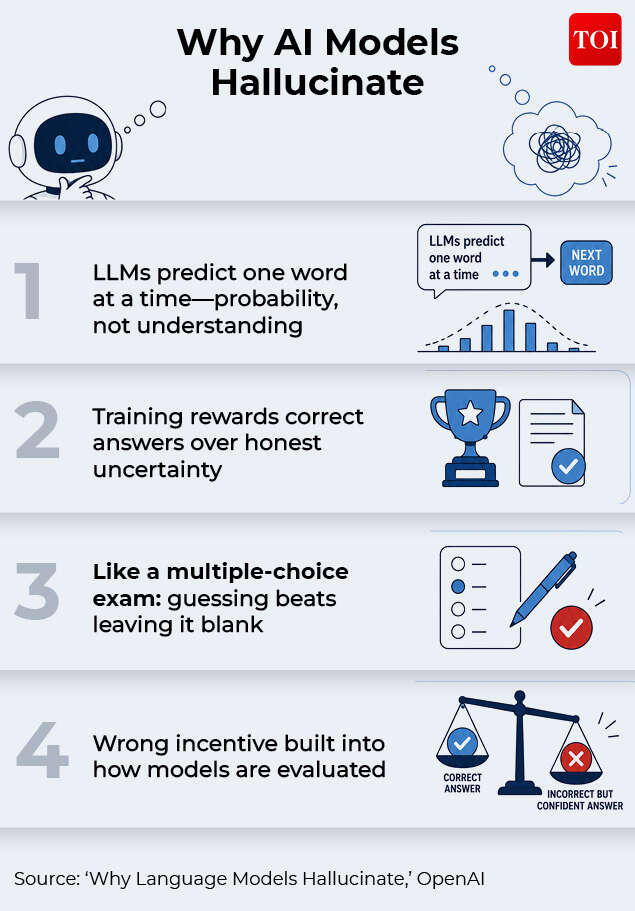
Why AI models hallucinateLanguage models hallucinate because standard training and evaluation procedures reward guessing over acknowledging uncertainty, suggests a research paper published by scholars at OpenAI titled: ‘Why language models hallucinate.’The paper explains it with an analogy: the multiple-choice question. A wild guess on an unknown question might be correct if luck is on one’s side. Leaving it blank on the other hand? That guarantees a zero. Large Language Models (LLMS) are graded similarly, based on accuracy and the percentage of questions they get right.This current evaluation method sets the wrong incentive, one that encourages guessing rather than an honest expression of uncertainty.Furthermore, language models respond to prompts by predicting one word at a time. It is simply a question of probability and patterns. Mistakes are inevitable in such a process.
WHY AI MODELS HALLUCINATE
Worrisome patternsIn October 2024, Associated Press published an investigation on the usage of OpenAI’s transcription tool Whisper in hospitals. It said that despite being pushed as having “human level robustness and accuracy,” Whisper was often prone to making up chunks of text and even entire sentences that were never said in the first place.Despite OpenAI’s warning about not using Whisper in “high-risk domains,” it was found to be used to transcribe doctor-patient consultations anyway, as it enabled medical providers to save time on report writing and note taking.“Those experts (more than a dozen software engineers, developers and academic researchers) said some of the invented text — known in the industry as hallucinations — can include racial commentary, violent rhetoric and even imagined medical treatments,” stated the report.The issue with AI-powered transcriptions is not just fabrication, but also bias. In the words of American linguist Mary Bucholtz, “All transcripts take sides, enabling certain interpretations, advancing particular interests, favoring specific speakers.”In May 2026, the accounting firm Ernst & Young (EY) retracted a report flagged for citation errors, fake footnotes and statistics suspected to be hallucinated by AI. EY Canada’s cybersecurity report on loyalty program safeguards had referred to studies that simply did not exist, revealed an investigation by GPTZero, an AI-detection startup.The report titled ‘Chasing the hallucinations’ suggested how contradicting references, low-quality sources and out-of-date statistics are all AI indicators. The report ended with a warning: “Fake information poisons the well and misleads future researchers, especially when published by a major consulting firm. Claude, ChatGPT, Perplexity all surface hallucinations from EY’s flawed report.”
WHEN AI FAKES ITS SOURCES
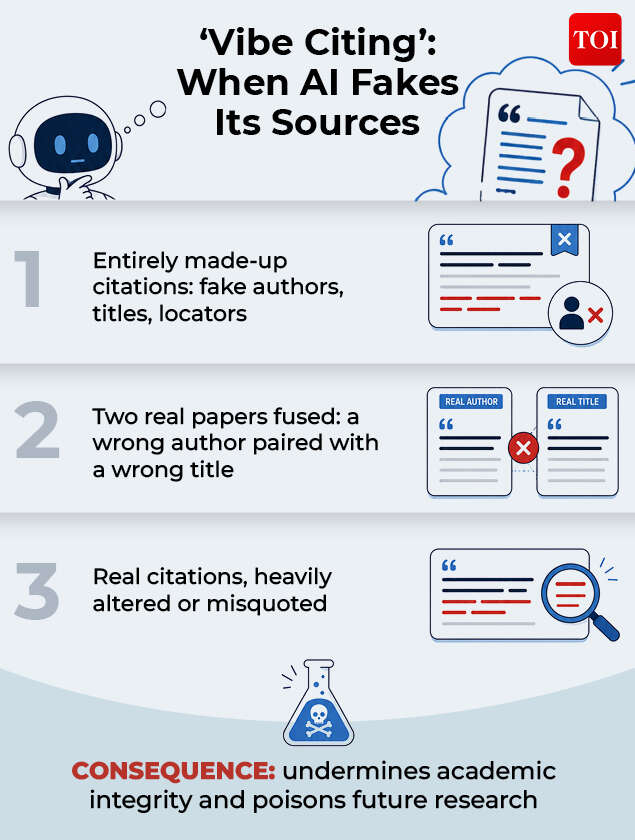
How AI hallucinations affect academics, researchers“On a number of occasions when I asked for references of books or Supreme Court cases, AI hallucinated and confidently provided incorrect citations which initially appeared accurate. But when I started checking from original sources, I found them inaccurate,” said Prof (Dr) Anand Pradhan of Indian Institute of Mass Communication. “A few times, it also confused the explanations of particular theories with the work of other scholars.”Researchers at GPTZero coined the term ‘vibe citing’ to refer to how generative AI models create citations or academic references that appear to be credible but are either misattributions or complete fabrications.They have classified this phenomenon into three distinct patterns, where human errors are exempt:
- Entirely fabricated citations (fake authors, title or container/locators)
- Two or more real references fused or misaligned (authors of one paper paired with the title of another)
- Real citations, heavily altered or paraphrased
Hallucinated citations not only call the integrity of the concerned work into question but also serve as a threat to the future of academia and research as a whole.A Master’s student speaks of persistent unease caused by the unreliability of AI-generated academic responses. “Gemini links the websites from which it generates its summaries. However, there have been so many times when I’ve tried to access the link but it ended up not being open source so I couldn’t fact-check. Other times, I see the website saying something completely different,” said Ushasi Chowdhury, who is pursuing a Master’s degree in English literature at Loreto College, Kolkata.Ushasi said that whenever a concept in literature or philosophy needs to be referenced, a simple Google search helps find websites for a quick and comprehensive understanding. Now that Google provides an AI-generated overview, sometimes it is convenient to read it from there, especially when there is a rush.“Constantly referring to 5 different books is a tedious process, sometimes I end up just going by what the Google AI-summary says,” said the literature student. “It cannot be a blind trust but I am presented with an illusion of reassurance during circumstances where I don’t have time to look through a lot of sources.”Dr Pradhan said that AI seems to be gradually improving accuracy. Even so, it is not yet 100% accurate and its responses still need to be verified, especially in journalism, academic and research contexts, warns the professor.
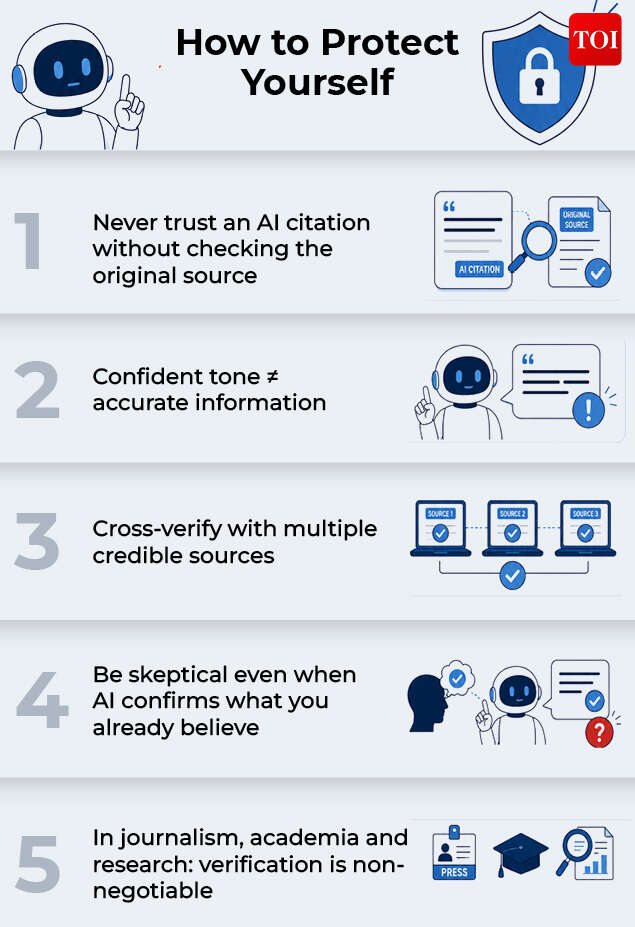
HOW TO PROTECT YOURSELF
Questioning and verification in the age of AIIt is established that any and all Artificial Intelligence models will sometimes confidently state falsehoods. At the same time, regarding convenience and haste, AI is invincible and cannot be done away with, says a growing consensus.Tools of media literacy prove useful in this predicament.What can help one mitigate the inaccuracy and misinformation is simply a process of vigorous, thorough fact-checking and verification. Not to trust any response given by an AI model blindly, no matter how plausible it sounds or how authoritatively the information it expressed—even, and especially, if it supports one’s preexisting notions.


Leave a Reply