
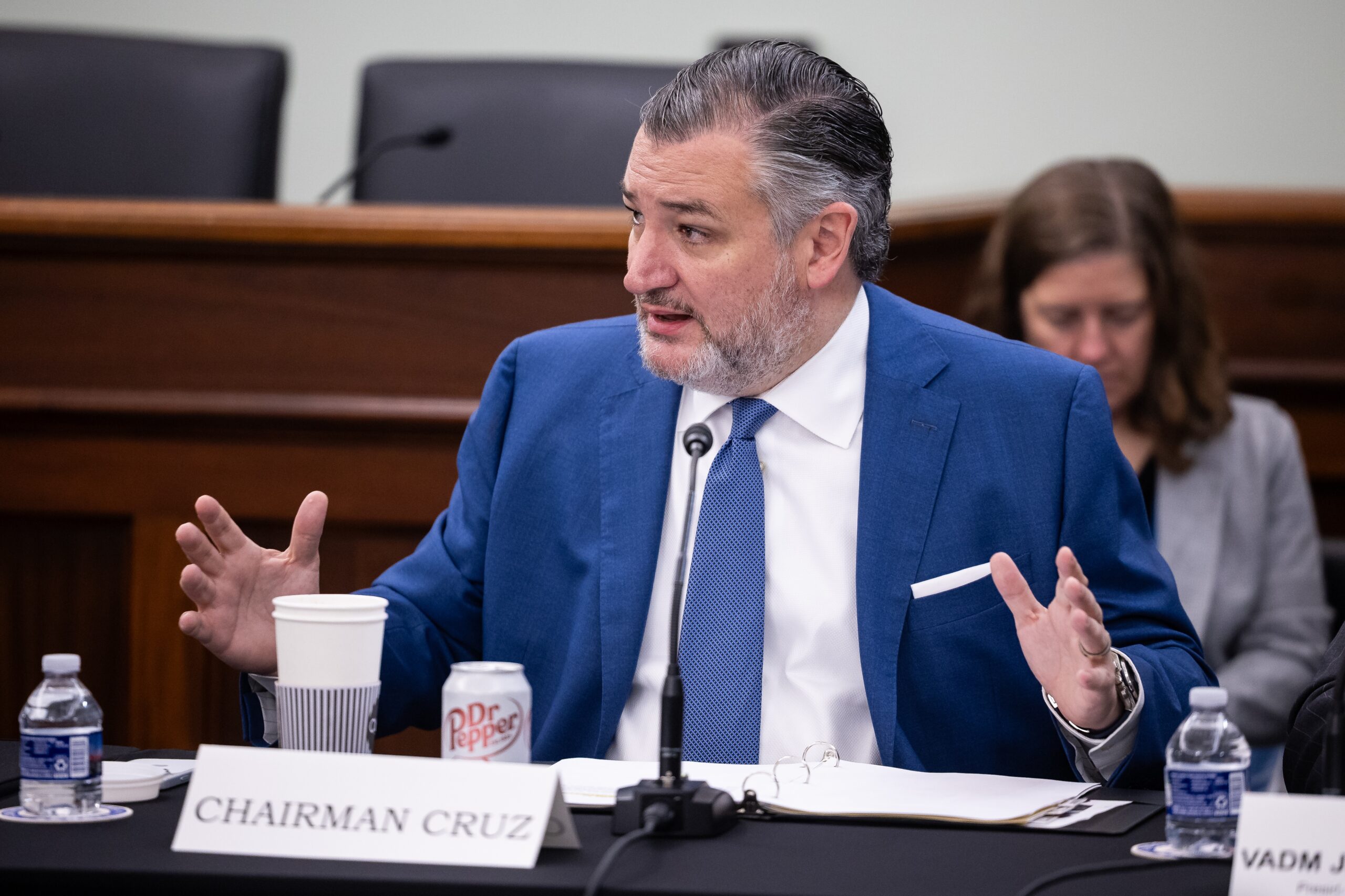

Few lawmakers have as much influence over the fate of artificial intelligence legislation as Sen. Ted Cruz, but he’s keeping people guessing about how he’ll use that power.
As chair of the Senate Commerce Committee, the Texas Republican has pledged to convene members to vote on bills that would regulate the AI industry. He asked GOP members of the panel several weeks ago to submit their proposals.
“This markup is designed to move legislation that has a real chance of passing into law,” Cruz said in an interview this week, adding that he was vetting bills depending on “what bipartisan agreement and consensus can be reached.”
Cruz’s aides, granted anonymity to speak candidly, said the senator believes the federal government should take “targeted” action in “truly novel circumstances” where existing laws are silent — such as catastrophic risk, deepfakes and chatbots.
But they also concede that GOP committee staff is still reviewing dozens of existing bills, and what measures will make the cut for the scheduled late July markup remain in flux. Senators on the panel also say they haven’t heard from Cruz about his criteria for what AI legislation to put on the agenda.
It’s bringing real uncertainty to what Congress might accomplish on the high-stakes issue this year. It also underscores how Cruz, a one-time presidential candidate who could run again in 2028, is attempting to carefully navigate one of the most politically divisive policy debates of the midterms.
Cruz has even avoided saying whether he’ll allow the committee to vote on an emerging deal between Sen. Marsha Blackburn (R-Tenn.) and the White House that would bundle a kids’ online safety package with preemptions of specific state laws.
He said this week he “fully expects” that Blackburn’s bill, known as the Kids Online Safety Act, “will be on the next markup as a part of the package addressing AI and children’s safety.” But he declined to say whether he’ll bring up any revised bill text Blackburn brokers with the blessing of President Donald Trump.
A Blackburn spokesperson did not return requests for comment Wednesday, nor did the White House.
The outlook for how Cruz plans to legislate around AI is further clouded by his own record on the issue.
Back in 2024, Cruz was warning against broad regulation of AI, saying that “Big Tech and the Radical Left” were poised to empower the administrative state, kill innovation and cause the U.S. to lose the AI race with China. He pursued efforts to undercut a Biden administration executive order that took a more hands-on approach to regulating the industry.
As Cruz was preparing to take the gavel in the waning days of the Democratic majority, then-Commerce Chair Maria Cantwell of Washington accused him of opposing the inclusion of seven AI bills in a year-end government funding package — even though those bills had been advanced by the committee on a bipartisan basis.
Cruz’s aides disputed this characterization, saying there was no single lawmaker holding up the bills in late 2024 and House GOP leaders had issues, too. Cantwell, now the committee’s senior Democrat, said in an interview Wednesday the measures “would have helped us in regulating some of the biggest national security concerns.”
She added she’s now “trying to read the tea leaves” about what Cruz has planned for the upcoming markup. At least one Republican said he thinks Cruz has undergone a “very significant pivot” when it comes to engagement and interest around AI that could offer some clues.
“He originally had the position that we didn’t need to adopt any AI legislation whatsoever — that we should just allow the market to work,” Rep. Todd Young (R-Ind.), a member of the committee who is heavily involved in AI policy, said in an interview. “My sense is he has adopted a different position now, and I’m gratified by that.”
As for what accounts for the shift, Young said, “you’ll have to ask him why he’s become more inclined to legislate in this space.” But he acknowledged that “many people are coming to recognize” that it would be a mistake to allow the rapidly evolving technology to go unchecked.
Cruz’s aides disagreed with Young’s characterization. They note Cruz championed a measure making it a crime to publish nonconsensual sexual images — including AI-generated content — which was signed into law last year with support from first lady Melania Trump. Cruz is also pushing legislation that would regulate chatbots, or online apps that mimic human conversation and can pose harm for children.
His aides also said Cruz continues to believe too much federal government intervention into AI policy could threaten innovation and stifle freedom of expression.
Adam Thierer, a resident senior fellow at the right-leaning R Street Institute, said Republicans at the start of the Trump administration seemed to be waiting for cues from the White House before taking a firm position. That has changed as the White House scrambles to enact its own rules governing AI while urging Congress to codify a federal regulatory framework.
Cruz tried, and failed, to include a provision in the GOP’s One Big Beautiful Bill Act last summer that would have enacted a 10-year moratorium on the ability of states to set their own AI laws. Yet in just one year, Thierer said, the political landscape has transformed, and now preempting state AI laws is basically a nonstarter.
“It’s quite a reversal,” Thierer said. “Even limited preemption has become extraordinarily toxic because a whole bunch of people have come to believe what states are doing benefits them.”
Last fall, Cruz released an AI policy framework that aligned with Trump’s AI action plan, which laid out a “light-touch” regulatory strategy; Cruz’s aides suggested the senator plans to build on this blueprint. In December, Cruz was standing beside Trump for the signing of an executive order that would empower the federal government to evaluate and challenge state AI laws.
“I think they have a heightened sense of urgency, which is understandable because it has become increasingly urgent, and one of the major questions is whether Congress can keep pace with the accelerating rate of change in AI,” said Sen. Richard Blumenthal (D-Conn.) of Republicans.
In the meantime, Cruz is facing tough choices about what bills to advance.
Cantwell said Wednesday she wants to see the seven bills that passed out of committee when she was chair, which she accused Cruz of undermining, taken up again next month. And a refusal to facilitate consideration of a potential Blackburn-White House agreement could put Cruz at odds with the president.
Cruz also could end up alienating colleagues whose support he needs on other legislative priorities in the coming months — including a major bill to overhaul the college sports industry.
Sen. John Curtis (R-Utah), a member of the Commerce Committee who has his own bill targeting chatbots that would go further than Cruz’s proposal, in an interview expressed some sympathy for the chair.
“Look, it’s a tough topic, right? There’s not a lot of consensus, and so anything that he can do to even further the conversation, I welcome,” he said. “I think we need to be having these conversations. I think we need to be having the hearings. Until we do, we won’t get to the right answer.”







Leave a Reply