
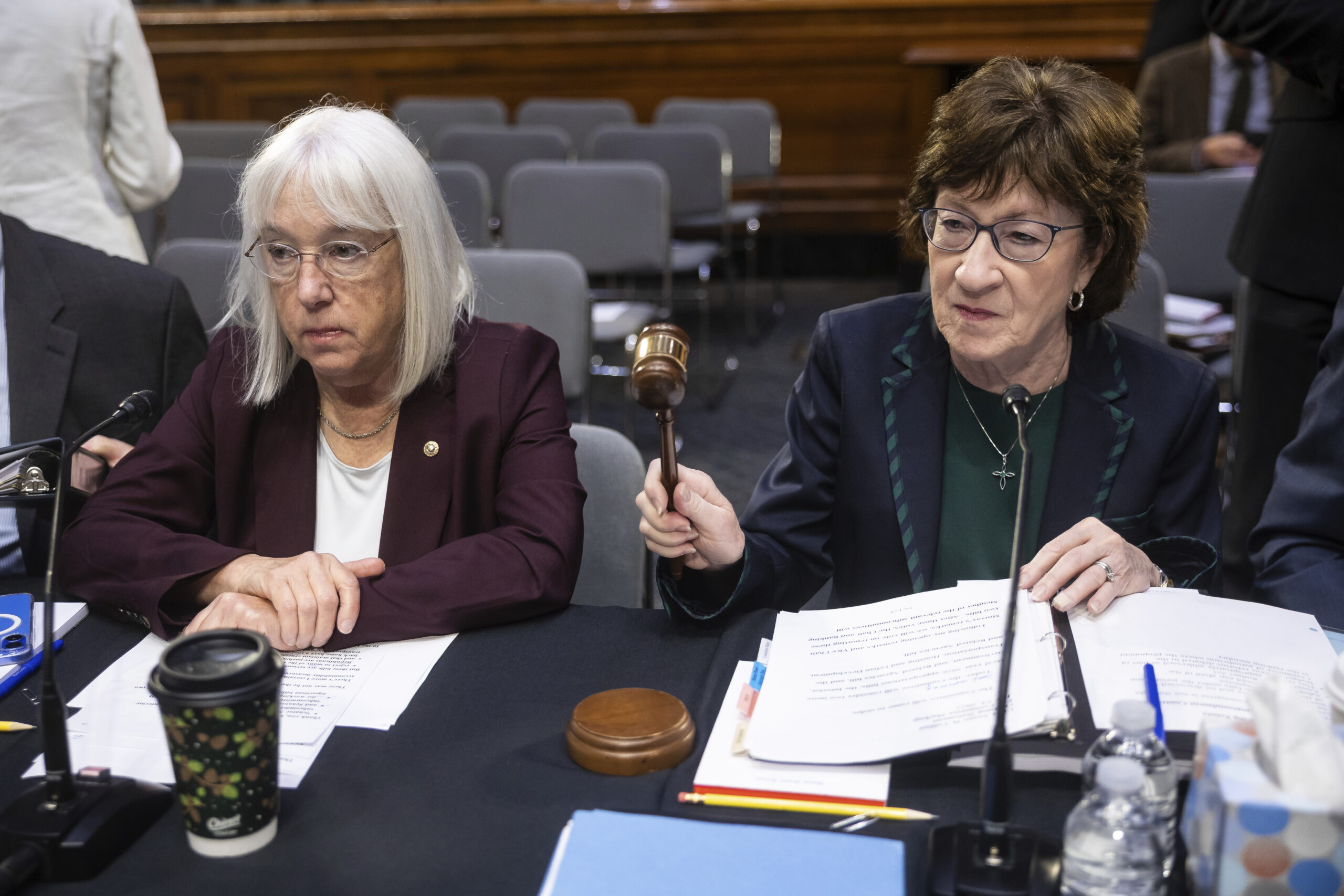

Sens. Susan Collins and Patty Murray have long prided themselves on working together to advance government funding bills. That collegiality is now showing signs of decay.
The Maine Republican and Washington Democrat have been openly feuding about the path forward on spending measures this summer. It comes after their successful collaboration on bipartisan legislation during Murray’s two-year reign as chair of the Senate Appropriations Committee, which continued when Collins took the gavel last year.
Democrats attribute the clash to Collins’ pursuit of President Donald Trump’s demands for a record military budget that eclipses domestic spending, as she fights to retain her Senate seat in November. Republicans say Murray is playing midterm politics by trying to prevent Collins from landing a deal before Election Day, when Democrats hope to regain House and Senate majorities — and the upper hand in year-end funding talks.
“It’s not personal, but it is very frustrating,” Collins said last week, while insisting she and Murray are still on good terms.
All Murray would say about the state of their relationship was, “We’re talking.”
While that impasse doesn’t necessarily heighten the odds of a government shutdown this fall, it could delay any meaningful Senate appropriations action until after the elections. The outcome of congressional races — including Collins’ toss-up contest against Democrat Graham Platner — could change the power balance in government funding negotiations.
“It certainly looks to me like the Democrats don’t want to give Susan Collins a victory,” House Appropriations Chair Tom Cole (R-Okla.) said in an interview. “I really think it’s intensely political. She is a very reasonable legislator. If you can’t make a deal with Susan Collins, you don’t want to make a deal.”
Part of Collins’ campaign-trail pitch to Mainers is that she gets results in Washington, and her inability to advance the dozen annual appropriations bills through her committee undercuts that narrative.
Collins isn’t refuting the idea that Democrats might want to deprive her of legislative success as she competes against Platner in one of the closest and most-watched races in the country.
“That’s certainly a viable theory, which is pretty pathetic,” she said in an interview.
This month Collins publicly accused Murray of sending government funding offers that have “made it clear that Democrats are abandoning the appropriations process.” Murray, meanwhile, suggested Collins was at fault for the stalemate by divulging she hadn’t responded to Murray’s latest offer in more than two weeks.
It’s a major tone shift for the two lawmakers, who have earned a reputation for trying to stay out of the partisan fray since they became their party’s top leaders on the Appropriations Committee in 2023. They’ve consistently resisted broadcasting behind-the-scenes friction during tough negotiations and succeeded in reaching cross-party compromises to advance funding bills each year — even after the record government shutdown last fall.
But they’re now at loggerheads over funding totals for the military and domestic programs, along with votes on hot-button Trump policies. Senate Republicans are seeking a military funding boost more than four times larger than any increase in domestic spending, as Trump calls for a record $1.5 trillion defense budget.
“We do not have an agreement,” Murray said, because Republicans “are set on increasing defense in an increasingly huge way that we’ve never had to deal with before.”
GOP senators also want to avoid any amendment votes that could sink approval of appropriations bills, including some related to the Justice Department’s “Anti-Weaponization Fund” administration officials have promised not to pursue.
The result is that Collins has yet to hold a committee markup on a single government funding bill with just three months left before federal dollars expire. And some Republican appropriators acknowledge it’s possible the panel won’t vote on any of the spending measures this year given the deadlock.
“Obviously Susan is up this year. And Democrats, at every level and every opportunity, are playing politics with it,” Senate Majority Leader John Thune said in an interview. “The appropriations process used to be fairly bipartisan. … Murray and the Democrats have turned it into a partisan game.”
Some Democrats openly sympathize with Collins’ predicament in trying to represent politically moderate Maine while holding one of the most influential positions on Capitol Hill during Trump’s second term and unified Republican control of Congress.
“The chair of the committee is being squeezed in every direction,” Wisconsin Sen. Tammy Baldwin, a senior Democratic appropriator, said in an interview.
Many Senate Republicans don’t “give a damn” about funding domestic efforts like public education and biomedical research, Baldwin continued. “I believe that the chairwoman does care about those issues. But you know, she’s in an unenviable position.”
Since Trump was reelected, Collins has worked to negotiate funding bills that spend far more on domestic programs than the president sought. The result has been essentially flat funding for nondefense programs and a 17 percent increase in military spending, which includes the billions of dollars Republicans enacted along party lines last year.
“Chair Collins is very devoted to, or interested in, following through to help the president get more money for the Department of War and munitions, et cetera,” said West Virginia Sen. Shelley Moore Capito, a top Republican appropriator. “And I think Senator Murray is on the opposite page.”
“Rather than legislate and work these things out,” Capito added, “I think it’s been decided on the other side to just be obstinate and not participate and not negotiate.”
Trump is calling this year for boosting Pentagon spending by more than 40 percent while slashing domestic programs by 10 percent. Illinois Sen. Dick Durbin, a senior Democratic appropriator who has served in Congress for more than 40 years, calls it “a massive change” in the way government funding has been divvied up for decades — by negotiating matching dollar-for-dollar increases in both military and nondefense funding.
“We’re so far apart. We haven’t faced anything like that in recent memory,” Durbin said in an interview. “And to accept the premise of it — what’s left for nondefense is terrible.”
Collins could proceed with markups this summer without an agreement with Democrats, as the House Republican majority has done for years. But Republican senators would need to be willing to vote on controversial amendments Democrats might offer — including proposals that defy Trump.
Senate Republican appropriators faced that issue last summer, when the panel unexpectedly adopted an amendment barring the Trump administration from repurposing cash intended for relocating the FBI headquarters. That outcome prompted several GOP senators to withdraw support for the funding bill.
“The challenge is that, if you have every Democrat voting against reporting the bill out — and then they also are offering poison pills — it’s hard to move those bills,” Sen. Jerry Moran (R-Kan.), chair of the Appropriations subcommittee that funds the FBI, said in an interview.
During the two years Murray chaired the full committee, Moran recalled, “We had members who wanted to offer what would probably be considered poison pills by Democrats. And Senator Collins talked Republicans out of doing so, to move the process.”
The two sides could easily reach an agreement on amendments and policy stipulations, some Democrats contend, if only Collins and Murray could bridge the divide between the president’s military funding demands and their own domestic priorities.
“Senator Collins is carrying out the administration’s wishes,” Oregon Sen. Jeff Merkley, another senior Democratic appropriator, said in an interview. “And Senator Murray is noting that a reckless increase in defense spending is not in the best interest of Americans.”
“So they’re both advocating for their viewpoint,” Merkley added. “That’s what we do in a democracy.”
Katherine Tully-McManus contributed to this report.






Leave a Reply