
DEHRADUN: The test of a government’s commitment to its most remote citizens is often most visible in what it does about aviation. Roads eventually reach most places. Rail, given enough time and engineering, can be extended into the mountains. But there are parts of Uttarakhand, high-altitude districts, deep valleys and villages accessible only by paths that are cut off during winter, where roads and rail alone are not enough. To overcome these challenges, the state government has made regional air connectivity a key component of its infrastructure strategy.The initiative includes three airports, a helicopter network serving both tourism and essential connectivity and air ambulance services that have changed the medical risk calculus for communities that were once several hours away from the nearest hospital.
The three airports
Uttarakhand’s aviation network is anchored by Jolly Grant Airport in Dehradun, Pantnagar Airport in the Kumaon foothills and Pithoragarh Airport, which serves the high-altitude border district of the same name. The presence of three operational airports in a state of Uttarakhand’s size reflects a deliberate investment in aviation infrastructure and an understanding that, for certain parts of the state, air connectivity is the only practical solution.Among them, Pithoragarh holds strategic importance. Bordering both Nepal and China, the district’s airport provides connectivity that would otherwise require a road journey of several hours. It has become critical for government administration, defence requirements, facilitates emergency medical transport and has also boosted tourism in the district’s scenic high-altitude destinations.
Helicopter connectivity: tourism and necessity
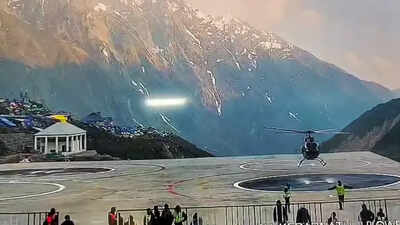
The state’s helicopter connectivity programme serves a dual purpose that is unusual in Indian infrastructure planning. On one hand, it supports tourism. While flights to Kedarnath have become an important part of the state’s tourism infrastructure, reducing travel time and offering a safer option during challenging weather, the same network also serves a vital public purpose.For residents of remote villages, helicopters can provide the quickest link to hospitals and essential services. When a medical emergency occurs in an isolated village and an air ambulance reaches the patient in about 22 minutes, the story extends far beyond tourism. It is an example of essential public infrastructure reaching citizens in the state’s most inaccessible regions.
The investment and its logic
The Uttarakhand government’s investment in air connectivity follows a clear logic: in a state where geography creates stark disparities in access, infrastructure spending must prioritise the most disconnected regions.The returns are not measured solely in passenger traffic or revenue. Better air connectivity is helping districts such as Pithoragarh attract more visitors, improving access for businesses and farmers, and encouraging people to continue living and working in the hills instead of migrating elsewhere. Every flight operating from Pithoragarh reinforces the case that the hills can remain economically viable. That, ultimately, may prove to be the state’s most significant infrastructure investment.






Leave a Reply