


Growing up in the late 1990s or early 2000s meant watching the internet arrive not as a single platform, but as a world opened through web browsers.British computer scientist Tim Berners-Lee created the first web browser in 1990 and called it WorldWideWeb. A few years later, Mosaic made the web more visual by bringing graphics into browsing. Microsoft launched Internet Explorer, Mozilla introduced Firefox, and Google later released Chrome.As browsers evolved, so did the culture around them.The internet became a place not just to search, but to wander. Blogs flourished. Forums grew. Platforms such as Quora and Reddit began offering peer-to-peer knowledge, turning the web into a digital version of the ancient Greek agora, a public square where people gathered to ask questions, exchange ideas and debate answers.Over time, this space became the internet’s Mr Fix-it.From solving complex mathematical problems to figuring out how to heal after a breakup, browsing became an everyday habit. People searched, clicked, compared, skimmed, bookmarked and fell into rabbit holes.Now, artificial intelligence is changing that habit.Instead of moving across multiple webpages, users are increasingly turning to AI tools for direct, customised answers. The promise is simple: convenience, speed and efficiency. But the shift also raises a larger question — what happens to the experience of the internet when the answer arrives before the search really begins?
From rabbit holes to ready answers
Neha, a 42-year-old working professional, remembers a time when the internet was not easily accessible and even a small research project required a trip to a nearby cyber cafe.“When I started using the internet on my personal computer, I used to spend hours reading Wikipedia pages. Easy access to abundant information fuelled my curiosity, and I would go down a rabbit hole on the internet, often losing track of time. It was intellectually stimulating to go down a wiki-rabbit hole and learn obscure facts,” she said.For her, browsing was not just about finding information. It was about the process.She also remembers the sense of achievement that came after a long browsing session led to a successful discovery.“It was like a reward for hours of labour,” she added.That older version of the internet rewarded patience. Users opened multiple tabs, followed links, compared sources and slowly built their understanding of a topic.AI has compressed that process.
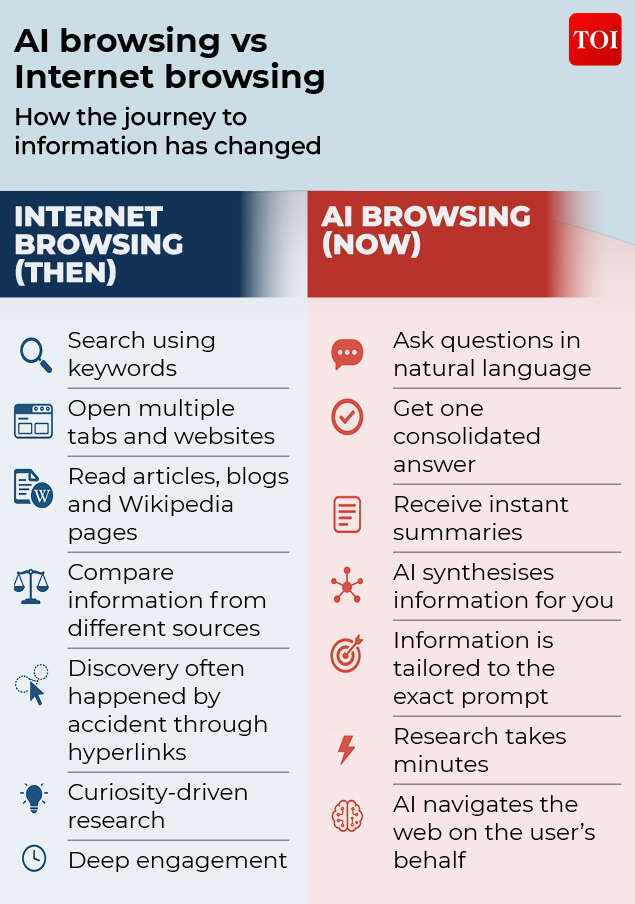
Internet Browsing vs AI Browsing
The changing internet user
Sameer Sheikh, an Instagram influencer with 1.6 million followers, says he once relied almost entirely on Google Search to craft scripts for his videos, which decode Bollywood lyrics.His research process involved reading multiple research papers, blogs and articles, comparing information from different sources and then piecing it together into a compelling narrative.AI has changed that workflow.“Since the rise of AI, I now use tools like ChatGPT, Claude and Perplexity to quickly get a concise summary of information gathered from multiple sources across the internet. This saves me a significant amount of time compared to reading every article individually,” he said.For creators, students and working professionals, this is the biggest draw of AI-assisted browsing. It reduces the time spent moving across webpages and gives users a structured answer almost instantly.But it also changes the relationship between the user and the information.Earlier, users discovered information by navigating the web themselves. Now, many are receiving information filtered, arranged and summarised by AI systems.
Is SEO dead in the age of AI browsing?
For years, search engine optimisation, or SEO, has been the backbone of digital visibility. The goal was straightforward: optimise webpages so they rank higher on search results and attract more clicks.That model is now under pressure.As AI Overviews and generative search tools answer user queries directly on the results page, the traditional click-through model is being disrupted. Users may get the answer they need without visiting the website that originally produced the information.This has triggered anxiety across the digital publishing and marketing world. If AI can answer questions directly, what happens to websites that depend on search traffic?But digital marketing experts argue that SEO is not dying. It is changing.Chandrakant Agrawal, co-founder and CEO of AppSquadz, said AI Overviews are reshaping how search engines surface and deliver content.“AI Overviews are reshaping how search engines surface and deliver content, answering queries directly on the results page, which can reduce traffic for some websites while, in some cases, driving more qualified and intent-rich visitors than traditional organic clicks ever did,” he said.According to him, the metric of success is no longer just the click.“The marketers and businesses adapting well are those who have accepted that the KPI is no longer the click alone. It now also includes citation, reference and brand recall within the AI responses itself. The businesses which built shallow, keyword-dense content for ranking are losing relevance fast. The ones investing in context-rich, credible, expert-led content are finding that AI systems surface them more consistently,” he said.In other words, AI may not kill SEO, but it is forcing it to evolve.Agrawal said marketers are increasingly turning to Answer Engine Optimisation, or AEO, as a separate discipline from traditional SEO.“The toolkit for AI-era visibility looks meaningfully different from what dominated SEO conversations five years ago. Marketers are increasingly turning to Answer Engine Optimisation as a discipline in its own right, distinct from traditional SEO. The underlying principle, however, is unchanged: AI systems cite sources they assess as credible, consistent and contextually authoritative,” he said.
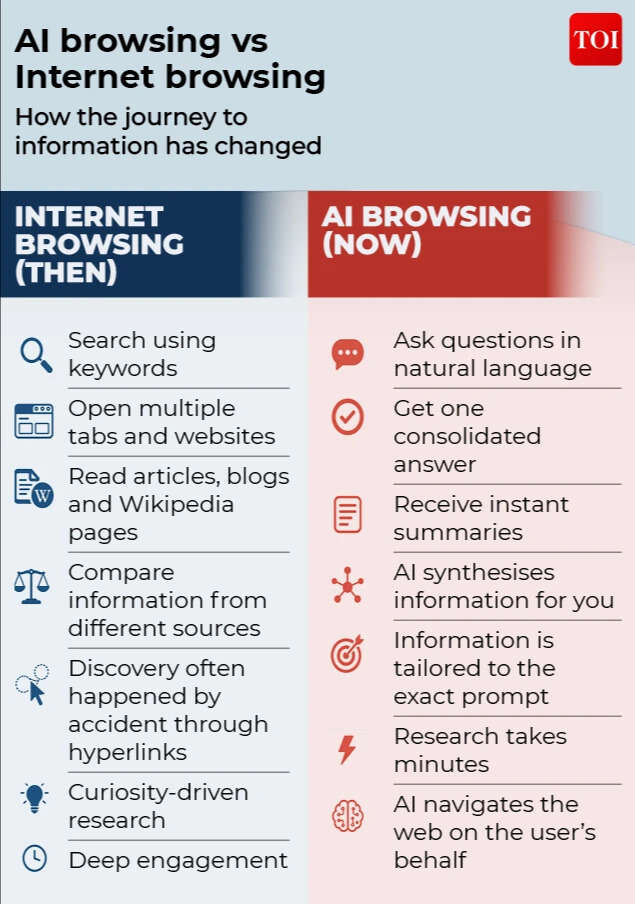
Internet browsing vs AI browsing
Convenience, but at a cost
AI-powered browsers and agentic browsing tools are designed to make the internet more interactive and task-oriented.They can summarise webpages, compare information, help plan trips, assist with bookings, fill forms and, in some cases, complete tasks across websites. Instead of simply displaying information, they can interact with it.For users, this can feel like a major upgrade. A browser is no longer just a window to the web. It can become an assistant that reads, explains, compares and acts.But the same capability also brings risks.Agentic browsers may need access to sensitive user data, including cloud storage, email, banking sessions, shopping accounts and social media platforms. They may be able to click buttons, submit forms and make changes through authenticated sessions.That level of access creates concerns around privacy, security and user control.An article by the University of Tennessee’s Office of Innovative Technologies noted that AI agents may not always be able to distinguish between safe websites and scam sites. A malicious website could embed hidden instructions in its HTML, text or metadata. An agent might misread those instructions as legitimate commands and perform unauthorised actions, such as submitting forms, changing account settings or extracting sensitive information.This is the central trade-off of AI browsing.The more useful an AI agent becomes, the more access it may need. And the more access it has, the higher the risk if something goes wrong.

Convenience comes with risks
What changes when AI becomes the browser?
The internet was once built around exploration.Users searched, clicked, wandered, compared and discovered. The journey was part of the experience. A simple question could lead to a Wikipedia page, then a blog, then a forum thread, then a research paper, and finally to an answer that felt earned.AI is turning that journey into a shortcut.That shortcut is powerful. It saves time, reduces information overload and helps users make sense of complex topics quickly. For people who work with large volumes of information, it can be transformative.But it also changes how people learn, verify and trust information.When users browse less and ask more, discovery becomes narrower. The web becomes less of a landscape to explore and more of a system that delivers answers on demand.That does not mean the old internet is disappearing. People will still search, read, watch, compare and debate. But the first instinct is changing. Increasingly, the question is not “What should I search?” but “What should I ask AI?”The browser once taught users how to navigate the internet.AI is now teaching them how to skip parts of it.







Leave a Reply