
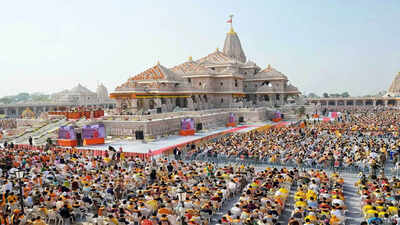
NEW DELHI: Communist Party of India (Marxist) MP John Brittas has urged the Centre to reconsider its decision to keep the Shri Ram Janambhoomi Teerth Kshetra Trust, which manages the Ram Temple complex in Ayodhya, outside the ambit of the Right to Information (RTI) Act.In a letter to Union home minister Amit Shah dated July 4, Brittas argued that bringing the trust under the RTI Act would “serve the interest of transparency and public accountability.”The Shri Ram Janmbhoomi Teerth Kshetra Trust is at the centre of a controversy over the alleged embezzlement of donations offered by devotees at the Ram Temple.Brittas noted that after the Supreme Court’s November 2019 Ayodhya verdict, that paved the way for the Ram Temple’s construction, the Centre framed the scheme governing the Trust, constituted it through a gazette notification, and vested it with the acquired land. He also highlighted that 12 of its 15 members were initially nominated by the government.Referring to the Central Information Commission’s (CIC) June 6, 2025, order holding that the Trust is not a “public authority” under the RTI Act, he argued that the decision relied largely on the Union home ministry’s stand and urged the ministry to review its position.The Rajya Sabha member contended that the Centre’s argument that the Trust was not “established or constituted” by a government notification simply because the notification was issued in compliance with the Supreme Court’s directions deserved reconsideration. He pointed out that Section 2(h)(d) of the RTI Act makes no distinction between a notification issued independently by the government and one issued pursuant to a judicial direction.He also highlighted the Trust’s governing framework, which includes serving IAS officers representing the Centre and the Uttar Pradesh government, reflecting the government’s continuing institutional association with its administration.“While these representatives may not enjoy voting rights, their statutory inclusion in the governing framework reflects the public character of the institution and the Government’s continuing institutional association with its administration,” Brittas wrote.He argued that the governmental presence cannot be ignored in determining whether the Trust should be subject to the RTI Act.“The public character of the Trust also arises from the nature of the functions entrusted to it. It administers one of the country’s most revered religious institutions, manages land acquired under a Parliamentary enactment and vested through government notification, and receives contributions from millions of devotees across India and abroad,” he said.The CPM leader argued that the “extraordinary confidence” reposed in the Trust by the public carries an equally compelling expectation of transparency.Drawing a parallel with the Shri Mata Vaishno Devi Shrine Board, Brittas maintained that institutional autonomy and public accountability are not mutually exclusive, noting that religious bodies established under statutory or governmental frameworks continue to enjoy autonomy in religious matters while operating within transparent administrative and financial systems.(With PTI inputs)






Leave a Reply