
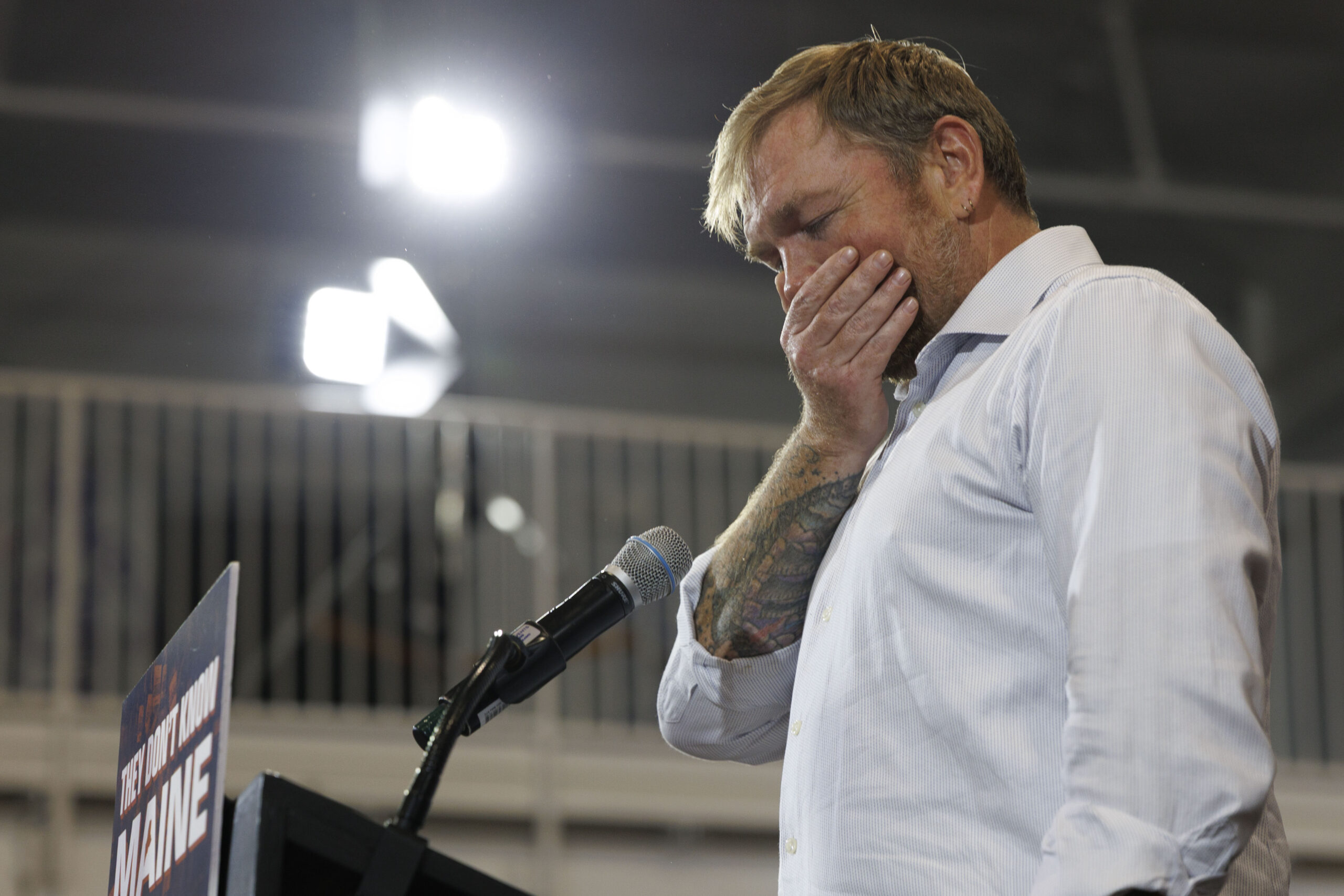

Democratic Maine Senate candidate Graham Platner ended his campaign on Wednesday after facing a detailed allegation of sexual assault, an astounding and rapid fall for the progressive oysterman whose meteoric rise and grassroots support helped him overcome establishment opposition to secure his party’s nomination.
But a persistent accumulation of controversies weighed on Platner’s campaign for months, and Monday marked a turning point: Democratic leadership, many of Platner’s staunchest progressive backers and key groups who had been helping fund his bid withdrew their support of Platner and pressured him to drop out after POLITICO reported a new allegation of sexual assault.
Maine resident Jenny Racicot said Platner forced her to have sex with him nearly five years ago despite her repeated objections. Platner called the allegations “all false” in the 11-minute, 15-second video posted on social media Wednesday night, adding, “it’s not real.”
“We are suspending campaign operations,” Platner said in the video. “I want to make clear, though: I intend to file my paperwork to withdraw.”
The Maine Democratic Party has until July 27 to name a replacement candidate, according to state law. Platner faced a July 13 deadline to decide whether he would drop out so the party could have time to replace him on the ballot.
“We believe that for the movement to continue, it can’t be me,” Platner said in the Wednesday announcement. “This is incredibly difficult, because I know that some will think it’s an admission of guilt, and it most certainly is not. We’re not doing it because of the allegations, we’re doing it because of the structures that are being taken away from us by those in power.”
Party officials, who previously called for Platner to withdraw from the race, did not immediately respond to a request for comment.
Within hours of POLITICO’s article publishing Monday, top Democrats in Maine and Washington demanded that he end his campaign. Those figures included former major supporters, such as Sen. Bernie Sanders (I-Vt.), Rep. Ro Khanna (D-Calif.) and Sen. Elizabeth Warren (D-Mass.).
The Democrat also lost key financial backing in a contest where cash will be king. He was abandoned by the Democratic Senatorial Campaign Committee, the Democratic National Committee and the Senate Majority PAC, the top super PAC supporting Senate Democrats, which said it is “redirecting resources away from the Maine Senate race in light of the latest allegations.”
VoteVets, a group that supports veterans for elected office, and End Citizens United, a liberal good governance group, also rescinded their endorsements.
Racicot’s allegation is the latest and most serious one Platner has faced, after The New York Times reported that she and several other former romantic partners alleged the candidate had displayed disturbing and sometimes violent patterns of behavior. Platner denied those claims, too.
Racicot told POLITICO she cut off contact with Platner after telling him their encounter was not consensual. She said she was torn over coming forward, in part, because she agrees with him politically.
Platner first announced his outsider campaign for Senate in August of 2025 with a flashy launch video highlighting his rural Maine roots and pledge to take on corporate interests.
But as he drew national attention, a slow drip of controversial moments from his past emerged.
POLITICO and other outlets revealed last fall a series of Reddit posts that Platner had made including posts that disparaged rural Mainers, promoted violent political action and described himself as a “communist.”
He later drew further criticism when an old photograph revealed a tattoo on his chest of a skull that resembled a Nazi totenkopf. Platner later had the tattoo covered and denied that he knew of its Nazi associations.
Still, Platner continued to gain momentum in the polls, and his rise forced Democratic Gov. Janet Mills — establishment Democrats’ preferred pick to take on GOP Sen. Susan Collins — to suspend her bid before the primary, citing a lack of financial resources. Platner went on to win the largely uncontested June 9 Democratic primary with 72 percent of the vote.
Platner’s decision to drop out leaves Democrats scrambling ahead of a critical Senate race against Collins — one that the party had identified as a must-win in order to regain control of the upper chamber in November.
It is unclear if Mills might be open to rejoining the race, though a person familiar with the situation told POLITICO that there was little prospect of party chiefs receiving support for her. Other potential Democratic candidates include former public health official Nirav Shah, Maine Secretary of State Shenna Bellows and former Maine Senate President Troy Jackson — who unsuccessfully ran for governor this year — as well as state Rep. Valli Geiger and brewery owner Dan Kleban, who briefly launched his own Senate campaign last year but dropped out when Mills entered the race.
The Maine Democratic Party approved a plan on Wednesday, shortly before Platner’s announcement, to choose the replacement candidate in a state party convention.
Aaron Pellish contributed to this report.






Leave a Reply