


If the UBS Global Wealth Report 2026 is anything to go by, acche din has arrived for a growing slice of Indians who are fast moving up the social ladder. India added 31,033 new US-dollar millionaires in 2025, more than twice mainland China’s 14,079. India’s millionaire count rose 3.4% in the year against China’s 0.3%, though China is working off a far bigger base. For all the talk of the dragon breathing fire while the elephant lags on infrastructure and industrial heft, this is one scorecard where India comes out ahead. But the shape of that wealth carries a pattern policymakers will want to watch, because even as Indians get richer, they still don’t store their wealth the way the West does.UBS defines wealth as financial assets plus real assets, principally housing, minus debt. Measured that way, only 25.8% of India’s gross personal wealth sits in financial assets, against 78.9% in the US, 68.9% in Japan, 54.9% in South Korea and 51.9% in mainland China. India is close to the bottom of the table on this count.
How the data has changed
China still has a far larger millionaire base. UBS estimates over 5.3 million dollar millionaires there, against India’s roughly 944,000, with the US in a league of its own at more than 23.6 million. But in 2025, India minted more new dollar millionaires than China, Russia, South Korea, Germany and Italy.
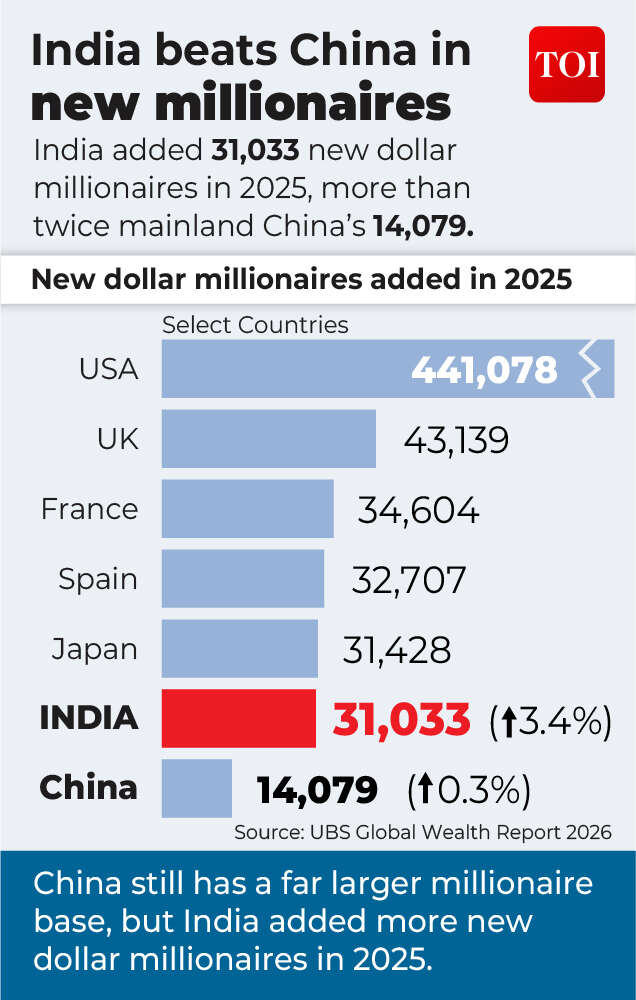
India beats China
That is a sharp shift from the previous cycle, though UBS cautions against reading too much into such comparisons because its methodology has changed. In 2024, the US added 379,000 dollar millionaires, or more than 1,000 a day, and mainland China added 141,000, or over 386 a day, while India added around 39,000 in the year.A second yardstick tells a similar story. The Mercedes-Benz Hurun India Wealth Report 2025 estimated the number of millionaire families in India at 871,700, up from 458,000 in 2021 and 159,900 in 2017, with Mumbai alone accounting for 142,000, followed by New Delhi at 68,200 and Bengaluru at 31,600. Hurun counts families and UBS counts individuals, so the totals aren’t directly comparable, but the trends run in the same direction. The millionaire class is expanding fast, but remains concentrated in a few cities.
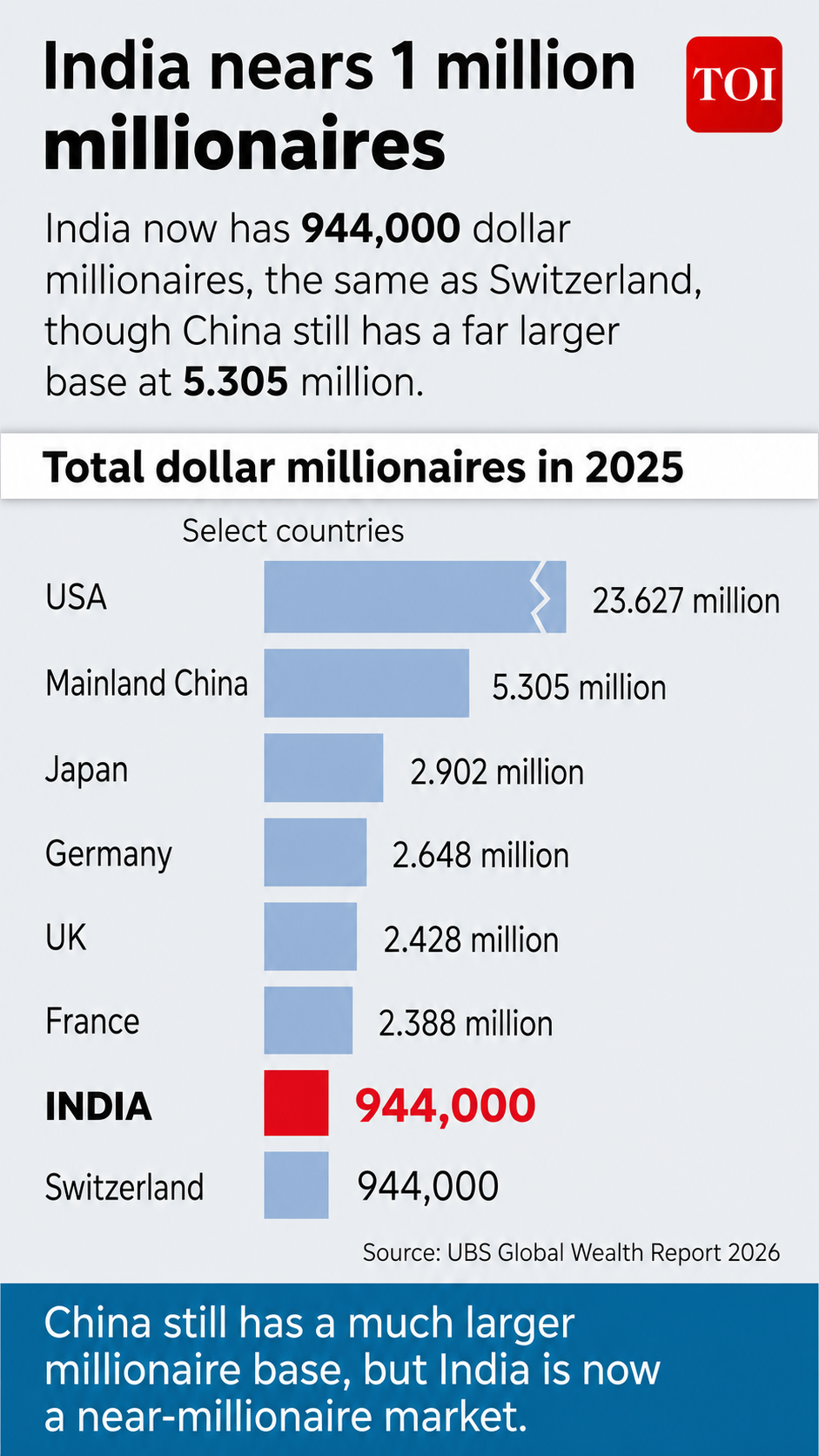
India nearing 1 million millionaires
How Indians are different
Here, the Indian wealth story diverges from richer financial economies. The Indian wealthy are far more attached to real estate than their peers in the West. The habit is old and well documented, an RBI-linked household finance study found that the average Indian household held 77% of its assets in real estate, 11% in gold, 7% in durable goods and just 5% in financial assets. In that sense, UBS’s 2026 finding confirms a well-established trend.The World Gold Council estimates that Indian households sit on as much as 25,000 tonnes of gold, held not only as an investment but also as wedding heirlooms, emergency collateral and what many regard as an inflation hedge. Gold and real estate, especially in posh locations, are also visible markers of upward mobility. For many, being seen as rich is as important as being rich.
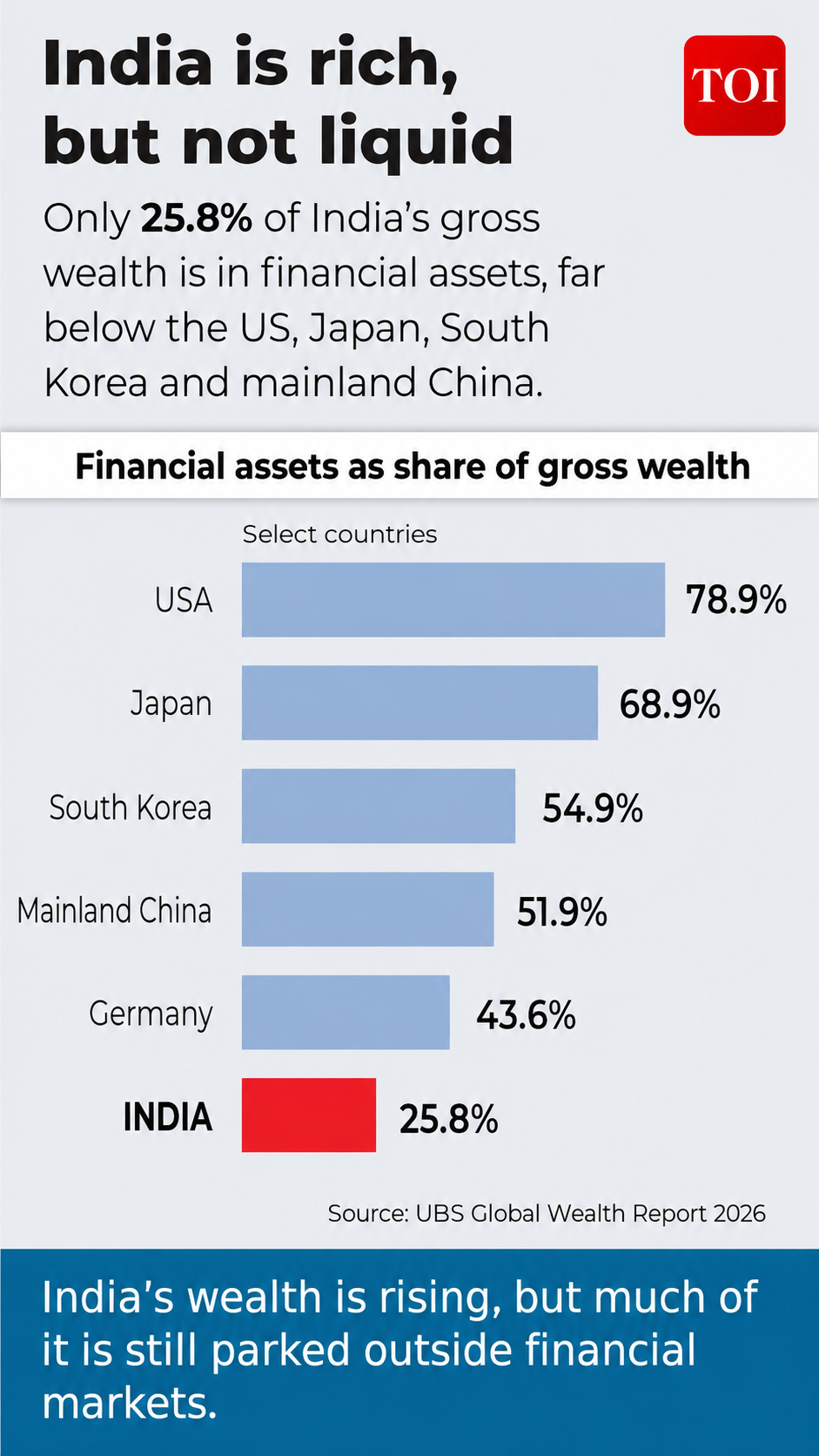
India is rich but not liquid
Equities have gone more mainstream on the back of SIPs, mutual funds, demat accounts and the post-pandemic retail rush, but UBS figures show it is still early days for those instruments. Fresh savings continue to flow more into tangible assets. In FY24, household net financial savings came to 5.3% of GDP while savings in physical assets rose to 13.5%.The preference isn’t costless, though the comparison depends heavily on the period chosen. Official housing-price data points to modest national gains. National Housing Bank study puts India’s housing price index CAGR at 4.75% over 2013Q2–2024Q3, while residential rental yields have generally stayed modest, in the 2–6% range. Gold did well too, compounding at roughly 9–11% a year over the decade on most estimates, before the 2025–26 price spike pushed returns even higher.Equities, however, have generally rewarded financialisation more strongly over long periods, with Nifty 50 total returns in the low double digits and midcap indices higher. A house in the right Tier-1 pocket may have done far better than the national average, but a typical property-heavy portfolio has often seen lesser returns. At 8.2% of gross wealth, India’s household debt sits below mainland China’s 10.6%, the US’s 10.9%, Japan’s 11.9%, Australia’s 18%, the UK’s 20% and Brazil’s 23.4%. Prima facie, it is reassuring that Indians aren’t overleveraged, but coupled with India’s thin financial-asset share, it points to wealth that is deeply concentrated and locked mostly away from market instruments.
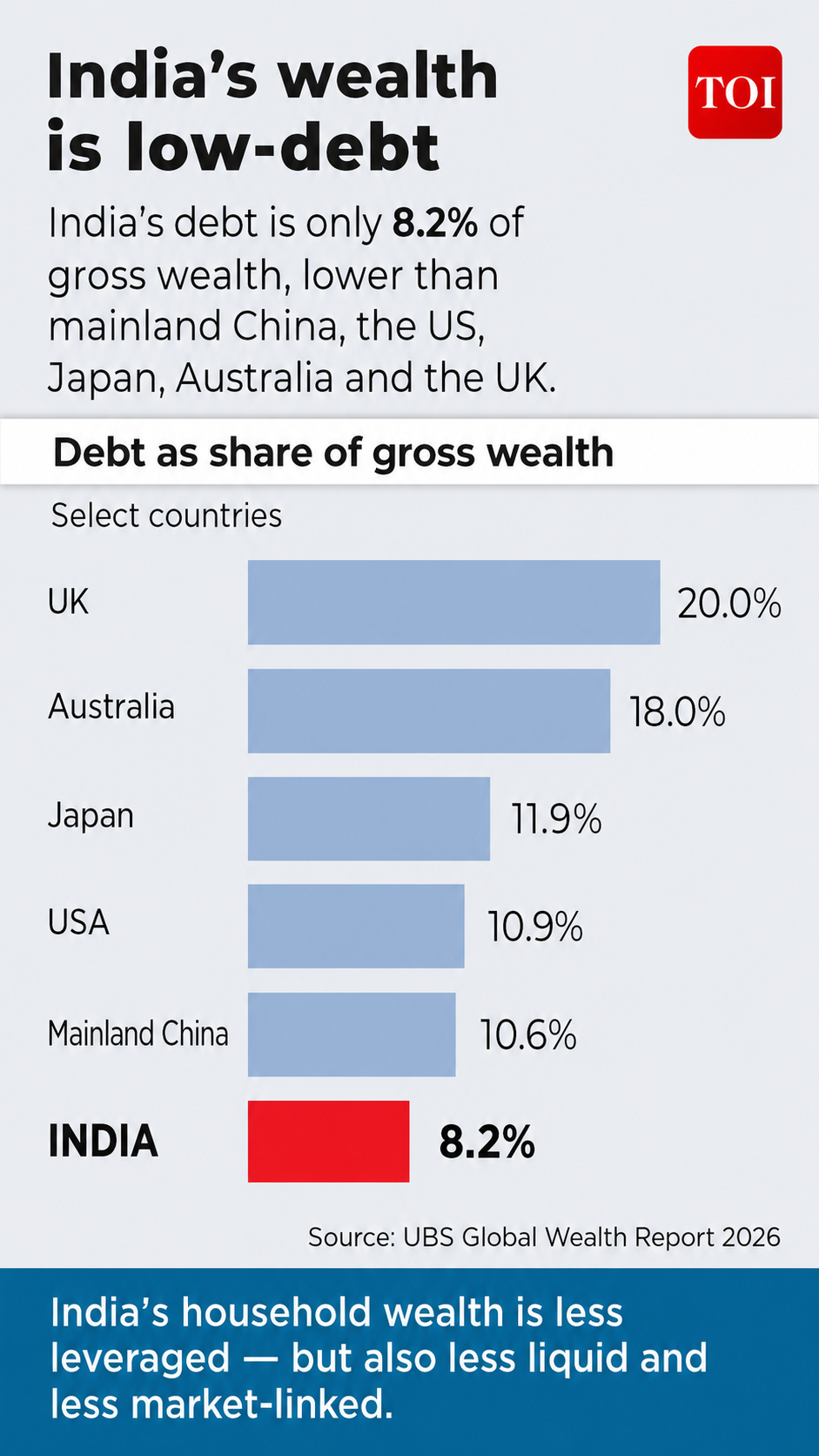
India’s wealth is low-debt
Very high inequality
The inequality data points to a similar picture. UBS puts India’s wealth Gini at 0.74, close to the US’s 0.77 and well above mainland China’s 0.60. A Gini score of 0 indicates perfect equality, while 1 indicates extreme inequality, so India’s 0.74 is fairly high by UBS’s metric.As UBS chief economist Paul Donovan notes in the report, people tend to judge their wealth relative to others rather than in absolute terms, so many don’t feel rich even when they are better off than before. For many, Sharma ji ka ladka in the neighbourhood is always one notch higher on the social-mobility ladder. Yet there is hard data to show that Indians are doing better, and even beating the global average. UBS notes India is among the few markets where median wealth has climbed roughly 20% since 2020, while many others saw it fall.
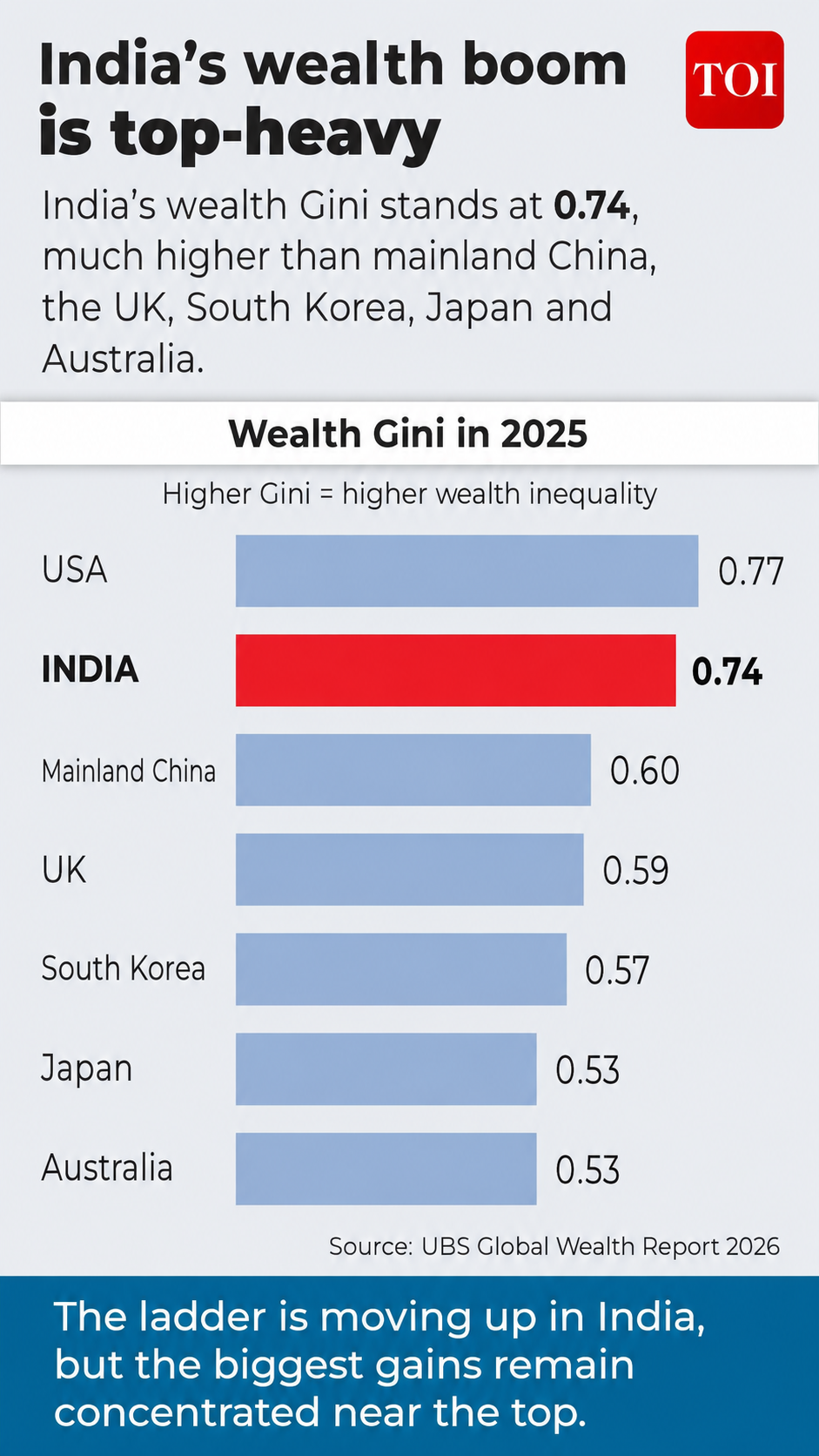
Stark inequality
For policymakers, the stakes are obvious. A more financialised base of household wealth would deepen capital markets, put retirement planning on firmer ground and ease the economy’s overdependence on property. The economic historian Joel Mokyr, interviewed in the same report, makes the case that money follows opportunity, if the conditions are right and the idea is good, he argues, capital will flow to it.India’s challenge is the reverse of a capital shortage. The money is already here, sitting in gold and brick. Whether a new crop of affluent Indians breaks the pattern of yore will be a trend worth following.







Leave a Reply