
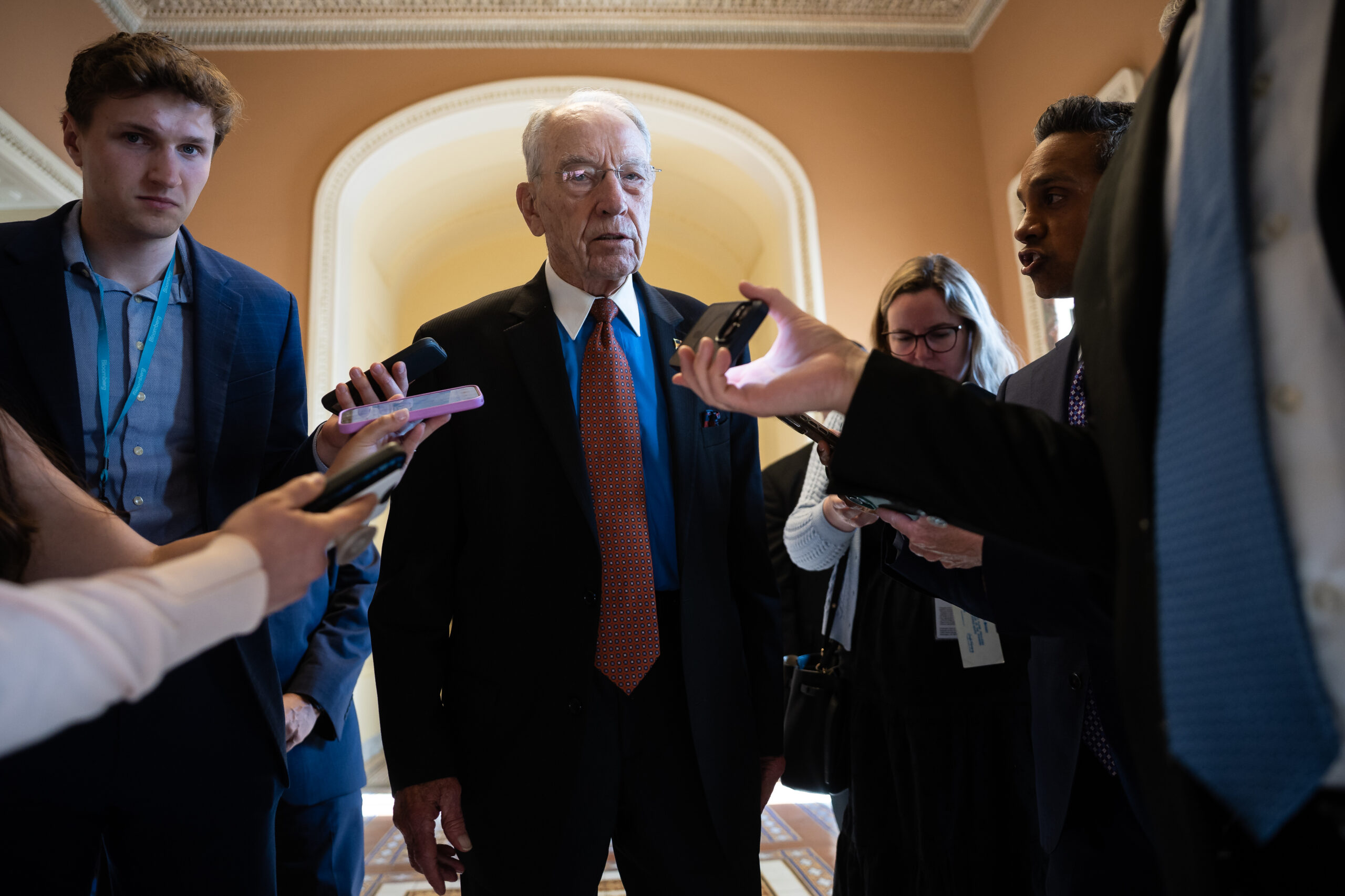

Former special counsel Jack Smith obtained text messages that 44 members of Congress sent to senior White House officials during the final weeks of President Donald Trump’s first term, Senate Judiciary Chair Chuck Grassley revealed Tuesday.
The latest exchanges were part of a trove of materials that the National Archives turned over to Smith’s team following a subpoena for White House records stretching from Oct. 2020 to Jan. 2021. Smith’s top deputies received the materials in August 2023, just weeks after securing a grand jury indictment against Trump — and, according to internal emails Grassley released Tuesday, indicated they were quickly preparing to share them with Trump’s legal team as part of the pre-trial “discovery” process.”
Grassley’s release of these materials is part of a broader effort by the Iowa Republican and other Trump allies to portray Smith as a reckless or overaggressive prosecutor in his pursuit of criminal cases against Trump during the Biden administration, which many GOP lawmakers believe were politically motivated.
Grassley was already on the warpath for Smith after learning that investigators obtained his call records as part of Smith’s investigation into Trump’s efforts to subvert the 2020 presidential election, which culminated in the Capitol attack on Jan. 6, 2021.
“Jack Smith has answering to do, and I intend to have him before the Senate Judiciary Committee in the coming months to hold him accountable,” said Grassley.
A spokesman for Smith did not immediately respond to a request for comment. Smith testified to the House Judiciary Committee both privately and publicly earlier this year.
The newly disclosed records show that a wide range of lawmakers were communicating with the White House in the final months of Trump’s first term — from Grassley himself along with 19 other senators, to top House Republicans like then-GOP Leader Kevin McCarthy.
Several exchanges with Democrats, including Sen. Cory Booker and then-Rep. Karen Bass, were also among the subpoenaed materials.
Grassley is also seeking to cast the revelation that members’ text messages were divulged to investigators as a potential breach of Congress’ constitutional “speech or debate” protection that prevents the Executive Branch from prying into lawmakers’ legislative business.
Unlike executive privilege, which protects a president’s communication from disclosure in many cases, speech-or-debate privilege is explicitly mentioned in the constitution — part of the founders’ effort to prevent the Executive Branch from using its prosecutorial power to bend legislators to its will.
Notably, Smith’s investigators laboredfor more than a year to obtain text messages and emails sent by Rep. Scott Perry (R-Pa.) after the FBI seized his phone in August 2022. Perry sued, contending that his phone contained thousands of messages protected by the speech or debate clause, and slowed Smith’s team for more than a year while they litigated the contours of the privilege.
Eventually prosecutors won access to about 1,600 of Perry’s messages that judges deemed unrelated to Perry’s work as a legislator.
Perry is among the lawmakers whose text messages were obtained in the two-month window before Trump’s first term ended.






Leave a Reply