
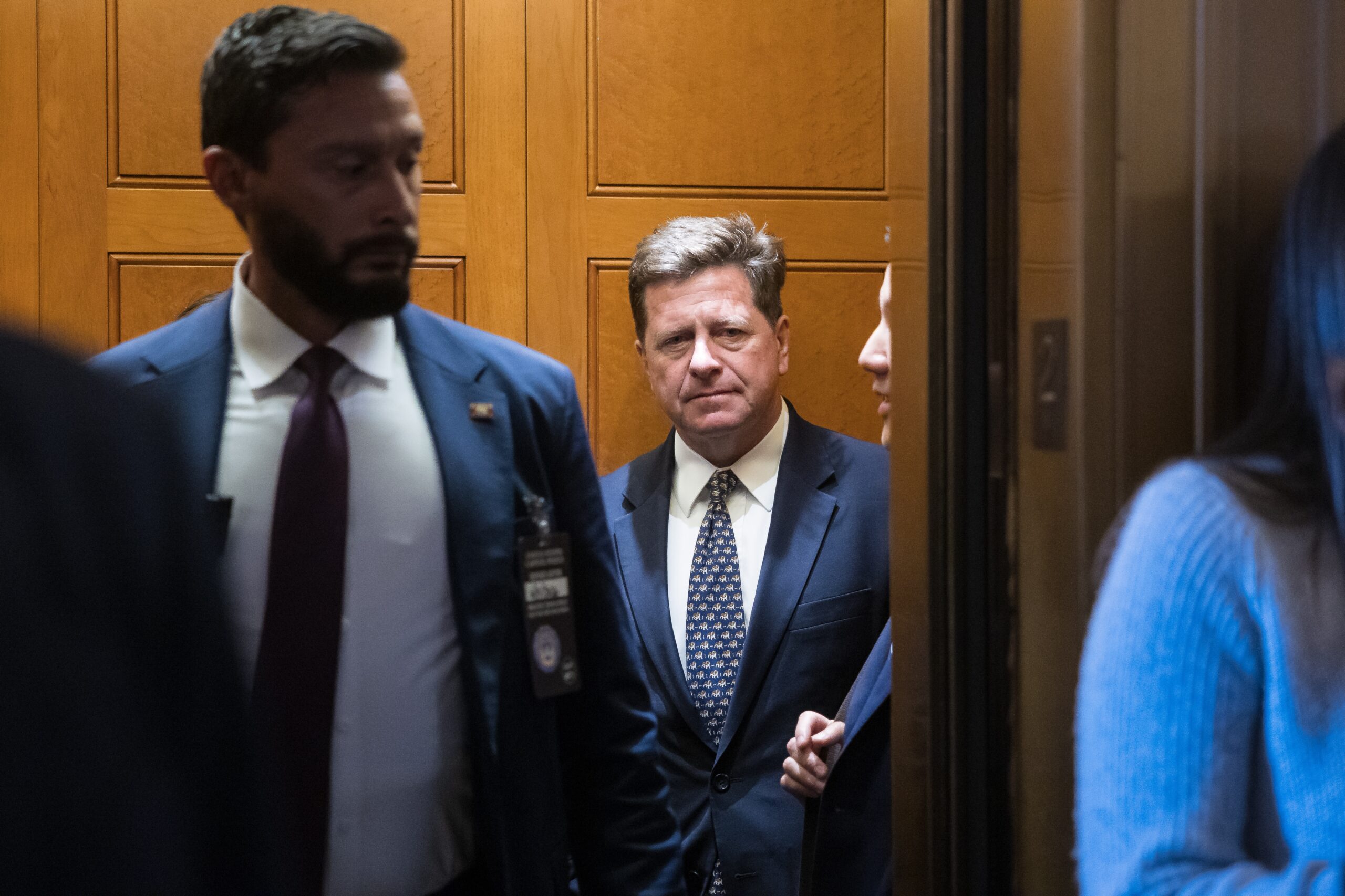

At Jay Clayton’s confirmation hearing to be director of national intelligence on Wednesday, senators are likely to grill the office as much as the man.
Democrats, Republicans and former intelligence officials have in recent weeks floated a range of options to cut, curb or even eliminate the Office of the Director of National Intelligence. Regardless of whether the proposals come to fruition, they underscore a stark reality: Trust in an agency that technically stands astride a hulking U.S. spy community has cratered since the rocky tenure of former DNI Tulsi Gabbard and her interim replacement, Bill Pulte.
“The consensus among many members is the ODNI was a colossal mistake, and it just gets in the way of real intelligence and national security work,” said one senior GOP congressional aide, granted anonymity, like others, to share details of private conversations among staff and lawmakers.
The crisis of confidence in ODNI is a mixed bag for Clayton, the former SEC chair and current U.S. Attorney for the Southern District of New York.
There is little doubt the Senate will eventually confirm Clayton, as Democrats are eager to replace Pulte, a Trump loyalist with no prior national security experience. Republicans hope doing so will unlock Democratic votes for a powerful spy law that expired last month, when Trump forced a delay in Clayton’s prior nomination hearing. At the time, Trump said Pulte deserved more time atop ODNI, and urged the Senate to confirm Clayton’s replacement at the Manhattan prosecutors’ office first.
But Clayton’s hearing could still bring up uncomfortable issues for a man known for trying to stay above the fray politically. Gabbard and Pulte’s turns atop the intel coordination hub have left Democrats more worried than ever that the spy czar post can be abused to target the president’s political opponents, buttress legally dubious executive branch policies and sow doubt in elections.
Clayton is likely to get questions from Democrats on subpoenas the Justice Department issued last Friday to New York Times journalists who reported on security concerns with Trump’s new, Qatari-donated Air Force One. Clayton’s name appeared on the subpoenas, alarming Sen. Ron Wyden (D-Ore.), a member of the Senate spy panel.
In an interview last month, Clayton also questioned whether California’s voting procedures left open “the opportunity for fraud” in the state’s June primaries — another issue Democrats could key in on.
Rachel Cohen, a spokesperson for Sen. Mark Warner (D-Va.), the top Democrat on the Senate Intelligence Committee, said Democratic support for Clayton hinges on his performance Wednesday. Clayton must show he can be an “independent voice” and “won’t assist Trump in weaponizing the intelligence community or manipulating elections,” she said.
While Democrats don’t have the votes to block Clayton’s confirmation, they can throw up some short-term hurdles, such as blocking the committee from quickly advancing his nomination to the Senate floor and then slowing it down once it gets there. But that’d likely only amount to a few weeks delay.
And, it would mean retaining Pulte, which Democrats also don’t want.
Both Democrats and Republicans who spoke with POLITICO said the pressure to get Pulte out and renew the now-expired spy law means the scrutiny Clayton will face at the hearing could be less intense than it was for his predecessors. The office has also fallen into such low esteem that many do not expect Clayton to act as the “principal intelligence adviser to the president” — the key statutory responsibility for the DNI. Many say that role is already filled by CIA Director John Ratcliffe.
“Ratcliffe is now the principal intelligence adviser to the president,” said Fred Fleitz, National Security Council chief of staff in Trump’s first term and vice chair of the America First Policy Institute. “That’s the way the president wants it. That’s the way it should be.”
Most of the concern in Congress about Clayton has not been about whether he can be confirmed, but how quickly.
After Trump announced he intended to replace Gabbard with Pulte on an acting basis last month, Democrats were so livid they threatened to withhold support for Section 702 of the Foreign Intelligence Surveillance Act, a key spy law. Trump then nominated Clayton, and Warner and Sen. Tom Cotton (R-Ark.), chair of the Senate Intelligence Committee, quickly struck a deal to fast-track his nomination in exchange for Democratic support for Section 702.
But Trump derailed that plan with an eleventh-hour social media post, in which he defended Pulte as “very fair” and “talented” and said he had told Clayton not to show up for the scheduled hearing.
Trump also said Clayton’s nomination should not move forward until the Senate confirmed James McDonald, his pick to succeed Clayton at SDNY, and threatened to withhold support for Section 702 unless Congress first passed a partisan voter ID bill, the SAVE Act.
It is not clear what convinced Trump to let Clayton appear before the Senate now, though the Justice Department announced last week McDonald was joining SDNY as Clayton’s deputy. The delay also guaranteed Pulte would have some time atop ODNI.
Since taking over in mid-June, Pulte has ousted several Gabbard holdovers and reassigned roughly 45 career intelligence officials, including many in the agency’s intelligence coordination hub.
While Pulte has not implemented as many changes as critics feared, Trump said this month he wants Pulte — who touted mortgage fraud investigations into Trump’s political enemies while serving as the head of the government’s housing finance regulator — to “declassify almost everything” before he leaves ODNI.
That’s one reason why there is such urgency among Democrats to see him replaced.
Though Clayton does not have direct experience in the intelligence community, he is held in far higher regard by both Democrats and Republicans, several of whom were lukewarm or quietly opposed to Pulte.
Clayton built trust with some Democrats during his time at the SEC, and has earned praise inside and outside the administration for his work at the Manhattan U.S. Attorney’s office, one of the most prestigious in the country. While there, he handled several high-profile national security cases, including the criminal case against deposed Venezuelan leader Nicolás Maduro.
A GOP congressional aide also noted that Clayton is reported to have a close relationship with the president, an asset that could end up making him a more effective DNI than anyone now anticipates.
“Is he a career intel official? No,” the aide said. “But he is someone who has a good rapport with the president.” The aide noted that other influential Trump aides, like peace envoy Steve Witkoff, do not have traditional national security backgrounds.
Congress crafted the legislation creating ODNI in the aftermath of the 9/11 terror attacks and the intelligence failures leading to the 2003 invasion of Iraq. The hope was that the office could improve the flow of information between powerful spy bureaucracies while providing a more balanced assessment of intelligence matters than could any single member of the U.S. spy community.
But the office never got off to a strong start, and for years lawmakers on both sides of the aisle and former intelligence officials have alleged it is a bloated bureaucracy that needlessly slows down or dilutes intelligence analysis.
For Democrats, Gabbard’s tenure added a troubling new dimension to those gripes, demonstrating how some of the unheralded authorities of the office could be misused for political purposes.
Gabbard ousted intelligence community personnel who helped craft an assessment that undercut Trump’s immigration agenda. She used her perch to declassify spy material she used to accuse former President Barack Obama and his intelligence chiefs of “treason.” Most troubling for Democrats, she stretched her office’s legal authorities beyond their seeming limit by attending an FBI raid of an elections facility in Georgia, and seizing voting machines in Puerto Rico.
Republicans took a different lesson from Gabbard’s time as DNI.
Trump repeatedly sidelined Gabbard on high-stakes military decision-making, instead relying on Ratcliffe to be his intel aide and conduit to the U.S. intelligence community.
The apparent success of that model has given fresh ammunition to ODNI skeptics like Cotton who feel Gabbard did not go far enough in reforming the intel coordination hub. Cotton last year introduced legislation to cap the office at 650 people — roughly half its current size — and move some of its functions elsewhere in the intelligence community.
For Republicans on Wednesday, the focus will be “how do you wind this [ODNI] down and get the bureaucracy out of the way,” said the senior GOP congressional aide.
The hearing may not be the only hurdle Clayton has to clear this week. A speech Trump has planned for Thursday night could also affect how quickly Clayton is confirmed. In the Oval Office on Tuesday, Trump said the primetime address involves a “very big announcement” and pertains to “free and fair elections.” Democrats fear Trump, who has long alleged the 2020 election was rigged, plans to release new intelligence that falsely buttresses those claims.
“Trump has been laying the groundwork to justify massive interference in our midterms,” Warner tweeted Tuesday. “It’s coming on Thursday. Don’t let him fool you.”


![Hanuman Ansh Full Movie Collection: ‘Hanuman Ansh’ box office collection Day 32 [LIVE]: Rs 2 crore budget film on Neem Karoli Baba eyeing to cross Rs 130 crore in India | Hindi Movie News](https://onlinechhattisgarh.com/wp-content/uploads/2026/09/hanuman-ansh-box-office-collection-day-32-live-rs-2-crore-budget-film-on-neem-karoli-baba-eyeing-to-cross-rs-130-crore-in-india.jpg)


Leave a Reply