
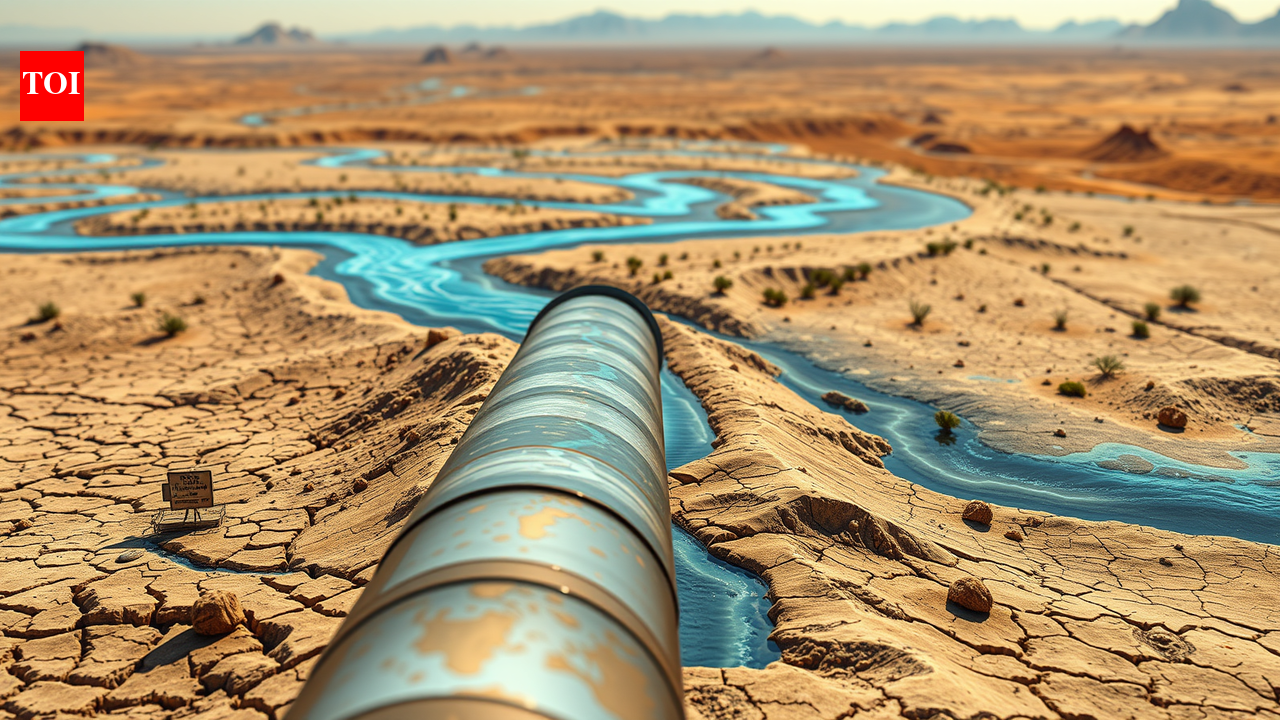
In 1964, American engineers at the Ralph M Parsons Corporation drew up one of the most ambitious infrastructure plans in history, a scheme called the North American Water and Power Alliance, or Nawapa. The idea was to capture excess river water from Alaska and northwestern Canada and send it south through the Rocky Mountain Trench, across the Rockies, and into the water-starved plains and deserts of the United States and northern Mexico. It involved hundreds of dams, canals and tunnels, and was seriously discussed in the US Congress as a project comparable in scale to the space programme. Six decades later, the plan never left the drawing board, but it still shapes conversations about water scarcity today.
What was the Nawapa water diversion plan
Nawapa stood for the North American Water and Power Alliance, a continental water management scheme first conceived in the 1950s and developed into a detailed engineering blueprint in 1964. According to the Smithsonian Institution’s archival records, the plan was designed by the Ralph M Parsons Corporation to collect surplus water from the northwestern part of the continent and distribute it to water-deficient regions across seven Canadian provinces, thirty-three American states and three Mexican states. The scale of the undertaking was staggering even by the standards of an era that had just built the interstate highway system and was racing to put a man on the moon.The plan called for 369 separate construction projects, including a reservoir running the length of the Rocky Mountain Trench in British Columbia that would have stretched hundreds of miles when full, far longer than any reservoir built in North America since. Water would have entered the United States through northern Montana before being redirected toward the headwaters of rivers such as the Colorado and the Yellowstone, effectively rewriting the natural drainage pattern of the continent.
Why engineers wanted to redirect rivers through the Rockies
The logic behind Nawapa came from a simple observation about geography. Alaska and northwestern Canada receive enormous volumes of river runoff every year, most of which flows unused into the Arctic and Pacific oceans, while the American Southwest and northern Mexico were already showing signs of chronic water stress by the early 1960s. Engineers argued that moving even a fraction of that northern water south could secure water supplies for a century or more.The idea fit into a broader mid-century pattern of massive infrastructure ambition. A recent peer-reviewed study on large-scale water transfer projects, published in the International Journal of Environmental Sciences and Natural Resources, places Nawapa alongside other continental-scale diversion schemes proposed during the same period, including Soviet plans to move water from Siberia to Central Asia. The comparison shows that Nawapa was not an isolated fantasy but part of a global engineering mindset that believed water scarcity could be solved through sheer scale of construction.
Why the Nawapa plan was never built
Despite backing from some members of Congress and years of promotion by the Parsons Corporation, Nawapa collapsed under the weight of its own ambition. The projected cost of roughly 100 billion dollars in the 1970s, comparable to the entire interstate highway system, made federal funding politically difficult. Canada was also unwilling to hand over control of its northern rivers to a joint continental authority, and growing environmental awareness through the 1960s and 1970s turned public opinion against a project that would have flooded huge tracts of wilderness and fundamentally altered river ecosystems across two countries.By the 1970s, serious discussion of Nawapa had effectively ended, though the Parsons-backed foundation that promoted it did not formally dissolve until 1990. Archival material held at the Smithsonian, including correspondence between company executives and members of Congress, shows just how far the lobbying effort went before the plan quietly faded from the political agenda.
Does the Nawapa idea still matter for water scarcity today?
Nawapa never became more than paper and promotional film, yet the underlying question it raised has not gone away. Water stress across the American Southwest has only deepened since the 1960s, and large diversion projects elsewhere in the world, including China’s south-to-north water transfer system, show that continental-scale water engineering is still very much part of the conversation among planners and policymakers.What makes Nawapa a useful case study is less the plan itself and more what it reveals about how societies respond to water scarcity. Sixty years on, most water experts now favour smaller, more flexible approaches such as conservation, efficiency and regional transfers over a single grand continental fix. But the scale of Nawapa’s ambition still serves as a reference point whenever a new mega-scale water project is proposed, a reminder of both what large-scale engineering can imagine and why so many of those imaginings never leave the drawing board.







Leave a Reply