
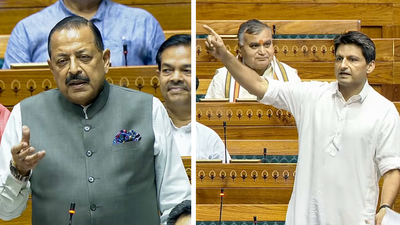
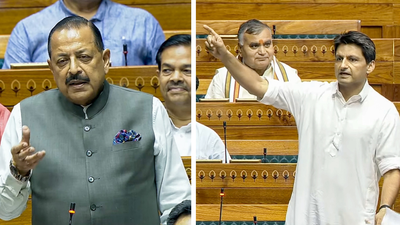
NEW DELHI: “The Leader of the Opposition had gone ‘MIA‘. ‘FOMO‘ perhaps explains why he eventually went and sat outside the Prime Minister’s residence.” These are the words of 69-year old Union minister Jitendra SIngh, who was addressing the Lok Sabha on Wednesday.Until recently, these words belonged to Instagram comment sections, meme pages, K-pop fan communities and WhatsApp chats. This week, however, they echoed through the halls of Parliament.During the Monsoon session, MPs infused their speeches with Gen Z slang and internet catchphrases while taking on political rivals, discussing governance and framing arguments around issues ranging from education to development.BJP MP Bansuri Swaraj, while defending the Centre’s policies, urged the Opposition to “clock it” — a Gen Z phrase meaning to recognise or acknowledge something. “Where Congress created a policy vacuum, Modi clocked it, if I may borrow the language of Gen Z, and created a solution. All the Opposition did was chase political opportunism,” she said, explicitly acknowledging that she was borrowing from the vocabulary of younger generations.BJP’s Tejasvi Surya reached for another popular internet expression, calling the Opposition “delulu” — shorthand for “delusional” — suggesting its criticism of the government was detached from reality.Not to be left behind, Congress MP Deepender Hooda, during debate on anti-paper leak in Lok Sabha, slipped in ‘Kuchu Puchu’ and viral internet catchphrase “Vasteguna Huiya” in a swipe at Centre. “Aaj mera birthday hai toh please kuchu-puchu isteefa de do naaa (Today is my birthday, so please resign cutie pie),” he remarked, giving example of slogans at the recent student protests.Meanwhile, Shiv Sena MP Shrikant Eknath Shinde labelled the Opposition as suffering from “FOMO” — the “Fear of Missing Out” — and even described it as “MIA” (Missing in Action), implying that the Opposition was scrambling to remain politically relevant after missing key opportunities.It was an unusual moment.As Hooda put it, the GenZ with Bhagat Singh’s slogan of ‘Inquilab Zindabad’, turned it into ‘Vastaguna huiya’ when they protested against the government.Parliament, traditionally associated with constitutional language, Hindi idioms and literary references, suddenly sounded like an Instagram comment thread.
What these words mean and where they come from
The internet has a way of making words travel across continents, cultures and generations. Many expressions that now dominate Gen Z conversations were born in niche online communities long before they entered mainstream discourse.
Clock It
Unlike many internet expressions, “clock it” has a much older cultural lineage. The phrase traces its roots to African-American and LGBTQ+ ballroom culture in the United States, where “to clock” someone meant to notice, identify or call out something—often a flaw or inconsistency.Popularised through drag culture and shows such as RuPaul’s Drag Race, the expression later migrated to TikTok and Instagram, where Gen Z adopted it to mean “spot the truth” or “call it as it is”.
Vasteguna Huiya
The phrase traces its roots to the viral meme “Can I get a Hoya?”, in which a teenager shouted the line in an exaggerated tone. In India, content creators gave the meme a local twist by replacing the original phrase with the nonsensical-sounding “Vasteguna Huiya”.The humour lay not in the words themselves—they have no literal meaning—but in the confused reactions they elicited. From there, the phrase spread rapidly across Instagram memes, reels and comment sections before making its way into the CJP student protests.
Kuchu Puchu
“Kuchu Puchu” does not have a single, traceable origin like “delulu” or “FOMO”. Instead, it evolved organically from baby talk, a simplified, affectionate style of speech used by parents, grandparents and couples across many Indian languages.The phrase is believed to be a playful variation of words like “kuchi kuchi,” “guchu puchu,” “kuchi poo,” and similar rhyming expressions that mimic the sounds babies make. Such reduplicative words are common in Hindi, Bengali, Tamil and several other Indian languages, where they are used as terms of endearment for children, pets or romantic partners.In recent years, “kuchu puchu” was revived and popularised by Instagram Reels, YouTube Shorts and meme pages, where it took on a new, often sarcastic meaning. Calling someone “kuchu puchu” can imply that they are overly pampered, babied, innocent or treated with excessive affection.Its popularity surged during the CJP-led student protests, where protesters and social media users used “kuchu puchu” satirically to poke fun at political leaders and institutions.
FOMO
Unlike most Gen Z slang, FOMO predates social media. The acronym, standing for “Fear of Missing Out”, entered popular vocabulary in the early 2000s as psychologists and marketers described the anxiety people felt when they believed others were enjoying experiences they were not part of.Instagram amplified the phenomenon, turning FOMO into one of the defining emotions of the social media age. Today, the term is used far beyond personal life—to describe everything from investment trends to political strategy.
MIA
Originally a military abbreviation for “Missing in Action”, MIA has been repurposed by internet users to describe people who suddenly disappear from conversations, social media or public life.
Delulu
Perhaps the most recognisable Gen Z word today, “delulu” is a shortened version of “delusional”. It first gained popularity within K-pop fandoms, where devoted fans jokingly described unrealistic fantasies—such as believing their favourite idol secretly loved them—as being “delulu”.Over time, the term evolved beyond fandom culture to describe anyone perceived as wildly optimistic or disconnected from reality. Today, it has become a staple of political banter, where opponents routinely accuse each other of being “delulu”.
Why Gen Z language matters
The timing of Parliament’s linguistic makeover is not accidental.The recent protests spearheaded by the Cockroach Janta Party (CJP) over NEET examination paper leaks were organised as much on Instagram and X as they were on the streets. Protesters used memes, short-form videos, viral hashtags and internet humour to mobilise students and simplify complex issues around examination reforms.For many young Indians, politics is now consumed through Instagram Reels, YouTube Shorts and meme pages rather than lengthy parliamentary speeches or television debates. Viral clips often carry more influence than hour-long discussions.Taking notice of the same after massive protests, Prime Minister Narendra Modi also advised his Cabinet to engage with the youth on Instagram through reels and interactive sessions. “Young people are just on Instagram. This is a potential segment of citizens that we all need to connect with,” he said.India’s demographic profile makes this shift even more significant. With one of the world’s youngest populations and millions of first-time voters entering the electorate every election cycle, speaking the language of youth has become a political strategy as much as a communication style.
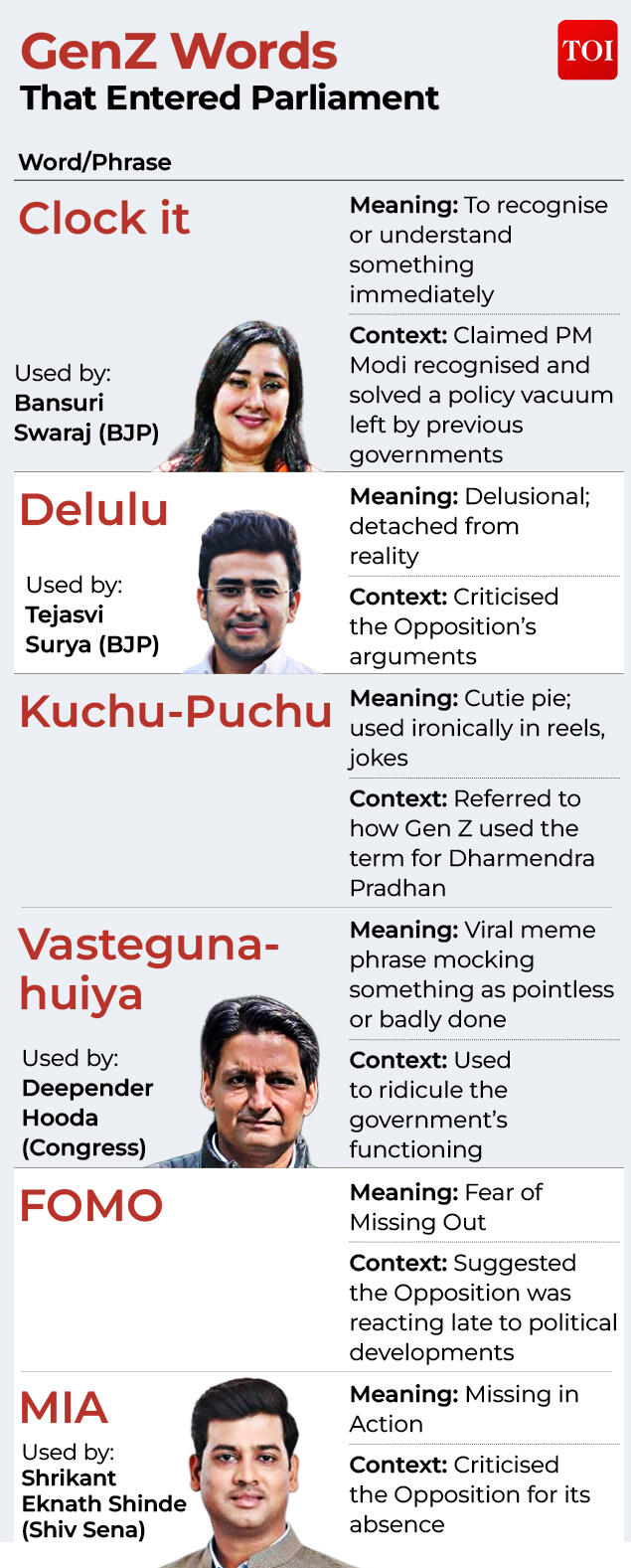
Clock It: Parliament has learned GenZ
Parliament has always borrowed popular language
Although Gen Z slangs in Parliament may sound dramatic, Parliament has always reflected the language of its times.In the early decades after Independence, speeches frequently quoted verses from the Bhagavad Gita, couplets by poets like Mirza Ghalib, Allama Iqbal. Hindi literary works were seen as a mark of oratorical skill.Long before MPs began saying “delulu” or “clock it”, Parliament had embraced the language of popular culture. Bollywood dialogues have long been used to simplify political arguments, inject humour and produce memorable sound bites.Rahul Gandhi’s dig at GST by calling it “Gabbar Singh Tax” transformed a complex debate on GST into a phrase instantly understood across India, while Prime Minister Narendra Modi invoked the character “Mausi” from the Sholay to mock the Congress party during his address in Parliament on July 2, 2024. He teased the opposition over their electoral defeat by mimicking a dialogue: “Arey Mausi, teesri baar toh haare hain, par moral victory toh hai na!” (Oh Mausi, we have lost for the third time too, but it’s a moral victory, right?).In another instance, BJP MP Kangana Ranaut brought DDLJ’s iconic dialogue ‘Ja Simran, jeele apni zindagi’ to life while addressing women’s reservation bill in Lok Sabha.Cricket metaphors soon followed, with terms like “hitting a six”, “playing on the back foot” or being “clean bowled” by the Opposition. Finance ministers have described Budgets as “innings”, while election victories and defeats have routinely been framed as cricket matches.In many ways, Gen Z slang is simply the latest chapter in this evolution. Parliament has never existed in a linguistic vacuum; it has always absorbed the language spoken beyond its walls.
Language keeps evolving
Every generation believes the next one’s vocabulary sounds strange.Words like “cool”, “awesome”, “dude” and “LOL” were once dismissed as youthful fads before becoming mainstream. Today’s internet lexicon follows the same trajectory.Many Gen Z expressions have travelled remarkable distances—from Korean pop fandoms to American drag culture, from gaming communities to TikTok trends—before landing in Indian political discourse. Their journey illustrates how digital platforms have accelerated the movement of language across borders and cultures.Not every slang term will survive. Internet vocabulary evolves at dizzying speed, with new words replacing old ones every few months. But some expressions inevitably escape their online origins to become part of everyday speech.When lawmakers adopt them, it signals that these words have crossed into the mainstream.When Bansuri Swaraj paused to say, “if I may borrow the language of Gen Z”, she acknowledged something larger than a passing linguistic trend.Politics is no longer communicated solely through ideological speeches or parliamentary rhetoric. It increasingly competes in the same digital ecosystem as influencers, meme pages and viral videos, where relatability often matters as much as reasoned argument.Whether that makes parliamentary debate more accessible or more performative remains open to debate. But one thing is clear: as India’s politics becomes increasingly digital, the House is learning to speak not just to Gen Z, but increasingly like Gen Z.






Leave a Reply