


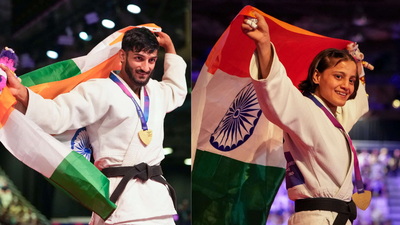
India enjoyed a memorable day in judo at the Commonwealth Games in Glasgow on Friday as Asmita Dey and Harsh Singh won gold medals in their respective categories.Asmita created history by becoming the first Indian judoka to win a Commonwealth Games gold medal after defeating Canada’s Heidi Quach in the women’s 48kg final.Asmita defeated Quach by yuko (2-1) after a golden score contest to give India its first-ever judo gold at the Commonwealth Games.The 23-year-old from Tripura was under pressure early in the final after conceding a yuko and then receiving a penalty, which allowed Quach to take the lead.Asmita fought back with a more attacking approach and levelled the contest at 1-1 shortly after the halfway mark of the four-minute bout.Neither judoka could score the winner during regulation time despite several exchanges, sending the match into the Golden Score period, where the first scoring move decides the result.Asmita stayed calm in the sudden-death period and produced the decisive attack to earn another yuko, sealing the gold medal for India.
Harsh pips experienced Australian judoka for historic men’s 60kg gold
Meanwhile, India’s celebrations continued as Harsh Singh won the men’s 60kg gold medal, defeating Australia’s Joshua Katz by waza-ari (10-0) in the final.The victory gave India their second judo gold medal at the Commonwealth Games. With the victory, Harsh became the first male judoka from the country to win the title.The 23-year-old, competing in his maiden Commonwealth Games, claimed the biggest title of his career with a composed and tactically astute performance against the Australian Olympian, who was widely regarded as the favourite for the gold.Katz started aggressively, but Harsh defended well and prevented the Australian from taking an early advantage.Harsh looked for his opportunities throughout the contest. At one stage, Katz almost pinned him down, but the Indian escaped and tried to pin his opponent in return. Neither effort earned any points.With neither judoka scoring and less than a minute left, Harsh produced the winning move at the 3:19 mark, executing a throw and pin that earned him a waza-ari, enough to seal the contest.A waza-ari is the second-highest score in judo and gives a major advantage. It is awarded for a throw that misses one element needed for an ippon or for a ground hold lasting 10 to 19 seconds. Two waza-aris equal one ippon, which ends the match immediately.Unfazed by his opponent’s pedigree, Harsh remained composed throughout the contest, refusing to be overawed by the occasion. His decisive waza-ari ultimately proved enough to seal the Australian’s fate and deliver India second judo gold of the day.





Leave a Reply