
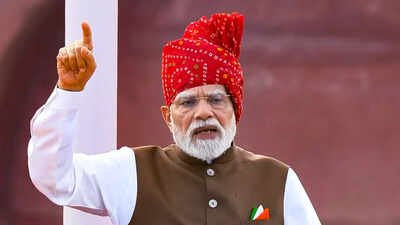
NEW DELHI: Prime Minister Narendra Modi on Saturday laid out a broad roadmap for building a Viksit Bharat by 2047 during his Independence Day address, outlining seven “shaktis” that he said would drive India’s next phase of growth. The framework, called ‘Shakti Ki Saptadhara’, covers manufacturing, agriculture and food processing, technology and innovation, Gati Shakti, defence production, the green and blue economy, and India’s soft power.Addressing the nation from the ramparts of the Red Fort on the 80th Independence Day, PM Modi also said India had moved from being counted among the ‘Fragile Five’ economies to becoming the world’s fastest-growing major economy over the past 12 years. He linked the country’s economic ambitions with the target of becoming a developed nation by 2047.PM Modi also focused on India’s manufacturing and export ambitions, calling on businesses, particularly MSMEs, to use the opportunities created by free trade agreements. He said Indian products ranging from textiles and machinery to medicines and seafood should reach global markets while meeting international standards on cost, quality and scale.Also read – ‘Every heart is beating with rhythm of Vande Mataram’: PM Modi addresses nation on 80th I-Day – top quotesThe prime minister announced several initiatives aimed at India’s youth, including a plan to train one crore young people in artificial intelligence skills and provide free online coaching for competitive examinations. PM Modi also linked the Viksit Bharat goal to India’s young population, saying the youth would be both the biggest beneficiary and the biggest enabler of the country’s development.Also read – 80th Independence Day: A throwback at PM Modi’s signature Red Fort turbansOn internal security, PM Modi said armed Naxalism had been curbed but warned against what he called “dimagi naxals”. He said such people, whom he accused of retaining Maoist thinking, needed to be “identified, and isolated” so that the country’s youth could be brought together for a developed India.PM Modi also spoke about India’s strategic self-reliance, including defence production, semiconductors, energy and technology. He said India must reduce dependence on external sources in critical sectors while expanding its role as a global supplier and innovation hub.Also read: Key highlights from 80th Independence Day
1. ‘Shakti Ki Saptadhara’: PM Modi unveils 7-point roadmap for Viksit Bharat
PM Modi unveiled ‘Shakti Ki Saptadhara’, outlining seven areas that he said would form the foundation of India’s journey towards becoming a developed nation by 2047.“Today I want to remind you of ‘Sapta Sindhu’. Now, to build a Viksit Bharat, we need a new current. The first ‘shakti’ of the Sapta Dhara is the manufacturing sector. For this, we need to focus on three things: cost, quality and scale. There should be no compromise on quality. This will be our brand value. The second ‘shakti’ is food processing. With the new FTAs, we have access to greater global markets now. The third ‘shakti’ is technology, innovation and digital technologies,” the PM said.Manufacturing: PM Modi said India must become a reliable global manufacturing hub, with companies competing on cost, quality and scale.“From Design to Manufacturing, India must become a reliable hub in the global supply chain. For this, I want to place special emphasis on 3 things. My brothers and sisters in the field of Manufacturing, do not let this opportunity slip away. For this, we will have to meet global standards on cost, quality, and scale,” PM Modi said.He also stressed quality as a core requirement for Indian manufacturing.“When it comes to quality, there should be ‘No Compromise’. Therefore, our core mantra must be: ‘Quality, Quality, Quality’,” he said.Agriculture and food processing: PM Modi identified agriculture and food processing as the second stream, saying Indian farmers should use access created by FTAs to reach international markets.“The second strength of Saptadhara is agriculture and food processing. We must move forward in this direction. The world’s markets are now open for our farmers. Due to FTAs, we are gaining access to a very large market; we must reach it. We must go from the farm to the export market. Our traditional cuisine, millets, spices, and fruits and flowers should become global brands,” he said.Technology and innovation: PM Modi described technology and innovation as the third strength, with AI, quantum technology, space, robotics and data centres among the areas India needs to develop.“The third strength of the Saptadhara is technology and innovation. This is the era of robotics, AI, quantum technology, space and data centres. Emerging technologies are presenting new challenges, and we must become a global hub of innovation,” PM Modi said.“We have already demonstrated our strength through UPI and Digital Public Infrastructure. Now, we must take the next leap in next-generation communication technology,” he added.Gati Shakti: The fourth stream focuses on connectivity and infrastructure, including high-speed rail, highways, inland waterways, airports, multimodal logistics hubs and ports.“Through Gati Shakti, we must focus on seamless, high-speed connectivity across the country. We need to connect cities via high-speed rail, build modern highways, inland waterways, advanced airports, and robust multimodal logistics systems,” he said. PM Modi also called for port-led development.Raksha Shakti: Defence production forms the fifth stream, with PM Modi calling for greater self-reliance and the development of next-generation defence technologies.“The importance of defence capability is paramount in every sense. My dear citizens, achieving Aatmanirbharta in defence is essential; India and the world have realised that there is no alternative. When the world looks out for itself, India cannot merely remain an arms market for other nations,” he said.Green and Blue Economy: The sixth stream covers renewable energy, energy storage, green manufacturing and the blue economy.“The sixth strength of the Sapta Dhara is the Green economy. We must work in the areas of renewable energy, energy storage, green storage and manufacturing. India has an opportunity in the area of the Blue Economy. “PM Modi said the blue economy offered opportunities in areas including fisheries, coastal tourism and ocean technology.Soft power: India’s soft power is the seventh stream, with PM Modi citing yoga, Ayurveda, handicrafts, culture, films, animation, gaming and digital content.“The seventh strength of the Sapta Dhara is India’s soft power. Today, Yoga has connected the world to India. Our Ayurveda, holistic healthcare, handicrafts, culture, films, animation, gaming, digital content. The world is recognizing and looking forward to India’s WAVES summit. We have more than 100 national parks. We have an opportunity to attract foreign tourists through the power of soft power.”PM Modi also said, “India’s soft power is truly immense. Today, Yoga has connected the entire world to India. Yoga is becoming a source of energy for humanity and a major pillar of trust in India. For a country rich with centres of faith, Ayurveda, holistic healthcare systems, and the ‘Heal in India’ initiative, we can showcase our strengths to the world through handicrafts, culture, films, our creative ecosystem, VFX, animation, gaming, and digital content. In the creative world, India can establish its pre-eminence,” PM Modi said.
2. ‘Dimagi Naxals’ to be identified and isolated, says PM Modi
PM Modi said armed Naxalism had been curbed but warned that people with Maoist thinking remained present in different parts of the country.“For years, people with Maoist thinking were there in public life, even in government committees this thinking had affected various institutions and initiatives. My dear countrymen, we have been able to curb and free the country from ‘hathariya naxal’ (armed naxal). Even if these naxals are gone, but the ‘dimagi naxal’ (people with naxal thinking), are looking for an opportunity, looking to see ways of violence, and trying to drag the country to a wrong path. We need to identify these dimagi naxal, isolate them, and bring the youth together for a developed country,” PM Modi said.PM Modi said Naxalism and Maoism had affected large parts of the country for decades and referred to the deaths of more than 3,500 security personnel.“Naxalism, Maoism destroyed the dreams of lakhs of youth. It stole the sons of numerous mothers, crushed the dreams of numerous mothers. This naxalism had kept a large part of India and population as a hostage for 4 decades with the barrel of a gun, they had destroyed the Constitution,” PM Modi said during his Independence Day address.“More than 3,500 security personnel were martyred while protecting the people of the country. More police personnel were killed than soldiers in war, police personnel had to put their lives on the line so that people can get security. This naxalism had covered the country in blood. In 2014, when you gave us the opportunity we had decided that we will rid the country of naxalism, and today I am happy to announce that naxalism does not have even the strength for breathing,” the Prime Minister added.PM Modi said regions that had once witnessed Naxal violence were now seeing development.
3. From ‘Fragile Five’ to fastest-growing major economy: PM Modi highlights 12-year transformation
PM Modi said India had moved from being counted among the world’s ‘Fragile Five’ economies to becoming the fastest-growing major economy in the past 12 years.Addressing the nation from the Red Fort, PM Modi said India had faced doubts about its economic strength but had since made substantial progress.The prime minister also linked the economic transformation with India’s goal of becoming a developed nation by 2047.“When the world’s most populous nation sets its sights on becoming a developed country, it sends a powerful message to the world and is reshaping how the world sees India,” he said.PM Modi said India was moving ahead with greater speed and confidence and cited growth in several sectors. He said defence production had increased four times, electronic manufacturing seven times, modern railway coach production 21 times, internet users four times and digital transactions 100 times over the period cited by him.PM Modi also spoke about India’s semiconductor push, saying the country had already begun production at three semiconductor plants and that additional plants were expected to come up in the coming years.
4. MSMEs urged to use FTAs to take Indian products to global markets
PM Modi called on India’s micro, small and medium enterprises to use opportunities created by free trade agreements and expand the global reach of Indian products.“We have to reach the world. Everything that India produces should reach the world market,” Modi said, adding that sectors such as textiles, machinery and pharmaceuticals have significant potential to expand their global footprint.PM Modi said India had signed FTAs with around 40 countries since 2014 and that the agreements had opened new opportunities for domestic businesses, particularly MSMEs.He cited textiles, machinery, medicines, fisheries and seafood as sectors that could expand their presence in global markets. PM Modi also referred to India’s textile industry from Ludhiana to Tirupur and called for greater global representation for Indian products.The prime minister stressed that Indian companies would have to meet international standards to compete in global markets.PM Modi also set out broader ambitions for Indian companies, asking why India should not have 50 companies in the Fortune 500 in the coming decade. He also said India should aim to have an Indian bank among the world’s top five banks and one or more pharmaceutical companies among the world’s top five.“Why shouldn’t India have 50 companies” in the Fortune 500 in the coming decade, he asked.PM Modi said India’s technology companies should become globally recognised brands.“India’s technology companies should be a scoreboard in the world,” he said.
5. AI training for 1 crore youth, free online coaching for competitive exams
PM Modi announced that one crore young people would be trained in artificial intelligence-related skills as part of efforts to prepare India’s youth for emerging technologies.He also announced free online coaching for young people preparing for various competitive examinations.PM Modi linked the youth-focused initiatives with his broader Viksit Bharat vision and said India’s young population would be central to achieving the country’s development goals.“When I speak of a developed India, when I speak of propelling the nation forward at a rapid pace, the greatest beneficiary and the greatest enabler of this vision is the youth of my country, the youthful energy of my nation. Not only that, but the greatest beneficiary of a developed India is also the youth of my country. Therefore, we must advance the goal of a developed India by linking it with our youth,” PM Modi said.PM Modi also announced plans for a nationwide sports talent hunt to identify and nurture children between five and 15 years of age across villages and cities.He said the government was also working on civil defence reforms, including modernised training and enhanced capabilities to respond to emerging security challenges.“I announce today from the Red Fort that we will establish a vibrant Civil Defence network in the coming days. We will familiarize them with modern systems. What measures can be put in place to protect citizens from modern-day crises? We are going to create a massive, modern Civil Defence volunteer force capable of overcoming contemporary challenges. Today, the contribution of our sisters and daughters to nation-building serves as a great source of inspiration for us all. Whether it is fighter jets or civil aviation, our daughters are at the forefront. Be it the sports arena or STEM education, our daughters are leading the way. Even in the armed forces, daughters graduating from the NDA are demonstrating the capability to lead the nation’s military with great confidence and authority,” the PM said.
Semiconductors, nuclear power and self-reliance
PM Modi also outlined targets for critical technologies and energy as part of India’s broader self-reliance agenda.He said India had already started production at three semiconductor plants and announced that five to eight more plants were expected to come up in the coming years.PM Modi also said India aims to achieve 100 GW of nuclear power capacity by 2047, with five new reactors expected to become operational within the next six to seven years.On the wider question of strategic self-reliance, PM Modi said the global environment had changed, with countries increasingly prioritising their own interests and critical resources being used as strategic tools.“There was a time when I spoke of self-reliance, and people sitting in air-conditioned chambers would question what would happen to globalization. But the world is witnessing that, over the last decade, it seems as though the global discourse on globalization has ceased; the voices that once championed it are no longer heard. Every nation has shifted towards a mindset of looking after its own interests. Unfortunately, during this period of crisis, some have played the game of weaponizing resources to assert their dominance.
Share your thoughts in the comments
Be respectful · TOI community guidelines
The world is busy weaponizing whatever it possesses—be it petrol, diesel, fertilizers, medicines, or technology chips. Even territory is being weaponized. Had we not moved in the right direction for the past ten years, guided by the mantra of self-reliance, one can only imagine how we would have confronted such challenges with strength. And our preparedness continues to grow…”PM Modi said India’s manufacturing, technology, defence, agriculture, energy and cultural strengths would form part of the country’s effort to achieve Viksit Bharat by 2047.




Leave a Reply