
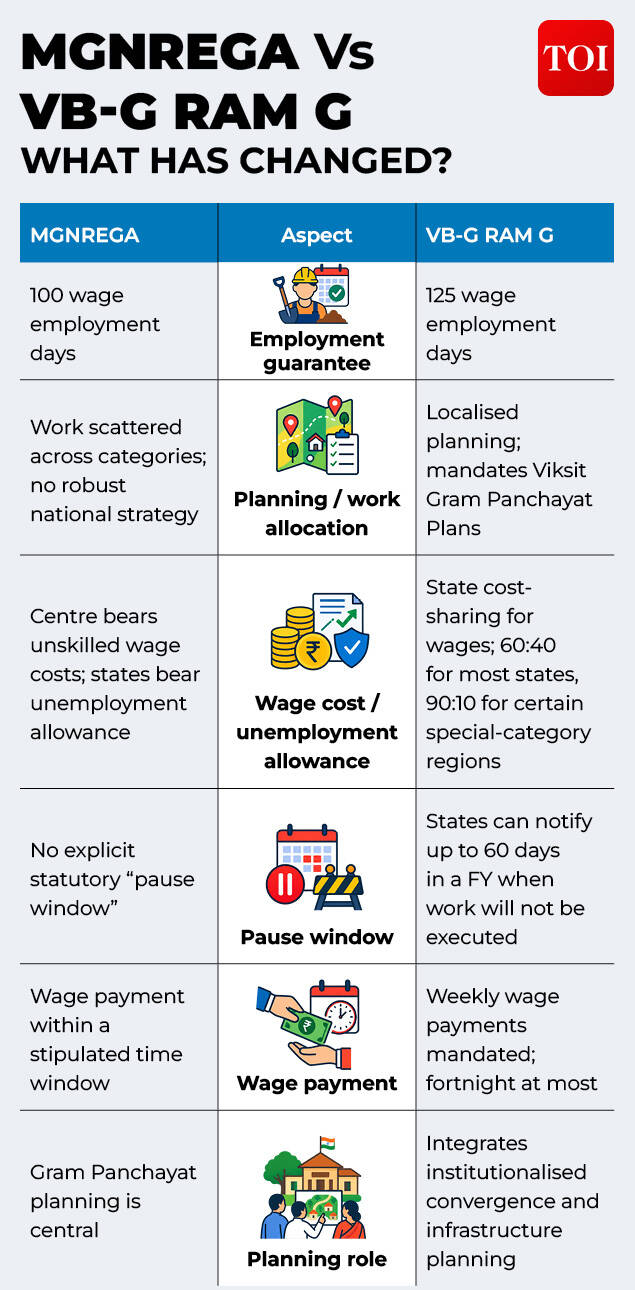
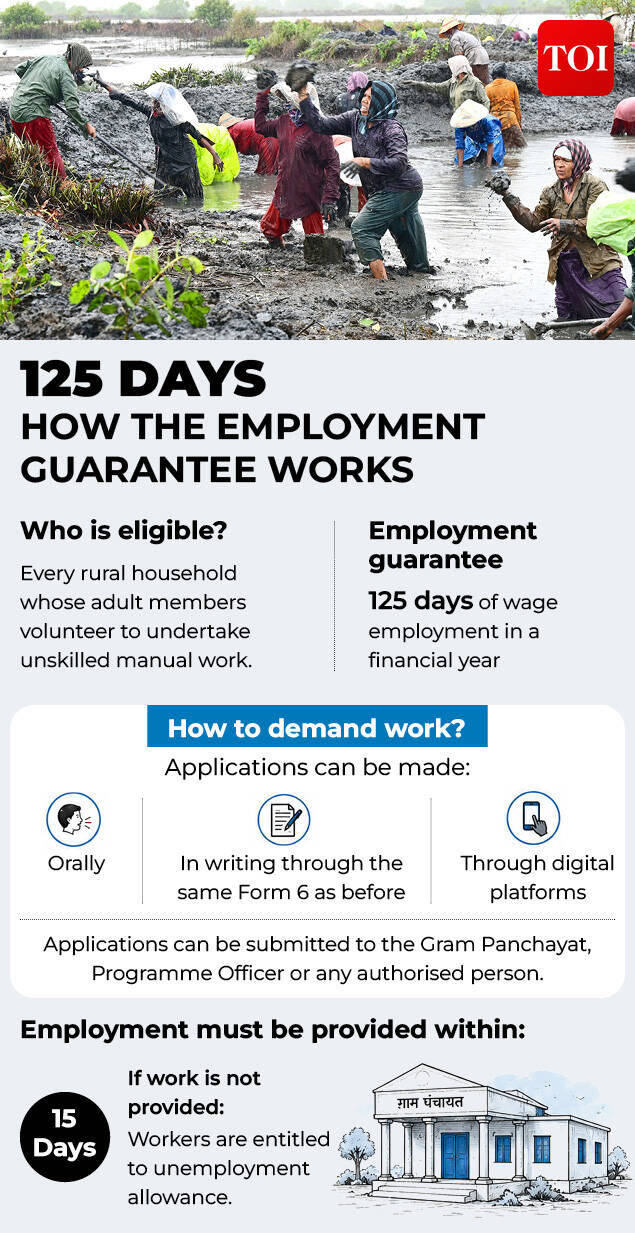
MGNREGA, which served as rural India’s job safety net for two decades, was repealed on July 1, 2026. In its place is the Viksit Bharat–Guarantee for Rozgar and Ajeevika Mission (Gramin), or VB-G RAM G, which raises the guaranteed employment from 100 to 125 days per rural household.The new scheme has set an approved labour budget of 95.03 crore person-days. So far, 62.20 crore person-days have been generated, or 65.51% of the approved target. Of these, 16.84% have gone to Scheduled Caste workers.Government data showed that 5.20 crore person-days had been generated by July 22, with more than 99.5% of workers who demanded employment having been offered work. Subsequently, the government told Parliament that more than 9.69 crore person-days had been generated in approximately the first month of implementation.That raises the bigger question: what does VB-G RAM G change for rural employment, and how does its scale compare with the programme it replaces? With 125 days of guaranteed work, a new funding structure and a different allocation framework, the impact will be particularly significant for states that have historically relied heavily on the rural jobs programme.
What will change under the new employment scheme
With VB-G RAM G, the government wants rural employment to create durable assets while linking wage work with village infrastructure, livelihoods and climate resilience. The permitted works include water-related projects, core rural infrastructure, livelihood-related infrastructure and projects to tackle extreme weather events.In short, the government’s pitch is simple: more days of work, better wages and more useful assets for rural India.But what does it mean for states?
The biggest change states cannot ignore
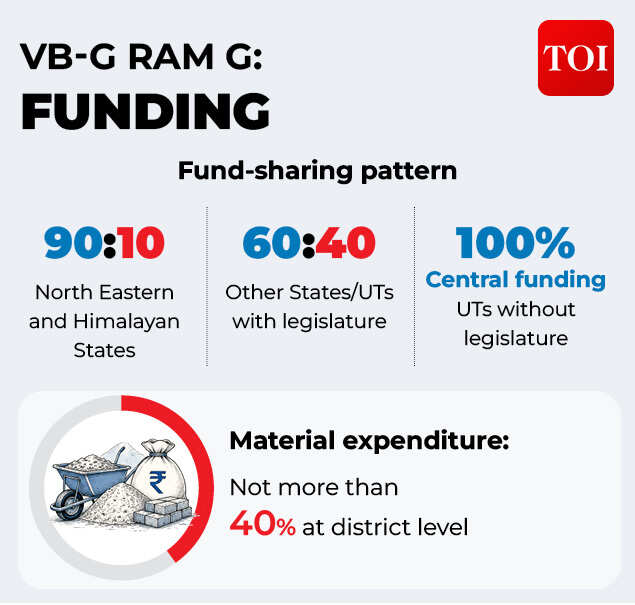
The Viksit Bharat–Guarantee for Rozgar and Ajeevika Mission (Gramin), or VB-G RAM G, came into force across rural India on July 1, 2026. With it, MGNREGA, enacted in 2005, was repealed.Workers continue to have the right to demand work and are entitled to unemployment allowance if employment is not provided within the prescribed period. But the way the programme is funded and allocated has changed significantly.Under MGNREGA, the Centre bore the full cost of unskilled wages and 75% of material costs and wages of skilled and semi-skilled workers, while states met the remaining share along with certain other liabilities.Under VB-G RAM G, most states will have to share the cost with the Centre in a 60:40 ratio. That means states will have to put more of their own money into the programme.This is important because many of the states that have historically generated the highest number of rural employment person-days are also among the biggest beneficiaries of the new scheme.The Centre has earmarked Rs 95,692.31 crore as its share for VB-G RAM G in 2026-27, covering the nine-month period from July 1 to March 31. Including the expected state contribution, the total programme outlay is estimated to cross Rs 1.51 lakh crore.
States at stake: Where the transition matters most
The new framework retains the rural employment guarantee but changes how work is funded, allocated and planned, with major implications for states that have historically accounted for a large share of rural employment workers and person-days.Tamil Nadu, Uttar Pradesh, Rajasthan, Andhra Pradesh and Bihar remain among the biggest users of the programme, according to government data. SBI Research, however, estimates that the new funding formula could significantly alter the distribution of funds among states.Under MGNREGA, the Centre bore the entire cost of unskilled wages and 75% of material and skilled or semi-skilled wage costs. Under VB-G RAM G, the ratio for most states has shifted to 60:40, while specified North-Eastern and Himalayan states and Jammu & Kashmir retain the 90:10 arrangement.The new law also allows states to notify an aggregate period of up to 60 days during the peak agricultural season when works under the programme may be paused, with the stated aim of ensuring labour availability for agriculture. The 125-day guarantee means at least 25 additional days of employment remain available outside this period compared with the earlier 100-day entitlement.Works will focus on four areas: water security, core rural infrastructure, livelihood-related infrastructure and climate resilience.Another key change is the move towards normative allocation. State allocations will consider factors including rural population, work demand, number of Gram Panchayats, women’s participation, person-days generated and individual asset creation.The government has, however, maintained that the scheme continues to be demand-driven and that workers retain the statutory right to demand employment. The normative allocation relates to how the financial envelope is apportioned among states.This could reshape the flow of funds, particularly for states that have traditionally relied heavily on the rural jobs programme.
UP, Maharashtra could emerge as biggest gainers
According to an SBI Research report released in December 2025, a hypothetical exercise comparing the new normative formula with average MGNREGA allocations during FY19-FY25, excluding Covid-hit FY21, suggests that Uttar Pradesh and Maharashtra could be the biggest gainers under the new framework.UP could see a notional increase of about Rs 5,568 crore, while Maharashtra could gain around Rs 4,284 crore. Chhattisgarh, Gujarat and Bihar follow, with estimated gains of Rs 1,609 crore, Rs 1,336 crore and Rs 1,152 crore, respectively.
What will change under the new employment scheme
The overall simulated gain for states is around Rs 16,946 crore. SBI Research says almost all states could be net gainers under the hypothetical formula, with Andhra Pradesh and Tamil Nadu the exceptions.However, these numbers are illustrative and not final allocations, as the outcome is liable to change depending on the final criteria, weights, demand and implementation.
UP: Largest potential beneficiary
Uttar Pradesh has one of the country’s largest rural employment bases, and SBI Research’s simulation suggests it could emerge as the biggest beneficiary under the new framework.More than a month after the scheme came into effect on July 1, rural development department data show that 7.69 lakh households have availed themselves of employment. The state has more than 1.77 crore job card-holding households, although the two figures cannot be directly compared as a measure of unmet demand because not every job-card household necessarily seeks work in a given period.Nationwide, government data showed that more than 99.5% of workers who had demanded employment by July 22 had been offered work.The early numbers come as the Centre pitches VB-G RAM G as an upgrade over MGNREGA, with a larger budget, 125 days of guaranteed employment and greater emphasis on creating rural assets.UP’s job-card base is also significant. Of the 1.77 crore households, around 52.8 lakh are from Scheduled Caste communities, 1.78 lakh are tribal households, while about 1.22 crore belong to the general and OBC categories.For comparison, SBI Research’s FY26 data show around 49 lakh households had worked under MGNREGA in UP, while government data show more than 62 lakh people availed themselves of employment under the scheme in FY25-26.SBI Research has also argued that there was scope to improve employment generation through better spending efficiency. In its FY25 analysis, it estimated that spending levels could potentially have supported employment for around 81 lakh households in UP, compared with 65.3 lakh households actually employed.
Tamil Nadu has a lot at stake
Tamil Nadu is one of the largest users of the rural jobs programme. In FY26 so far, around 53 lakh households in the state had worked under MGNREGA, according to the SBI Research compilation. The state also generated around 1,274 lakh person-days during the period covered by the report.The SBI simulation puts Tamil Nadu’s notional allocation Rs 909 crore below its historical average. However, the report says that if an unusual 29% rise in allocation in FY24 is excluded, the estimated loss falls to just Rs 63 crore.
Who will fund VB-G RAM G
Tamil Nadu’s importance is also visible in the government’s latest data. In FY25-26, 7.58 million people availed themselves of employment under MGNREGA in the state.
Rajasthan, Bihar and Andhra Pradesh also remain crucial
Rajasthan was another major user of the rural jobs programme. About 42 lakh households had worked under MGNREGA in FY26 so far in the SBI dataset, while the state received around Rs 7,582 crore under the 2025-26 allocation.Bihar had around 46 lakh households working under MGNREGA in the SBI data and received about Rs 6,716 crore under the FY26 allocation. SBI’s hypothetical formula indicates a potential gain of around Rs 1,152 crore for the state.Andhra Pradesh is a different case. It remains one of the biggest rural jobs states, with about 41 lakh households working under MGNREGA in the SBI dataset and an FY26 allocation of around Rs 7,707 crore. But the SBI simulation shows a small potential decline of around Rs 140 crore compared with its historical average.The Centre’s financial commitment under the new scheme is also higher. SBI Research estimates that the annual requirement for wages, materials and administration under VB-G RAM G could be around Rs 1.51 lakh crore, including the state contribution. The estimated Centre share alone is around Rs 95,692 crore, about 11% higher than the Rs 86,000 crore MGNREGA budget allocation for FY26.The government has also released state-wise allocations under VB-G RAM G for FY27. The total state-wise allocation is about Rs 93,842 crore, with the Centre’s overall share, including funds for social audit and central administration, taking the figure to Rs 95,692 crore.Among the biggest state allocations are Uttar Pradesh at Rs 9,721 crore, West Bengal at Rs 8,508 crore, Andhra Pradesh at Rs 7,707 crore, Tamil Nadu at Rs 7,585 crore, Rajasthan at Rs 7,582 crore, Bihar at Rs 6,716 crore and Madhya Pradesh at Rs 6,252 crore.
States pay more
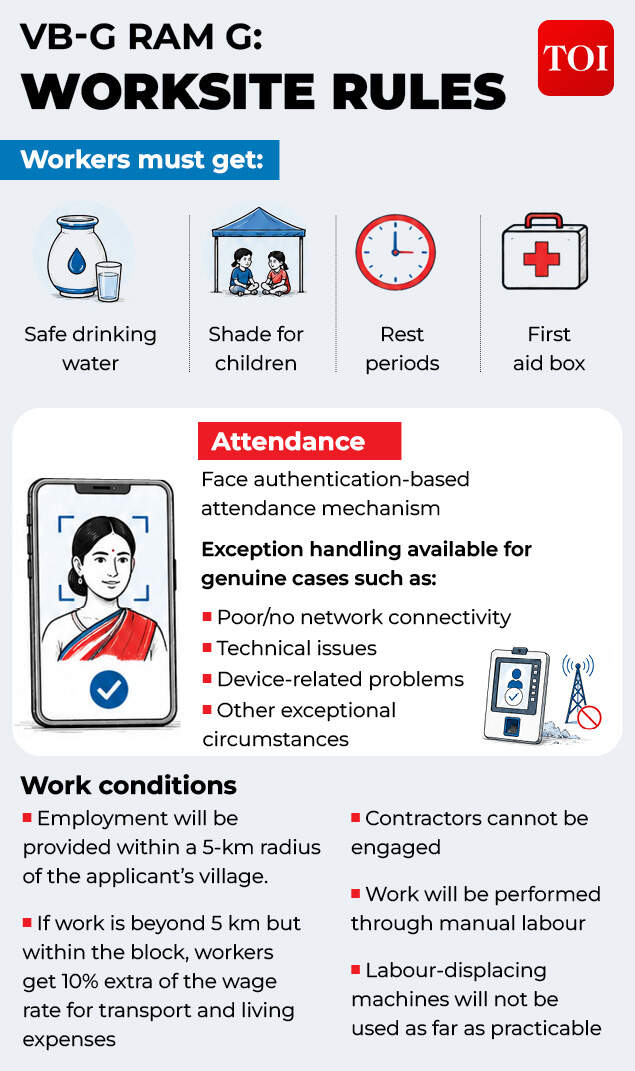
The bigger central allocation comes with a bigger financial responsibility for states. Under the new 60:40 arrangement, most states will have to fund 40% of the programme cost.SBI Research argues that concerns over widespread fiscal stress may be overstated, noting that states already had financial responsibilities under MGNREGA, including unemployment allowance, part of material costs and state-level administrative expenses. It also points out that a majority of states have borrowed below their permitted fiscal-deficit limits in recent years.Still, the shift means states will need to decide where to deploy their rural-development spending, particularly because the new scheme is expected to involve more asset creation and infrastructure-linked works.
Applying for the new employment scheme
More jobs — but also more scrutiny
The biggest promise of VB-G RAM G is not simply higher spending, but better conversion of spending into employment and rural assets.SBI Research estimates that around 5.78 crore households worked under MGNREGA in FY25. Its analysis of 18 major states suggests that better spending efficiency could potentially have supported employment for more households under the old system.The new system therefore brings stronger monitoring mechanisms, including biometric authentication, spatial technology-based planning, digital monitoring, weekly public disclosure and strengthened social audits.The role of Gram Panchayats is also being expanded. They are expected to become the centre of planning, implementation and monitoring, with the idea that works can be better matched to local requirements.
The bottom line
The shift from MGNREGA to VB-G RAM G changes more than the number of guaranteed workdays. For states, the bigger questions are how funds are allocated, how much they have to contribute and what the money delivers on the ground.The new formula could reshuffle the state-wise picture, with SBI Research’s simulation pointing to Uttar Pradesh and Maharashtra as potential major gainers, while Tamil Nadu and Andhra Pradesh could see modest reductions compared with their historical averages. The final outcome, however, will depend on the criteria and weights adopted and how efficiently states use their share.
Share your thoughts in the comments
Be respectful · TOI community guidelines
For workers, VB-G RAM G raises the employment guarantee by 25 days, while retaining the statutory right to demand work. For the Centre and states, it introduces a different funding structure and a greater emphasis on creating durable rural assets.The comparison with MGNREGA, therefore, is not simply about whether more or fewer person-days are generated. The bigger shift lies in the scale of the guarantee, how the programme is funded and how rural employment spending is expected to translate into infrastructure and livelihood assets. How these changes play out across states will become clearer as implementation gathers pace.






Leave a Reply