
Biryani made with Kaima instead of Basmati, payesh made with Badshahbhog, risotto made with Assam’s Bora. With heirloom rice vanishing from Indian kitchens faster than they could be documented, this seemed, until not very long ago, nothing more than nostalgia. The Green Revolution’s push for high-yield monoculture had, over the years, pushed out many old types of rice. But now, several of those varieties, thought long gone, are staging a comeback — thanks to the efforts of farmers, conservationists, NGOs, restaurateurs, and a bit of help from some state govts.
Guardians of the grain
In coastal Karnataka’s Nettanige village, Padma Shri awardee Sathyanarayana Beleri — everyone calls him ‘Seeding Sathya’ — nurtures more than 100 traditional paddy varieties in grow bags outside his house. It’s a small selection from his vast collection of over 650 seed varieties, collected from across India, Sri Lanka, Japan and the Philippines.He has strains of flood-resistant Edekunhi and Nereguli, the medicinal Dodda Byra Nellu, and Kalanamak (also called ‘Buddha Rice’). He’s distributed seeds to hundreds of farmers across Karnataka and Kerala, as well as to agricultural universities nationwide. “Rice”, he says, “can be cultivated in grow bags, just like vegetables at home. As climate change reshapes agriculture, conserving traditional, climate-resilient varieties is no longer a choice. It is a necessity.”
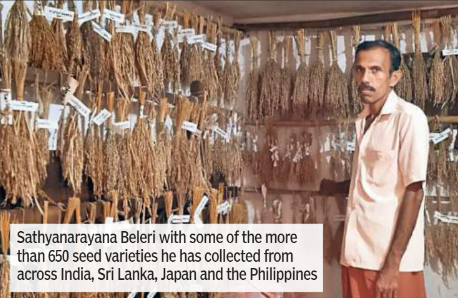
Sathyanarayana Beleri with some of the more than 650 seed varieties he has collected from across India, Sri Lanka, Japan and the Philippines.
Further inland, entire families have turned conservation into a generational commitment. In Belthangady taluk, the Rao family has conserved 180-190 traditional varieties on 5.5 acres since B K Deva Rao started a seed bank in 1988. His son, Parameshwar Rao, points to a benefit beyond biodiversity. “Paddy cultivation is among the best forms of groundwater recharge and rainwater harvesting,” he says. “Strong field bunds can retain water for nearly a week. Even two cropping cycles can substantially improve the groundwater table.” Their prized variety, Kayame — a red rice — “has a flavour rarely found in modern commercial varieties,” he adds.Some 1,300km away in Chhattisgarh, Khemlal Dewangan, a maths teacher in Rajnandgaon district, started farming traditional paddy around 15 years ago. Dewangan started with a handful of desi strains. He now has a collection of around 70 varieties.His seed collection has grown through a nationwide network of farmers — brought together on WhatsApp — who test small quantities in their fields. “I now receive 10-15 enquiries a day from social media and word of mouth,” he says.For him, the appeal goes beyond the market: he says traditional varieties are healthier, as they take longer to mature, absorbing more soil nutrients.
Roots of a revival
None of this happened by accident. Back in 2004, the UN’s second International Year of Rice, Kerala-based NGO Thanal decided something had to be done about India’s vanishing rice varieties. They launched the Save Our Rice campaign through a workshop in Kumbalangi village. Thanal teamed up with Tamil Nadu’s CREATE (a non-profit organisation) to run it, and the campaign took root in Tamil Nadu, Kerala, Karnataka and Bengal, later spreading into Chhattisgarh.
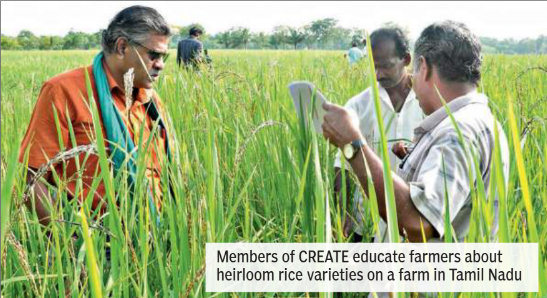
Members of CREATE educate farmers about heirloom rice varieties on a farm in Tamil Nadu.
India had over one lakh varieties of rice in 1966, but by the time the campaign started, that number had dropped to around 30,000 — most locked away in university seed banks, rather than growing in farmers’ fields. The campaign has had a big impact on southern states. “In the last 15-16 years, there has been a revival of traditional seeds in these states,” says Jayakumar C, executive director at Thanal. “Today, there are more than 25 or 30 farmers or groups doing traditional seeds in different parts of Kerala. Thanal’s own centre in Wayanad now holds around 320- 330 varieties of rice.”That demand has started showing up in the market. Thanal runs a regular shop now in Thiruvananthapuram. Jayakumar says Kaima (also called Jeerakasala or Jeeraga Samba), a traditional variety, has become popular for biryani. Brands have caught on, too. Thondi, from a Wayanad farmer-producer company, sells online and via courier across Kerala’s cities, even as Mappila Chamba has built a following.“Traditional rice tends to be more filling,” says Jayakumar. You feel full after eating less, unlike white rice hybrids. Also, the longer shelf life and taste after cooking is winning over urban households, especially the older people.”
When state stepped in
In Tamil Nadu, govt push gave the revival momentum. According to Suresh Kanna, project director at CREATE Trust, state govt began promoting six native varieties some 10 years ago under the State Heritage Rice Mission: Mappillai Samba, Karuppu Kavuni, Thooyamalli, Poongar, Kaattuyaanam and Kichili Samba. “Today, they are liked by consumers and can be seen in organic shops across the state. They also fetch good income for the farmers. A Kavuni farmer can get up to Rs 200 for a kilo. My calculation is that more than one lakh farmers in the state are now cultivating traditional paddy varieties,” Kanna says.Even in Karnataka, grassroots efforts are now finding institutional backing. KVK Dakshina Kannada has begun field trials of 10 traditional varieties sourced from Beleri, aiming to identify strains suited to the coastal region, and reintroduce them into local food systems. Karnataka’s agriculture department has documented 2,164 traditional landraces (local, traditional varieties that evolved through natural and human selection to adapt to a specific geographic and climatic environment) across 20 crops, with paddy topping the list at 1,469 varieties, under its Conservation and Promotion of Landraces Programme. Rs 1.3 crore in incentives went to 490 farmers in 2025-26 for viable seed samples. The effort centres on custodian farmers who “continued cultivating them on small patches of land,” as department director GT Puthra puts it.The department is now supporting GI registration for varieties including Kagga paddy, Rajmudi paddy, Bijapur Jola, Joni Bella and Kumbi Mudli, and plans incentives for 15 “forgotten treasure” shops.
Farm to fork, fork to fame
A few restaurants are actively championing rare, indigenous rice over commercial varieties. Edible Archives in Goa works with regional grains like Thavala Kannan from Wayanad (a red rice from Palakkad, whose name means “frog’s eyes” in Malayalam), and Pokkali, which brings a distinct coastal terroir.The Kolkata-based Amar Khamar, both a heritage-grain retail brand and restaurant, is entirely built around Bengal’s native rice. Its signature is ‘Chhuti-r Bhat’, an 11-course meal following the traditional sequence of a Bengali meal, centred on heirloom varieties like Sugondhi Chine Kamini Aatap.
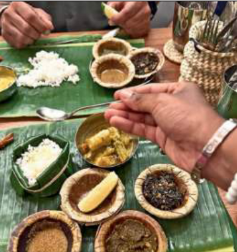
‘Chhuti-r Bhat’ in Kolkata’s Amar Khamar, which is an 11-course meal centred on heirloom rice varieties.
That influence has spread to other restaurants in the city. Sienna Cafe sources Chine Kamini, Radha Tilok, Kanakchur and Tulaipanji Atop from Amar Khamar; Yokocho, a Japanese alleyway-inspired bar and BBQ, draws on Kanakchur, Tulaipanji Atop and Karpurkanti; Red Bari incorporates Shatia, Mallifulo and Khejur Chhari.Juhi Punwani, head of kitchen operations at Amar Khamar, has built a career around collecting the many myths and stories behind Bengal’s native rice varieties. “Gobindobhog is not the only heritage rice in Bengal,” she says. A rice called Radhuni Pagol literally means “the cook gone crazy”, after lore that its fragrance once filled a kitchen so completely that the cook couldn’t think of anything else.Tulaipanji of North Bengal gets its name from how the cooked rice turns light and airy like cotton (tula); Khejur Chhari is named for the date palm its grains resemble; Radha Tilok’s dark-tipped grain evokes Radha’s tilak mark. “Every rice here has a beautiful story and a journey, and that’s what we’re trying to showcase,” says Punwani, whose team has worked to bring back over 100 varieties, keeping around 50 in active rotation.
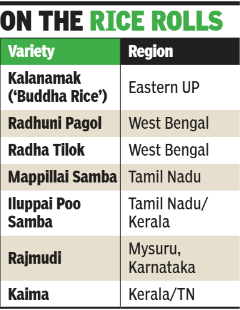
A look at select traditional rice varieties and the regions they are associated with across India.
This past summer, that ambition crossed continents, as Amar Khamar toured France and Germany. In Paris, working with sommelier Rajat Parr, the team built an 80-guest, 10-course tasting menu entirely around rice. Kanakchur turned up as fritters with brown butter hollandaise, Sundarbansgrown Karpurkanti and Chine Kamini appeared as aatapan alongside a jackfruit-seed mung dal, Barddhaman’s Mohansal was served boiled, the meal closing with a Jhargram Fine Black Rice phirni.In Stuttgart, the team built a fully vegan Bengali tasting menu, rice carrying the meal from a humble jhal muri to a coconut-milk Badshahbhog payesh for dessert. A separate 200-guest winery event tested whether the format could scale — from Karpurkanti-paired lentils, a Chine Kamini peas pulao to Sunday lamb curry and Badshahbhog milk-rice. “None of this would be possible without the relationships we have built with a network of farmers,” says Punwani, who executed the menu in Europe.
The traceability problem
But as heritage rice travels from the farm into retail shelves, a different problem emerges: knowing whether what’s being sold is really what it claims to be. One store has built its entire business around solving exactly that. In Chennai’s Mylapore sits a store unlike any other. Spirit of the Earth calls itself a “retail store and experience centre”, where customers come to see, touch, feel and know the story of every rice. Opened in 2017, it’s the retail face of a project that Sheela Balaji, chairperson of NGO AIM For Seva, began over a decade ago, built on a principle she believes the heritage-rice surge often misses: traceability.“Unfortunately, certain grains are being sold as certain varieties, which is inaccurate,” says Balaji.“The minute you say heritage rice, people will just come and buy it. But who is taking accountability? How do you know if it’s really diabetic friendly? So, I started this project more than a decade ago, first and foremost by building a seed bank. All the rice that you see in our store is grown from our farm in Manjakkudi, a village in Tiruvarur.”
Share your thoughts in the comments
Be respectful · TOI community guidelines
The 40-acre operation has grown as neighbouring farmers joined in, alongside a seed bank built from years of Balaji’s fieldwork with growers in Manipur, Maharashtra and Madhya Pradesh.For Balaji, the mission is beyond nutrition or nostalgia. “Rice in our culture is Lakshmi,” she says. “And reintroducing its forgotten names and forms, one customer at a time, is as much about restoring that reverence as it is about the grain itself.”

Sheela Balaji and Parameshwar Rao explain the importance of rice and paddy cultivation.






Leave a Reply