
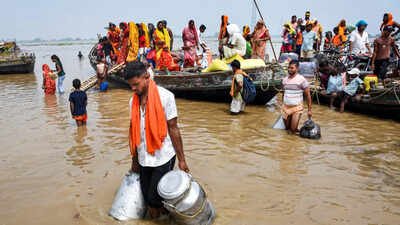
NEW DELHI: Boats replacing cars on flooded roads, families moving to relief camps and swollen rivers spilling into villages. North Bihar is bracing for familiar scenes once again as floodwaters from Nepal move downstream.Floods have long been a part of life in northern Bihar. But a growing population and rapid urbanisation have made their impact more severe over the years.The rivers that sustain the region for most of the year turn dangerous during the monsoon. And for people living here, there is little choice but to face the floods, rebuild and prepare for the cycle to repeat itself.Bihar minister Ramkripal Yadav said the state government is closely monitoring the flood threat in Bihar in view of the tragedy in Nepal.“Bihar is adjacent to Nepal, and the water that has come from Nepal in the past has affected many areas of Bihar, leading to loss of life and property, destruction of crops and homes. The Bihar government and the chief minister himself are monitoring this,” Yadav told ANI.He assured that the state government will extend every possible help to those affected.“The Bihar government will provide every possible help. The flood victims of Bihar have the first right on Bihar’s treasury, and it is secure for them. The government will work,” he added.
What was the trigger this time?
A glacial collapse at the Nepal-Tibet border on August 26 triggered a flash flood in Nepal that has claimed more than 600 lives.Analysis of satellite imagery indicated that a large mass of ice and rock may have fallen into the Lende Khola river, temporarily blocking its flow and creating a natural dam that later breached, sending floodwaters downstream.Due to the collapse, a large volume of ice and rock debris entered the Lende Khola, a tributary of the Bhote Koshi river in Nepal, generating a sudden surge that carried water, sediment and large boulders downstream.
The scale of the devastation can be gauged from the fact that twelve hydropower plants were reportedly knocked offline, dozens of bridges were swept away and the only road connecting the valley to the rest of Nepal was destroyed.Nature could not care less about political borders. And a flood that originated in Nepal will not stop at the border. From Nepal, the floodwaters will eventually move into north Bihar, before flowing into West Bengal and eventually Bangladesh, where they will empty into the sea.
Why does Bihar drown every year?
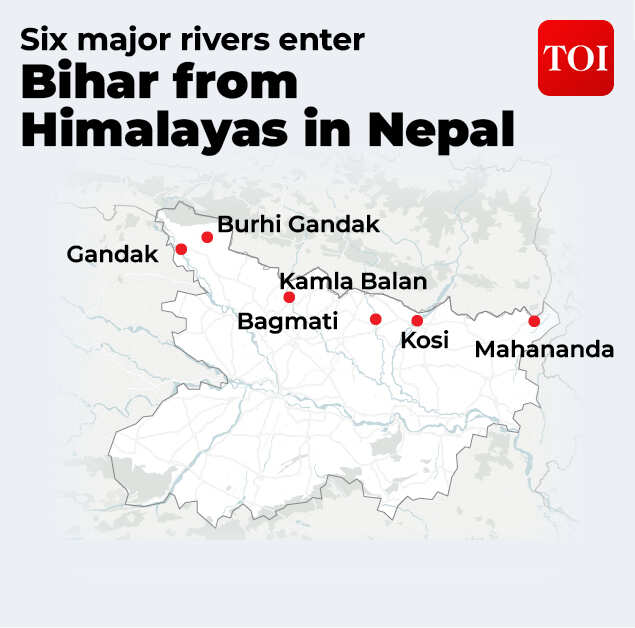
Speaking to The Times of India, IIT-trained civil engineer and flood expert Dinesh Mishra said Bihar’s locational disadvantage is one of the reasons why it drowns every year in floods. He said the state is situated in such a way that water comes directly through the south-flowing rivers from Nepal.“The first reason is Bihar’s locational disadvantage. Bihar is situated in such a way that water comes directly from the mountains,” Mishra said.“All the rivers that enter Bihar from Nepal are south-flowing. So, the area north of the Ganga will inevitably remain waterlogged. And if it does not, there will be drought in the region,” he added.
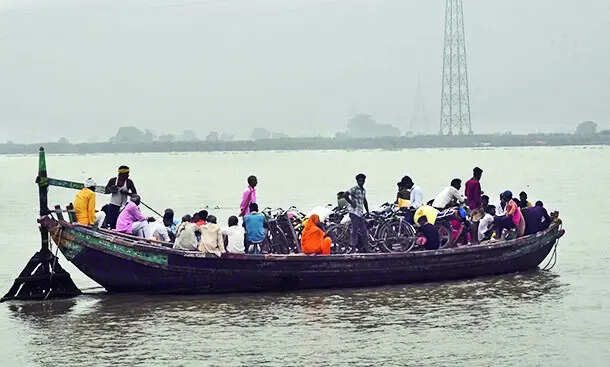
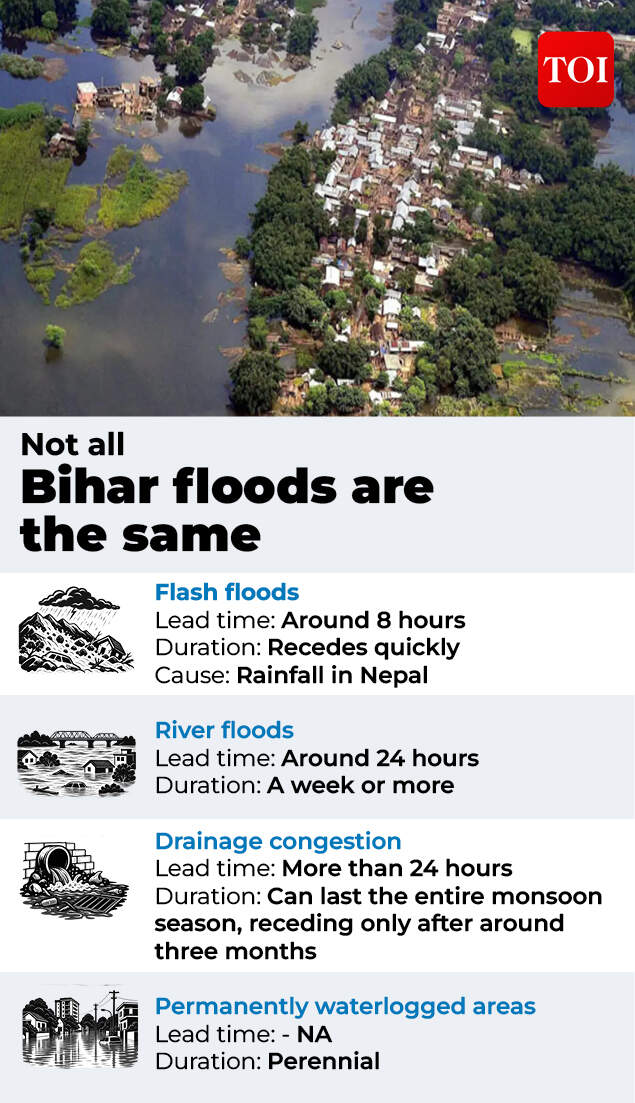
Rivers originating from the Himalayas, like Kosi, Gandak, Burhi Gandak and Bagmati, carry huge volumes of silt with them to Bihar. When the water level increases due to rain, these rivers overflow their banks.This makes Bihar India’s most flood-prone state, with 76 per cent of the population in north Bihar living under the threat of floods.Bihar’s disaster management authority classifies floods into four categories.
- Class I refers to flash floods, which occur due to rainfall in Nepal, have a short lead time of around eight hours between forecast and flood, and recede quickly.
- Class II refers to river floods, with a lead time of 24 hours and floodwaters that take a week or more to recede.
- Class III refers to drainage congestion at river confluences, where the lead time exceeds 24 hours and the water lasts the entire monsoon season, receding only after about three months.
- Class IV refers to permanently waterlogged areas.
This year, according to Bihar water resources department, the Gandak river has crossed the danger mark in Gopalganj, while the barrage at Valmikinagar released around 99,800 cusecs of water at 8 pm on Saturday.
“The water level of several rivers, including the Gandak, Kosi, Burhi Gandak and the Ganga, has been rising. Incessant rainfall in the catchment areas of Nepal has led to rivers touching or flowing above the danger level at several places,” a senior official of the water resources department said.People in West Champaran, East Champaran, Sitamarhi and Muzaffarpur, besides Gopalganj, Saran and Vaishali, have also been facing heightened fears over the past three days following an unprecedented inflow of water from Nepal.Other than flooding, another concern is soil erosion along the banks of swollen rivers.
Embankments: Solution or part of the problem?
For over a century, embankments along rivers have been a major preventive measure against floods. Successive governments built these walls along river banks to prevent rivers from deviating from their course and protect settlements.However, Dinesh Mishra said these embankments are the root cause of the havoc wreaked by floods rather than being the solution.“You build embankments basically to prevent river water from spilling out. But if floodwater that would naturally flow into the river is stopped, the water has nowhere to go,” Mishra said.
“If it cannot return to the river, it will move into areas that were previously not affected by floods,” he added.Mishra said Kosi once had space to spread and deposit its sediments, but embankments have now confined the river. With the sediments having nowhere to go, the riverbed has been rising, making the Kosi increasingly prone to overflowing.“The river carries silt with it, and because of the embankments, the riverbed continues to rise,” he said.Interestingly, Flood Atlas of Bihar, prepared by Isro along with the central and state governments, also says that “there must be a realisation that minimising the risk and damage from floods may be a more rational way of flood management rather than formulating structural measures along the dynamic rivers such as the Kosi.”
Everybody loves a good flood
During the conversation, Mishra, however, rejected the notion that floods have always been a source of sorrow for Bihar. He said floods are also a time of celebration.He said farmers eagerly wait for floods because, as he put it, “a fresh layer of silt is deposited on the fields after floods, making the soil more fertile.”He added that in the remote villages of north Bihar, people sometimes wait for floods because relief funds and the attention of politicians are also drawn towards villages where little development work has been done.“People have been made this way. Earlier, they had clear SOPs to protect themselves during floods. But now, because they have become dependent on the government for relief, lives are lost,” he said.
The traditions around floods
For generations, floods in north Bihar were not simply seen as a force to be feared. They were woven into the rhythm of life, with people learning to live alongside the rivers rather than trying to keep them at bay.“Our ancestors knew this was a water-rich, flood-prone region. When they settled here, they must have done so with that understanding,” Mishra said.
The relationship with the rivers was deeply personal. People revered them as mothers, and when the rains failed, women in villages would perform rituals to invoke the rivers and call for water.But when the floodwaters refused to recede, another ritual would follow. Women would gather with fruits, flowers, sandalwood, akshat and sindoor to persuade the river to leave.
Share your thoughts in the comments
Be respectful · TOI community guidelines
The rivers were considered unmarried, Mishra said, and women would even “threaten” them with marriage if they refused to listen.These traditions show how closely floods have been tied to life in north Bihar for generations.
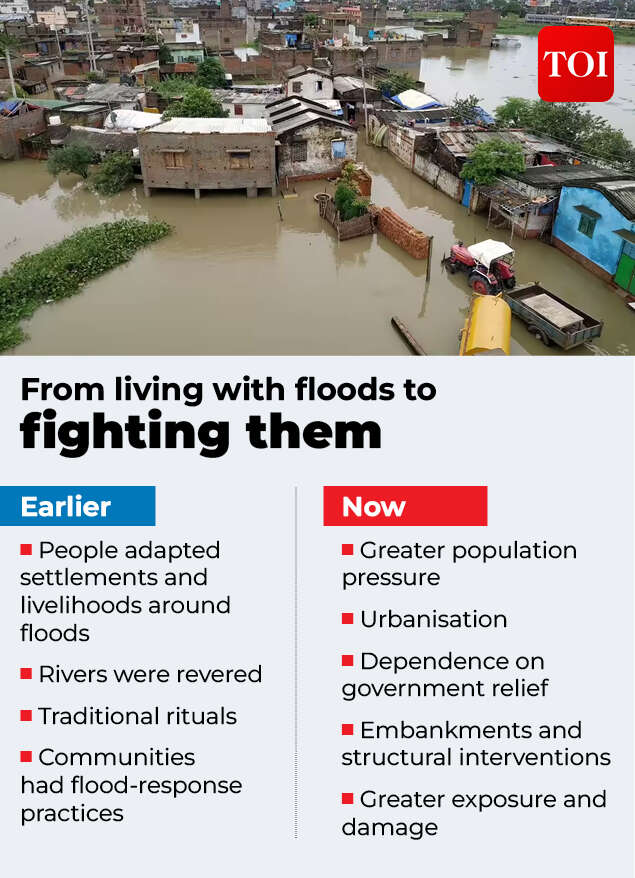
People did not always see the rivers only as a threat. They depended on them for water, fertile soil and agriculture, even as they feared the destruction that came when the rivers overflowed.That relationship continues even today. Every monsoon, the same rivers bring both relief and anxiety. And once the water recedes, people clean their homes, return to their fields and begin rebuilding knowing that the floods may return the next year.






Leave a Reply