
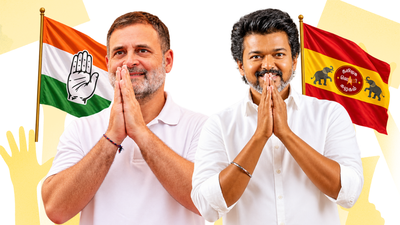
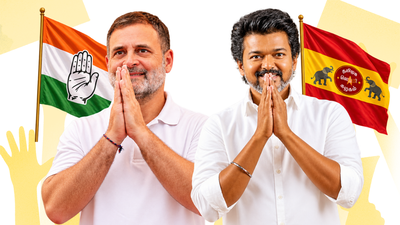
The honeymoon period between Tamil Nadu chief minister C Joseph Vijay’s Tamilaga Vettri Kazhagam (TVK) and its coalition partner, the Congress, appears to be over. Barely months after the two parties came together to form the government, they are already sparring over a question that is ostensibly about the 2029 Lok Sabha election: Who should be the opposition’s prime ministerial face – Rahul Gandhi or Vijay?What began as statements and counter-statements between the two party leaders has quickly acquired a sharper political edge.TVK PWD minister Aadhav Arjuna pitched Vijay as a potential national leader, arguing that the country’s highest political office should go to a leader from Tamil Nadu. On the other hand, state minister S Rajesh Kumar said Congress ministers in the Tamil Nadu cabinet would resign if TVK did not support Rahul Gandhi as the PM candidate in 2029.The confrontation spilled into the assembly as well. Congress Legislature Party leader and MLA Tharahai Cuthbert was shifted on August 31 from the section allotted to TVK legislators to the front row of the opposition benches.But beneath the immediate fight over Rahul versus Vijay lies a much bigger question: Does Vijay intend to remain a powerful Tamil Nadu leader, or does he see the state’s 2026 mandate as the launchpad for a national political project?And if the latter is the plan, can he succeed where Arvind Kejriwal could not?
Vijay’s extraordinary first step
The scale of Vijay’s rise explains why the 2029 debate has surfaced so early.The April 2026 Tamil Nadu assembly election ended nearly six decades of dominance by the DMK and AIADMK. TVK, only two years old, emerged as the largest party with 108 seats in the 234-member assembly. The DMK won 59 and AIADMK 47, while Congress secured five seats, with the remaining seats going to smaller allies.TVK was therefore not merely a new party that performed better than expected. It emerged as the central political force in an election that disrupted the state’s traditional two-party equilibrium.There was, however, one problem: 108 seats were still short of the 118 required for a simple majority.That made Congress indispensable.Vijay eventually formed the government with the support of MLAs from Congress [5], VCK [2] and IUML [2], along with outside support from the Left parties [4]. The MDMK, which has two MLAs, later extended its support.Congress moved away from its long-standing association with the DMK and backed a TVK-led government along with smaller allies, taking the coalition’s strength to 121. Vijay was sworn in as CM on May 10.Congress had submitted its letter of support after the election, making it clear that its support would be conditional on TVK keeping “communal forces” out of the alliance.
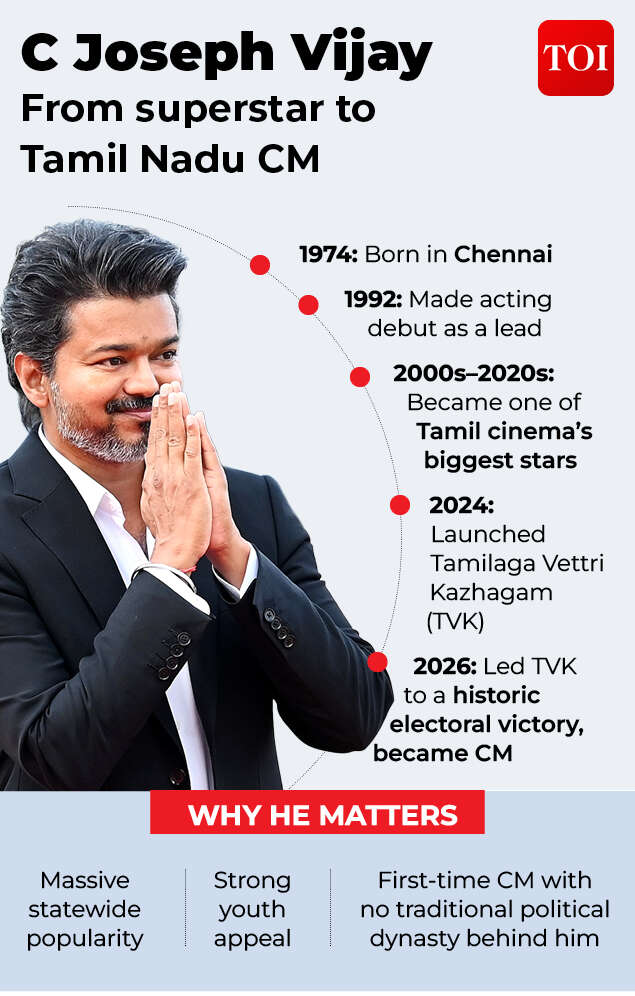
Vijay emerged as the disrupter-in-chief in Tamil Nadu elections.
The 234-member assembly currently has seven vacancies following the resignation of six AIADMK MLAs and Vijay vacating his second seat, Trichy East. The effective strength of the House is therefore 227, bringing the majority mark down to 114.The political equation is unusual. Congress is the junior partner, with only five seats, but its support helped Vijay cross the majority mark. At the same time, TVK’s 108 seats give Vijay overwhelming dominance within the coalition.That inversion may be at the heart of the present tension.Congress had been with the DMK in the pre-poll alliance and had never secured a place in MK Stalin’s cabinet. After the results, however, it quickly moved to TVK’s side and helped Vijay form the government.The alliance therefore contains a built-in contradiction: the party that needs Vijay’s government to survive does not want Vijay to emerge as the leader of the national opposition.
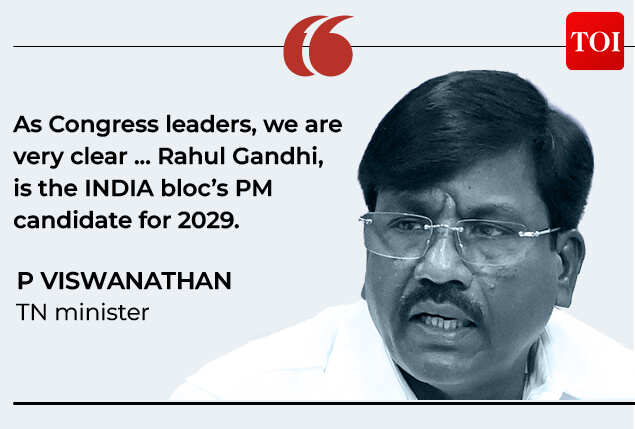
Congress leader on TVK’s ‘Vijay-for-PM’ pitch.
The ‘agnipath’ of Vijay’s path
Vijay’s route to Delhi runs into a problem that no amount of success in Tamil Nadu can entirely solve: numbers.Tamil Nadu sends 39 MPs to the Lok Sabha. Even a TVK sweep in 2029 would leave Vijay nowhere close to the 272 seats needed for a majority in the 543-member House.History, however, offers a little hope.In the past, India has had PMs whose parties did not come close to a Lok Sabha majority. HD Deve Gowda became PM in 1996 after the Janata Dal won just 46 seats, emerging as the consensus choice of the United Front with Congress support. IK Gujral followed a year later under much the same arrangement, with the Janata Dal holding only around 45 seats. Chandra Shekhar became prime minister in 1990 after breaking away from the Janata Dal with just 64 MPs, relying on outside support from Congress.This may give Vijay some hope.But it is also where the historical comparison begins to fray. The coalition politics that made these leaders PMs belonged to a different national landscape where coalition governments were a norm. The BJP, however, has changed that equation, building the NDA into a durable national coalition rather than the loose, post-election arrangements that defined much of the 1990s.The opposition, meanwhile, has come together in the form of the INDIA bloc which Vijay’s TVK is not part of yet.And yet, paradoxically, being outside the INDIA bloc may give Vijay an advantage over Rahul Gandhi.Rahul comes with the weight of the Congress’s history: its national footprint, its alliances and rivalries, the Nehru-Gandhi legacy and the political resistance that the party can provoke among regional leaders. Vijay comes with much less baggage. He would enter a coalition conversation not as the leader of a decades-old national party, but as a new political force with a mass following built before he entered politics.
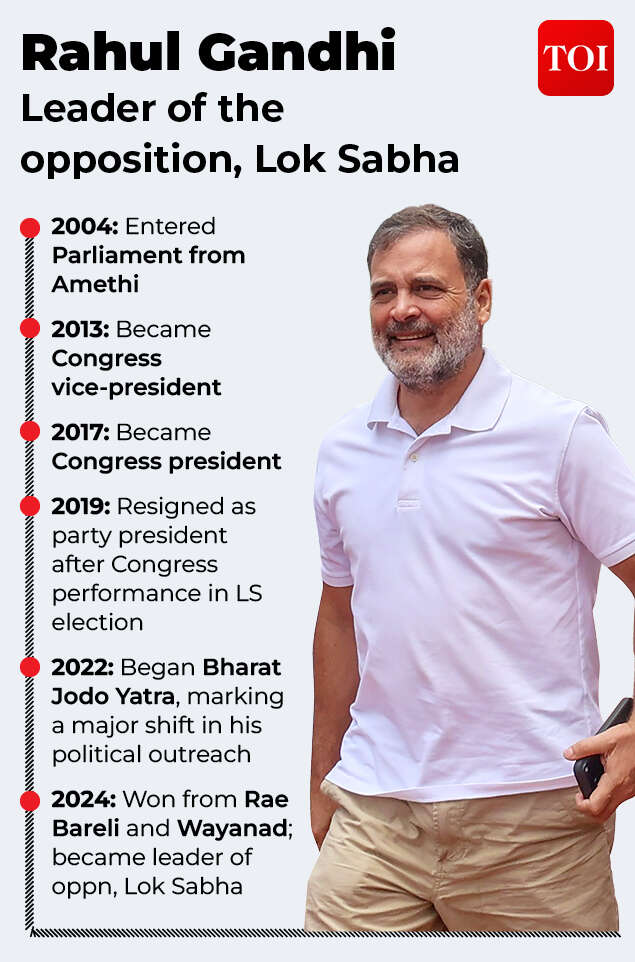
Rahul Gandhi’s political journey.
That distinction could matter if the next Lok Sabha produces another fractured mandate. But that is a big if, and one that looks unlikely in the present circumstances.Congress MP Karti Chidambaram has already put the arithmetic bluntly: “Every party has dreams, ambitions, and desires … but we know what the political reality is. There are 543 constituencies.”Thus, for Vijay, even if his party manages to sweep all 39 Tamil Nadu seats, the real test would be in finding enough allies to make Delhi possible.
Can Tamil Nadu be Vijay’s launchpad?
There is, however, one route Vijay could attempt that would give his national project a distinct political identity.He could build around Tamil Nadu’s distinctive relationship with the Centre and a broader southern assertion in national politics — the argument that Delhi needs a stronger voice from a region that has historically resisted political and cultural centralisation.That could give TVK’s national project a political argument beyond Vijay’s celebrity and the anti-incumbency against established parties.But it comes with its own problem.
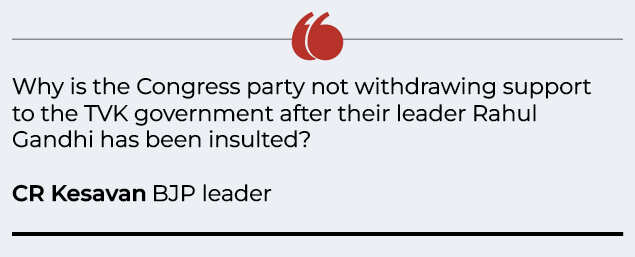
BJP has used the opportunity to question TVK-Congress alliance.
A political identity rooted in Tamil pride and southern assertion may work strongly in Tamil Nadu, but it does not automatically translate into votes in Uttar Pradesh, Bihar, Maharashtra, West Bengal or other states.Vijay would therefore have to balance two identities: the Tamil leader whose legitimacy comes from Tamil Nadu and the national leader who must persuade voters elsewhere that his politics is not confined to the state.
Why Congress cannot simply step aside
For Congress, the dispute is not simply about Rahul Gandhi’s personal ambitions or the future of the Gandhi family. It is about whether the party can retain its position as the principal national pole of the opposition after years of organisational and electoral decline.Rahul has spent years positioning himself as the principal challenger to Prime Minister Narendra Modi and the BJP. Congress’s improved performance in the 2024 Lok Sabha election and Rahul’s emergence as leader of opposition strengthened that claim.The subsequent assembly elections, however, have weakened the party’s position against the BJP.A recent survey placing Rahul as the second-most preferred PM choice and Vijay next is nevertheless significant. Vijay’s position is remarkable for a leader whose party has contested only one assembly election, even though such surveys are hardly a substitute for actual elections.For Congress, conceding the national leadership question to Vijay now would risk allowing another regional leader to occupy the political space the party is trying to reclaim, especially after the weakened positioning of Mamata Banerjee, MK Stalin and Kejriwal.
The Kejriwal test
Kejriwal also began with an extraordinary political breakthrough in a single territory before attempting to turn his party into a national alternative.When he launched the Aam Aadmi Party (AAP) in November 2012, his political project was built around challenging established parties, particularly Congress, which had governed Delhi for 15 years under Sheila Dikshit.AAP’s breakthrough came almost immediately. Kejriwal became CM in December 2013, resigned after 49 days and returned in February 2015 with one of the most emphatic mandates in Indian electoral politics: AAP won 67 of Delhi’s 70 assembly seats, reducing Congress to zero.But Kejriwal did not intend to stop at Delhi.The 2014 Lok Sabha election was his first major attempt to build a national footprint. AAP contested 432 seats and won four, all in Punjab. Kejriwal himself challenged Narendra Modi in Varanasi, while Kumar Vishwas contested Amethi against Rahul Gandhi. Neither challenge produced the national breakthrough AAP was seeking.The party then entered the Punjab and Goa assembly elections in 2017. Punjab became a second political laboratory, with AAP winning 20 of 117 seats and emerging as the principal opposition force behind Congress. Goa, however, exposed the limits of the expansion strategy, with AAP failing to win a single assembly seat.Punjab eventually provided the big breakthrough. In the 2022 election, AAP won 92 of 117 seats and formed a government under Bhagwant Mann.Kejriwal had therefore achieved something genuinely difficult: he had built governments in two states and turned AAP into a recognisable political force beyond Delhi.Yet the national leap remained elusive.AAP’s electoral strength outside its core states never matched the scale of its Delhi and Punjab victories. In Gujarat, where it tried to establish itself as a third force, the party won five assembly seats in 2022, while Goa remained marginal. Its Lok Sabha presence also remained modest.
Vijay’s one-point lead on Kejriwal
The Tamil Nadu CM has one advantage over Kejriwal though that their starting points are different.Kejriwal had to build a mass political identity almost from scratch. Vijay, however, spent decades building one through cinema before entering politics. He then converted that popularity into 108 assembly seats in his very first election, which was dubbed as an extraordinary political conversion.But it can also become a weakness.The question is no longer whether millions of people know Vijay. They do.The question is whether voters who know him as an actor and Tamil Nadu CM will vote for TVK in states where the party has no political history, local leadership or cadre network.To go national, Vijay would need candidates, local leaders, a cadre network and alliances. Most importantly, he would need a political proposition that resonates with voters who do not know him primarily as a Tamil film star.This is where Kejriwal’s experience matters most.AAP’s success in Delhi could not simply be reproduced across the country. Punjab offered a favourable political opening, but Goa and Gujarat demonstrated that national visibility and electoral organisation are very different things.Vijay’s task could be even harder because many of the states he would need to enter already have powerful regional leaders with their own political ambitions.For now, the 2029 PM debate may therefore be premature, but the political conflict it has exposed is not. Vijay may need Congress to consolidate the power he has won in Tamil Nadu even as he seeks to challenge Congress’s claim to national opposition leadership.
Share your thoughts in the comments
Be respectful · TOI community guidelines
That is the paradox at the heart of his political project.If Vijay can use the Congress alliance to build a durable organisation without becoming politically dependent on it, he may have found a route Kejriwal could not. But if TVK’s national ambitions remain ahead of its organisational reach, the 2029 debate could end up looking less like the beginning of a national challenge and more like the first sign of a regional party reaching beyond its electoral weight.



Leave a Reply