
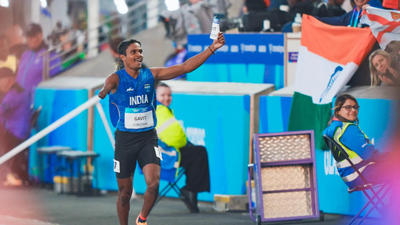
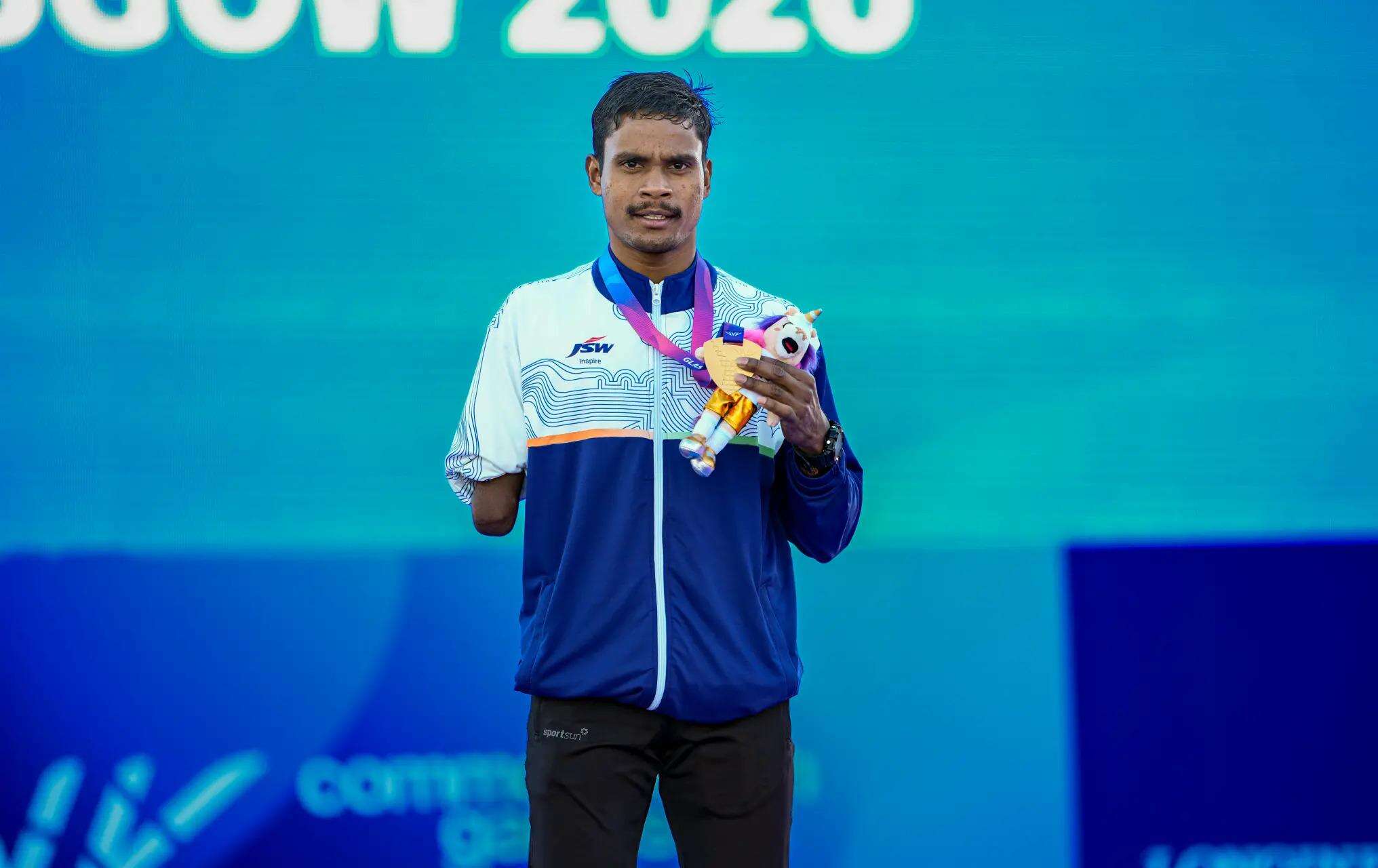
NEW DELHI: At five, Dilip Mahadu Gavit knew little about the fragility of life. A fall from a tree left him with a serious injury to his right arm, but there was no reason to believe that a childhood accident would alter the course of his life. The wound initially appeared manageable, but it turned septic. What followed was every parent’s nightmare. Doctors had no choice but to amputate his arm.For most, losing an arm at such a tender age could have meant the end of dreams before they had even begun. For Gavit, it became the beginning of a battle he would spend years fighting, one that would eventually take him to a place few could have imagined: the Commonwealth Games podium. Earlier this year in Glasgow, the 23-year-old won gold in the men’s 100m T47 final in 10.71 seconds, a Commonwealth Games record, and became the first Indian male para-athlete to win gold at the Games.For Gavit, though, the medal’s significance ran deeper than the timing or the record. He credited his medal to Vaijnath Kale, the coach who spotted Gavit’s potential when he was still a boy competing in local races in Maharashtra.“The first thing that comes to my mind is that the day of my event was Guru Purnima. So, in a way, I gave my guru his gurudakshina that day. That makes me feel very good, and it is something I will always remember,” Gavit told TimesofIndia.com on the sidelines of an event organised by (SBI) Life Insurance.Gavit’s CWG final was no textbook 100m victory. His start wasn’t the strongest, and by halfway, he looked to be chasing the race rather than controlling it. The explosive runners had established their advantage, while Gavit leaned on qualities built through years of 400m training. As others began to lose momentum, Gavit kept coming. His speed endurance became his advantage. He ate into the gap in the final 40 metres, moved past the runners ahead of him and crossed the line in 10.71 seconds. The Commonwealth Games record was gone, and so was any doubt about whether a 400m athlete could make a serious impact over 100m.For Gavit, it also vindicated the decision to pursue the event after the 400m was left off the programme. Even after producing the biggest 100m performance of his career, though, he knows there’s still work to do.
The guru who shaped Gavit’s career
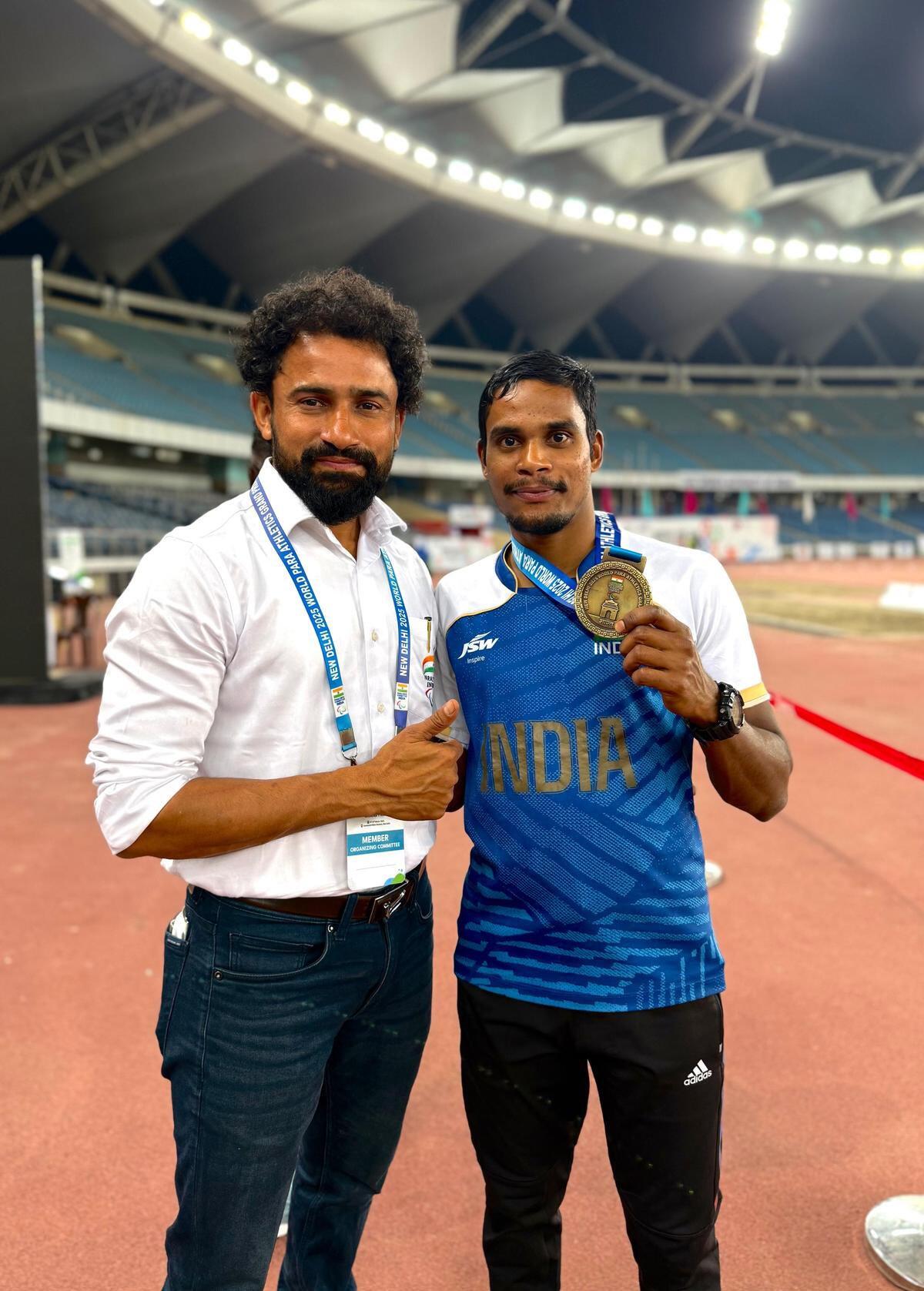
Gavit grew up in Tora Dongri, a tribal hamlet in Nashik, where sporting infrastructure was scarce and opportunities were limited. Gavit used to compete in races at school even when facilities and resources weren’t readily available, and his willingness to compete eventually brought him to Kale’s attention. Kale, a corporate employee turned coach, was impressed with Gavit and requested his parents to let him train, but due to the family’s financial difficulties, he didn’t get the green light. Kale was confident that he had found a special talent, and he virtually adopted Dilip.What followed was more than a conventional coach-athlete relationship. Kale took Gavit into his home and gave him the environment he needed to pursue athletics. For a boy from a village with little access to sport, it changed the trajectory of his life. Gavit has never forgotten it.“I come from a small village where there aren’t many facilities, especially when it comes to sport. To take me from there and keep me at his home is something not many people would do. He did that for me. For me, he has been like God,” he reminisced.
The switch from 400m to 100m in Glasgow
Kale began moulding him primarily as a 400m runner, an event that demands far more than raw speed. A successful one-lap athlete has to understand pace, conserve energy through the middle stages, and still have enough left to attack the final 100m.Gavit’s progress soon took him beyond para-athletics. Gavit competed in open competitions, regularly holding his own against able-bodied athletes. He reached the Under-20 400m final at the open nationals in 2021 and was part of Maharashtra’s bronze-medal 4x400m relay team at the 2022 Khelo India Youth Games.His move into international para-athletics took him to the 2022 Asian Para Games in Hangzhou, where he won 400m gold, establishing him as one of India’s leading para sprinters. Glasgow would require something different, and interestingly, he did not arrive at the 2026 Commonwealth Games as a 100m specialist. If one event defined the youngster, it was the 400m.On a wet track in Glasgow, though, it was the shortest sprint that gave him the biggest moment of his career. He wasn’t among the leaders for much of the race. The pure sprinters’ explosiveness had put him behind early, but things changed in the closing stages. Drawing on the speed endurance he has built as a 400m runner, Gavit surged through the final stretch and swept past his rivals.The absence of the 400m from the Commonwealth Games programme left Gavit with a choice. Rather than miss the Games altogether, he turned to the 100m, an event he was already running as part of his preparation for the longer sprint. The shift wasn’t as sudden as it may have looked from outside. Kale had been preparing him for the 100m for years.“The preparation for the 100m did not start this year. It has actually been going on for the last four years,” Kale told this website. “As you saw, he competed in the 100m at the 2023 Asian Para Games in Hangzhou. He reached the quarter-finals and semi-finals, but unfortunately, he fouled in the final and was disqualified.”That foul stayed with Gavit. He’d already won a 400m medal at those Asian Games, but the 100m disappointment bothered him. “My coach had actually started preparing me for the 100m much earlier, in 2022. At the Asian Games, I fouled in the 100m, so I could not finish the event. I won a medal in the 400m there, but I still felt bad about the 100m because of the foul,” he said.That made Glasgow personal. “So when I won the Commonwealth Games gold in the 100m, it felt really good,” he added.There was a practical reason for the switch too. “We have been training for both events in parallel. Since the 400m was not part of the Commonwealth Games programme, we focused on qualifying for and competing in the 100m,” Kale explained.
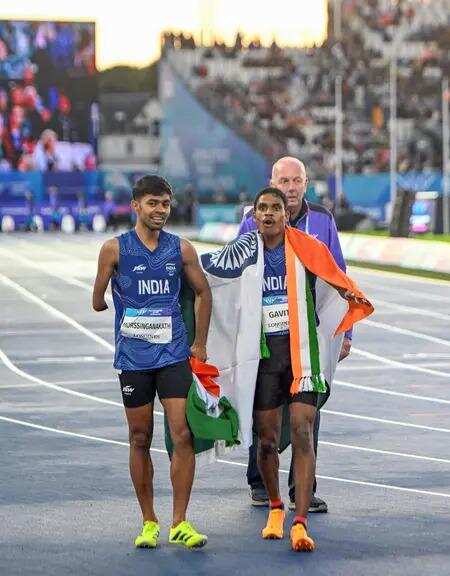
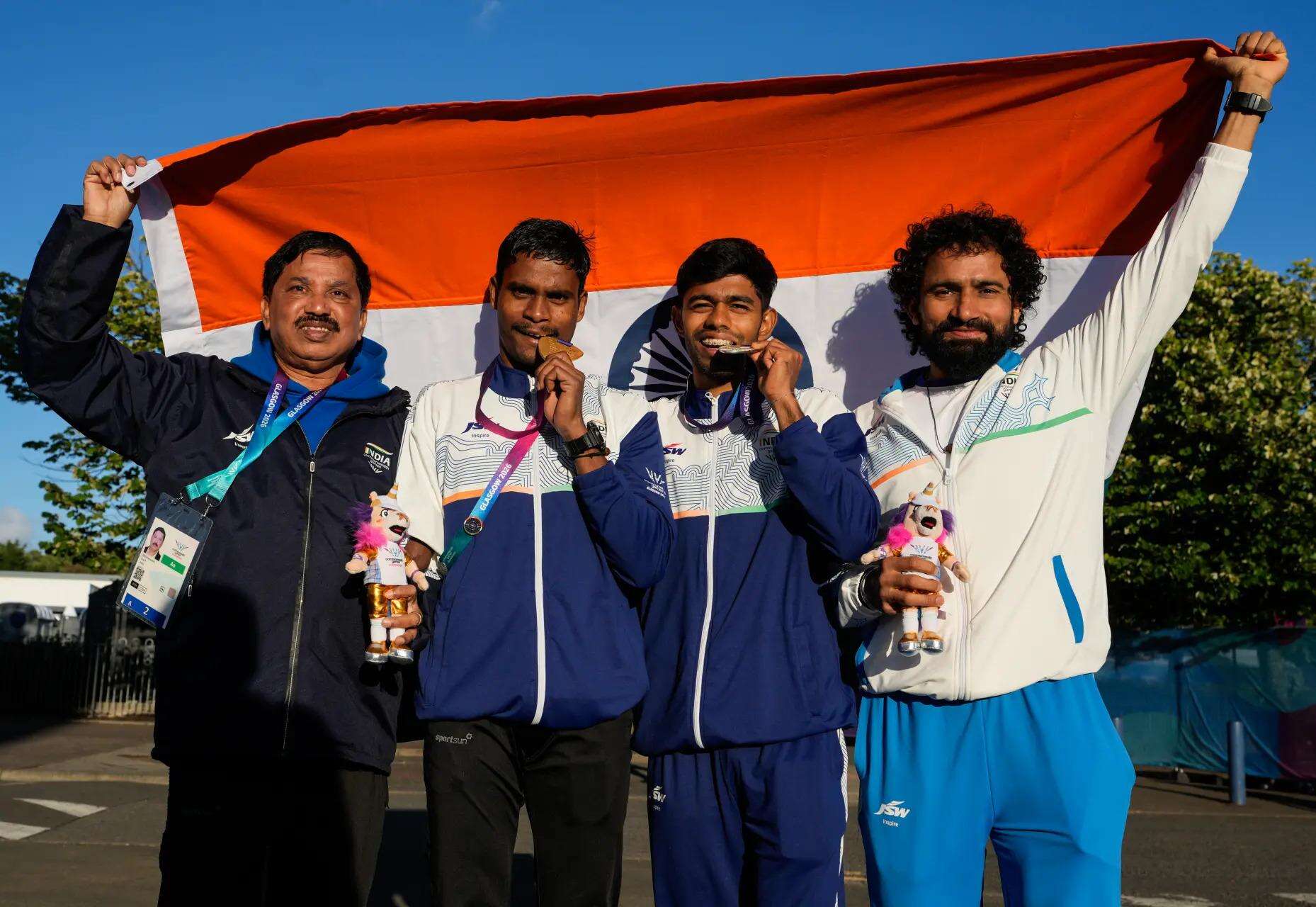
India’s Dilip Mahadu Gavit, right, gold medallist, and Mohammed Basil Morssinganakath (PTI photo)
‘Still a 400m runner’
The irony of Gavit’s CWG triumph is that despite winning one of the most prestigious sprint titles in Indian para-athletics, Kale doesn’t see him as a 100m specialist. “He is still primarily a 400m athlete. But his performance in the 100m has also been very good,” Kale said.The 100m and 400m are both sprint events, but the demands differ fundamentally: one is a battle for explosive acceleration and maximum velocity, while the other is about combining speed with the ability to sustain it over an entire lap.“The 100m is a sprint and demands speed, while the 400m is a speed-endurance event. Balancing the two is quite difficult, but fortunately, we have been managing both very well, and the results have also been very good.”Gavit sees the difference clearly himself. “In the 400m, the focus is much greater because you have to plan the entire race. You have to know how to run the first 100m, how to maintain your pace through the middle of the race and then give everything you have in the final stretch,” he said.“In the 100m, you just have to run hard and the race is over quickly. I actually enjoy the 100m because it finishes so quickly.”There’s something amusing in that: the athlete who has just conquered the Commonwealth 100m is still happiest thinking of himself as a 400m runner, while his coach tries to make sure both versions of Gavit keep developing.
The laurels he wants next
Gavit believes the Glasgow conditions cost him something. “The climate there was not very good, and because of that, my start was a little slow. That is something I want to improve.”A Commonwealth gold and a Games record might have been enough for most athletes to sit back and enjoy. Gavit is already looking at the next benchmark. “I want to break the Commonwealth Games record again in 2030.”Before then comes a more immediate challenge. The Asian Para Games in Aichi-Nagoya will demand that Gavit quickly switch gears from 100m preparation back to the 400m, and after two months of concentrating heavily on the shorter sprint, Kale knows the transition won’t be straightforward.“It is definitely a little difficult at the moment because our entire focus has been on the 100m for the last two months. Now, suddenly, we have to shift our focus back towards the 400m. So there are some challenges.” But the target is clear. “There is no doubt that we will give our best, and our commitment will be to win medals for India in both events.”Gavit wants more than medals. He wants gold in both. “At the next Asian Games, I want to compete in both the 100m and 400m and win gold in both.”






Leave a Reply