
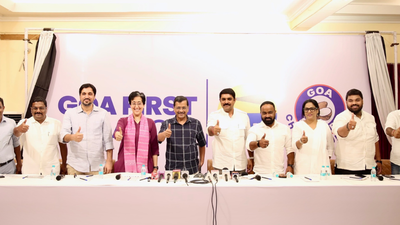
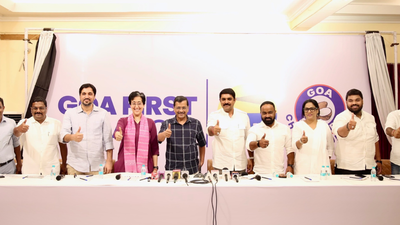
The Aam Aadmi Party and Goa Forward Party on Sunday announced a new political beginning for the state. They announced a pre-poll alliance for the upcoming 2027 assembly election named ‘Goa First’ and promised voters something the state has struggled to get: a mandate that actually stays intact.There was plenty of familiar political rhetoric at the launch in Panaji on Sunday. AAP national convenor Arvind Kejriwal claimed that BJP would not win a majority. “The people of Goa want a change. Goa First will form the government. We will win on our own,” Kejriwal claimed.Both parties presented the alliance as a credible, “non-BJP, non-Congress alternative”.In the press conference, the newly-formed alliance tried to build its political identity around a simple charge: defection.GFP chief Vijai Sardesai attacked the ruling establishment as a government of defectors. He said the BJP had not received a complete mandate in the previous elections and that even the Congress leadership could not deny the possibility of another round of defections.Kejriwal also opened up about the recent Rajya Sabha defection led by former blue-eyed boy Raghav Chadha. “It is a matter of great regret that our Rajya Sabha MPs left the party. They betrayed the party. The party sent them to the Rajya Sabha; the people did not send them,” the AAP chief said.He said the AAP had never betrayed the people through its elected representatives.“We believe that this is a lesson for us because such a thing has never happened in the Aam Aadmi Party before. From now onwards, before sending anyone to the Rajya Sabha, we will scrutinise the person thoroughly and ensure that he is the right person,” Kejriwal said.However, after the story of ‘Goa First’ gets interesting, at its hard-launch itself.GFP chief Sardesai declared: “This alliance has not closed the door; it is open to the like-minded political forces. Many people have approached us, including leaders from both parties who are tired of their politics.
Memory of 2017 and 2022
The anti-defection pitch is not difficult to sell in Goa because voters have seen the numbers change dramatically after elections.In the 2017 assembly election, Congress emerged as the single-largest party with 17 of the 40 seats, while the BJP won 13. Yet Congress did not form the government. The BJP stitched together a coalition with regional parties and independents, with GFP chief Vijai Sardesai becoming deputy chief minister.Two years later, the picture changed again.In July 2019, 10 Congress MLAs joined BJP, taking the saffron party’s strength to 27 and giving it a clear majority. The Congress, which had started the assembly term with 17 MLAs, was left with five.Then came the 2022 election.This time, BJP turned out to be the single largest party with 20 seats in the hung assembly. Congress won 11 and AAP two, while GFP won one. BJP formed the government with support from 2 independents and Maharashtrawadi Gomantak Party (MGP).Six months later, however, again eight of Congress’s 11 MLAs joined BJP.Among them were former chief minister Digambar Kamat and then leader of opposition Michael Lobo. Congress was reduced to just three MLAs, while BJP’s strength rose to 28.Defection runs so deep in Goa politics that, just eight months before the 2022 exodus, some Congress MLAs had gone to extraordinary lengths to prove they would stay put. They visited a temple, chapel and mosque, and signed affidavits promising not to defect. In September 2022, eight of the 11 Congress MLAs joined the BJP anyway.After years of battle in the assembly and courts, the Supreme Court in July had agreed to hear a plea challenging a decision of the Goa assembly speaker rejecting a petition by the Congress for disqualification of the eight MLAs.For Goa First, this history of defections may prove to be strong campaign material.
The ‘open door’ politics
Sardesai himself made clear that ‘Goa First’ is not going to be a closed club.The alliance, he said, was open to “like-minded political forces”. He claimed that leaders from both major parties had already approached them because they were tired of their respective politics.Strategically, that makes perfect sense.AAP and GFP together currently have only three assembly seats. If the alliance wants to become a serious statewide force, it needs some established names and local networks. Goa’s politics is intensely constituency-driven and established local faces can matter enormously.Turning away a strong BJP or Congress leader simply because that leader once belonged to the other camp could leave ‘Goa First’ with an admirable principle and a thin candidate list.But by welcoming such politicians, the alliance risks playing the very same game it accuses BJP of playing.However, if the leader joins before the elections, the alliance could defend it easily.
The GFP complication
There is another reason Sardesai’s role makes this debate particularly interesting.GFP itself has travelled through Goa’s shifting alliance landscape.In 2017, it was part of the BJP-led coalition that formed the government after Congress emerged as the largest party. By 2019, the relationship had broken down, and Sardesai became a bitter opponent of the BJP government. GFP subsequently allied with Congress for the 2022 election.
Share your thoughts in the comments
Be respectful · TOI community guidelines
It is now joining hands with AAP and positioning itself against both BJP and Congress for the 2027 elections. Thus, the positioning of the party has remained fluid.That, though, is not necessarily a contradiction, as we have seen several regional parties routinely negotiate their political space by switching alliances.The ‘Goa First’ alliance has now officially entered the 2027 Goa contest with defection as one of its central political themes. Yet, with its doors open to leaders from the BJP and Congress, the alliance’s own composition could become part of the election narrative. The first real test of that balancing act will come with its candidate selection.






Leave a Reply