
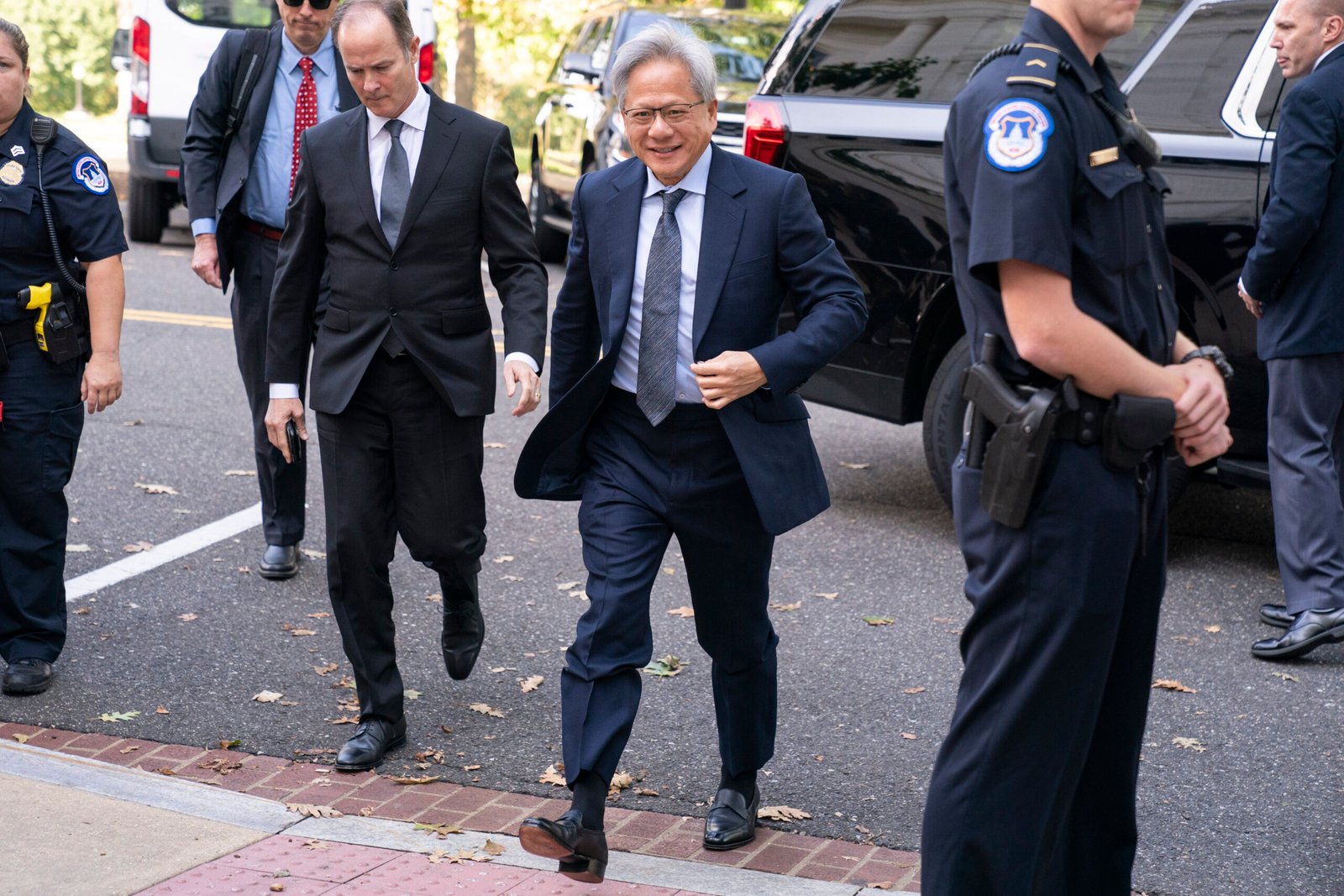

Nvidia boss Jensen Huang has been a powerful force pushing back on Congress’ recent efforts to restrict high-end computer chips. The all-consuming artificial intelligence safety debate is about to test that clout.
In the past year, Huang and his army of lobbyists have had some success convincing lawmakers to peel back regulations that would hamper the multi-trillion dollar company’s ability to sell its advanced chips to the world, particularly China.
But the political landscape has shifted in a matter of days, and the company’s stated mission of “solving humanity’s greatest challenges” via AI has started to sound out of touch — at least to some lawmakers’ ears — after the CEOs of three leading tech companies said AI was moving so fast it soon risked spiraling beyond human control.
One Senate Democratic aide, speaking on condition of anonymity to describe private meetings, said Huang’s recent visits to congressional offices have “repeatedly been seen as tone deaf, as he’s openly dismissed or downplayed the risks of AI, including denying any likely workforce disruptions from the technology.”
Nvidia and other chipmakers are now pressing lawmakers to strip provisions from the chamber’s draft of the annual defense policy package that would restrict China’s access to Nvidia’s most advanced chips as well as chip-making equipment — the building blocks necessary to power its AI ambitions. Affiliated groups have sent multiple letters pressing the issue in recent months.
“What Jensen argues is that the threat of China is greater if they have to develop their own chips, and that’s not a frivolous argument,” said Senate Commerce Chair Ted Cruz (R-Texas) in an interview. “At multiple hearings, [we] have questioned witnesses about, ‘how do you respond to this argument that Jensen’s laid out?’ And there’s some force to it.”
A spokesperson for Nvidia did not return a request for comment.
But this has become a much taller ask of Congress amid rising fears on Capitol Hill that the sales of Nvidia’s advanced AI chips could give China not just a competitive edge but accelerate the threat of human extinction. Whether Nvidia is now able to secure its legislative priorities in the coming months will be an indication of its staying power in a political environment overtaken by the fight over what role the government should play in regulating AI.
Nvidia in a recent earnings call said that less than 1 percent of its data center revenue came from certain high-end chips shipped to customers in China, but that data point isn’t reassuring critics. That includes China hawks who have said they don’t want the U.S. to slow down AI innovation so as not to cede the race to China, but fear that allowing Nvidia to sell advanced semiconductors to China could give Beijing a dangerous advantage.
“Jensen makes an argument — I’m not sure I fully buy it — that as long as the world is relying on Nvidia chips, that’s a good thing,” the Senate Intelligence Committee’s top Democrat, Mark Warner of Virginia, said in an interview, adding that he spoke with Huang at length at a conference earlier this month and described him as “very smart.”
Asked about Jensen’s influence on Capitol Hill, however, Warner said he thought “the place where Nvidia is gaining the most influence is obviously in the White House.”
He was referring to Huang’s recent viral moment, when he put the president on speaker phone while onstage at a major AI and tech conference. Trump, on the phone, declared that the “robots will not be taking over” — and the federal government would not be putting the brakes on the industry.
“I’m with you all the way,” Trump said through the phone to Huang, who is now expected to be a guest at an upcoming State Dinner to be held in honor of Chinese leader Xi Jinping.
Some close observers think this relationship will have its limits when it comes to whether Huang can leverage his ties to Trump to prod Republicans into taking a pro-Nvidia position in negotiations over the National Defense Authorization Act.
The Senate version of the bill — which has not yet passed the chamber and is likely to go straight to negotiations with the House after the midterms — is expected to require tracking of exported chips, allow Congress to block exports of advanced AI chips to China and other foreign adversaries and impose new controls on chipmaking equipment, in coordination with allies.
“Jensen Huang has a close relationship with the president, yes, but the NDAA is much bigger than that. It’s not a bill he can veto,” said Chris MacKenzie, vice president of communications for the Al safety group ARI, of the legislation that must be enacted at the end of this year.
He added that the “all-out campaign” Nvidia successfully waged against the inclusion of similar restrictions in last year’s defense bill “doesn’t seem to have manifested in the same way” this time around.
Over the past week especially, lawmakers of both parties have been taking stock of Nvidia’s arguments in light of conversations about what role Congress should play in regulating the AI industry, if at all. That includes evaluating both the costs and benefits of the White House’s support for the company and indications it could be planning to clear the way for the sale of high-end chips to China — and whether Congress should seek to use the defense bill to rein in those ambitions.
“There’s four things we need to win in the race to AI dominance: energy, data sets, talent, chip design,” said Sen. Chris Coons (D-Del.) in an interview. “China is our peer competitor or exceeding us … It is really dangerous to be advocating for exporting the most sophisticated chips and chip-making technology to China. So I haven’t heard from Nvidia or Jensen, but I’m a pretty strong believer in the importance of continuing export controls.”
The debate on export controls legislation is also coming to a head as China hawks in Congress grow increasingly frustrated with the Trump administration’s lack of executive action on tech restrictions — especially in light of this week’s summit with Xi, where the president is under pressure to pursue diplomacy in hopes of deescalating a trade dispute with the world’s second largest economy.
One Senate GOP aide, granted anonymity to speak candidly, said the administration’s slow pace on export controls is putting Republican senators “under pressure to do something and fill the vacuum” in the defense package.
Republican Rep. John Moolenaar of Michigan — chair of the Select Committee on the Chinese Communist Party and a vocal proponent of more restrictions on Chinese tech — said Nvidia is “under the belief that if we sell China more chips, they’ll become more addicted to our technology and that will create a dependency. And my belief is, we should have a rolling technical threshold where we allow people to sell into the Chinese market but not help improve their capabilities exponentially — maybe incrementally, but not exponentially.”
Moolenar said last week that lawmakers “do have a responsibility for public safety” while asserting it’s also important to “beat China when it comes to the AI race.”
Cruz, who said he discussed this issue when he met with Huang in July, is also treading carefully.
In a recent interview with POLITICO about the AI safety panic spreading throughout the country, Cruz underscored the need for the U.S. to stay ahead in the AI race, quipping: “If there are going to be killer robots, I would rather they be American killer robots, rather than Chinese killer robots.”
Asked in a separate, later interview about whether he thought Nvidia would come under greater scrutiny in the robust AI safety discussion, he said he’s still weighing the merits of Huang’s case.
“Nvidia has certainly been pushing against enhanced export controls, and Jensen in particular has been quite vocal making that argument,” said Cruz. “He argues we want to see American chips adopted globally. There are two sides to that argument, and I think I and other policymakers are evaluating both sides. I think we need to have meaningful export controls, but where the line should be is a complicated judgment call.”
John Sakellariadis and Connor O’Brien contributed to this report.







Leave a Reply