

Donald Trump has long fumed over a Senate practice that lets Democrats effectively veto some of his judicial nominees. He might soon have an ally in a position to do something about it.
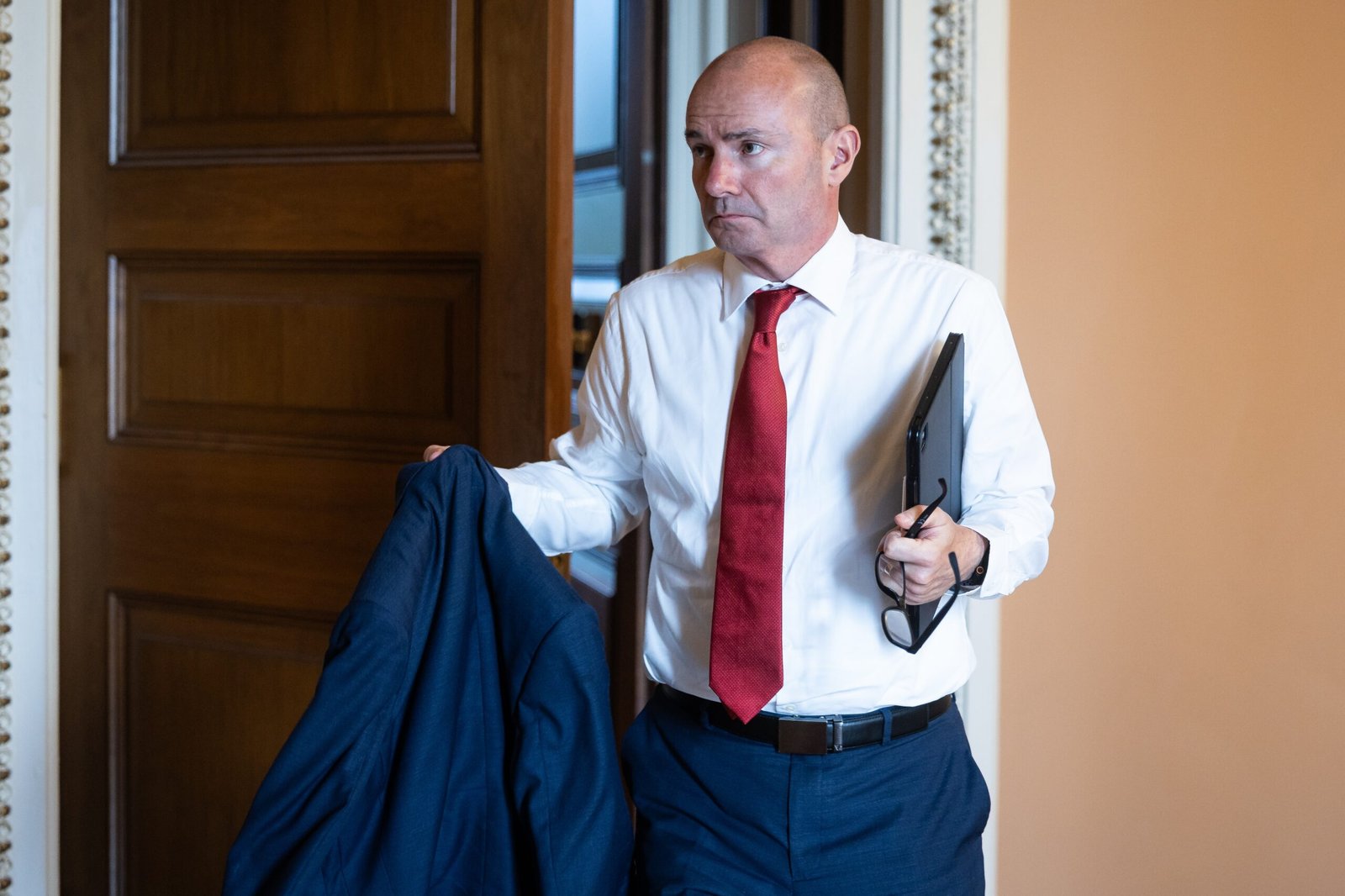
Utah Sen. Mike Lee is poised to chair the Judiciary Committee should Republicans manage to keep control of the Senate in the midterms. That would give the MAGA stalwart the power to decide the fate of the “blue slip,” which lets senators block any home-state district court judge, federal marshal or U.S. attorney nomination they oppose.
The decision risks pitting Lee against his Senate GOP colleagues, many of whom support the status quo. It also all but guarantees a public pressure campaign from Trump, with whom Lee has worked to ingratiate himself over the past two years.
Lee said in an interview that he didn’t expect to eliminate blue slips — actual pieces of paper senators sign to indicate their support for a nominee — but he left the door open to changing how the tradition is enforced.
“There is no appetite to just get rid of them,” Lee said before adding, “The blue slip itself has had a lot of evolution and it’s almost never static. Though it doesn’t mean that everything about the blue slip procedure will always be the same.”
Lee said it was “premature” to discuss in detail how he would approach the matter and noted it had undergone “iterative changes” as previous Judiciary chairs had “considered and in many many cases implemented [alterations] just in order to deal with things as they happen.”
Trump has a simpler view of the matter — demanding Senate Republicans completely ditch the blue slip, which he views as an intolerable fetter on his power to install federal judges. Current Judiciary Chair Chuck Grassley (R-Iowa) has repeatedly fended off Trump’s calls to end the practice, explaining that most of his fellow senators have no interest in giving up leverage in who gets home-state appointments.
Asked how the White House would want Lee to handle blue slips, a spokesperson pointed back to several of the president’s comments over the past year, including an October 2025 Truth Social post where he called it an “old and ridiculous custom.” Trump targeted Grassley directly last December, saying that it was “shocking” that he would allow “this scam to continue.”
More recently, Trump lamented the “ridiculous views of Republicans on blue slipping” when he temporarily backed off Jay Clayton’s director of national intelligence nomination, which derailed a bipartisan surveillance deal. Clayton himself had previously been caught in a blue slip fight after Trump nominated him as U.S. attorney in Manhattan, and Trump feared a repeat.
While Senate colleagues widely expect Lee to face the same pressure from Trump that Grassley has endured, several Republicans indicated in interviews they hope Lee sticks to precedent.
“I think, you know, he’s a traditionalist, and I think he’ll honor the blue slip,” said Sen. John Cornyn (R-Texas), a longtime Judiciary Committee member who is leaving the Senate at the start of next year.
For one thing, Lee is likely to face immense peer pressure. While Lee could unilaterally scrap or modify the blue slip precedent as Judiciary chair, he’d risk angering some fellow Republicans who want to keep control of nominations in their back yards — including under future Democratic administrations.
“Senators have few prerogatives and tools, and that’s one of them,” Cornyn said.
Lee also confronts the prospect that, in a thin GOP majority, a small number of fellow Republican senators could hem him in by pledging to oppose any nominees that do not have home-state-senator support.
Grassley nodded to that reality amid Trump’s pressure last year, posting on X that “a U.S. Atty/district judge nominee without a blue slip does not [have] the votes to get confirmed on the Senate floor & they don’t [have] the votes to get out of [committee].”
Sen. John Kennedy (R-La.), a member of the Judiciary Committee, said he would vote in committee and on the floor to preserve the blue slips.
“I know who is qualified in my state to be a federal judge a lot better than somebody in Washington, D.C., does,” Kennedy said, predicting that Republicans would be able to “outvote” Lee were he to move to eliminate them.
With the GOP unlikely in the next Congress to maintain the three-vote cushion it now enjoys, Lee would need to convince potentially every Republican on the Judiciary Committee — and nearly every Republican in the chamber — to back him up.
That could be difficult, given the strong support within the Republican conference for keeping the blue slip as is, according to two GOP aides granted anonymity to discuss internal dynamics. Lee’s emerging role will also require him to win over many of the same colleagues he has alienated over the past year with his advocacy for a partisan elections bill that has no clear path to passage.
Senate Majority Leader John Thune said late last year that there are “way more Republican senators who are interested in preserving” the blue slip “that those who aren’t.”
“I have to assume everybody supports the blue slip,” Grassley said in an interview Tuesday, voicing his support for keeping it as-is.
“A president of the United States can’t know exactly what is going on in those individual states, and you need to guarantee senator input for marshals, U.S. attorneys, and district judges,” he said.
That said, Lee is correct that the blue-slip precedent has already been eroded: Republicans effectively ended the practice for circuit judges during Trump’s first term, arguing at the time that courts of appeals cover broad regions and thus shouldn’t be subject to veto by a single state’s senator.
Lee said amid that debate in a 2018 Judiciary Committee hearing that the blue slip “is not, and never has been, codified as a rule.”
“Its use as a de facto veto has definitely been the exception rather than the rule,” Lee said.
During his second term, Trump has erupted over instances where Democrats have used the blue slip to block — or at least complicate — the confirmations of his favored nominees.
Schumer and fellow New York Democratic Sen. Kirsten Gillibrand refused to greenlight Clayton’s U.S. attorney nomination; he was later appointed to the job by Manhattan’s federal judges.
But New Jersey Sens. Cory Booker and Andy Kim successfully blocked the nomination of Alina Habba to become their state’s permanent U.S. attorney last year, and Trump’s pick for U.S. attorney in Southern California, Bill Essayli, was also sidelined due to Democratic opposition.
Sen. Dick Durbin of Illinois, the top Judiciary Democrat and a prior chair of the committee, said that he was largely in the dark about Lee’s views on the blue slip but urged the Utah Republican to “think twice” before undoing it.
“I stuck with it through thick and thin,” Durbin said. “A lot of people who criticized me as chairman for observing it thanked me after we lost the majority. … So I hope he sticks with it.”







Leave a Reply