

Senate Democrats will soon have to decide whether to do one of their most vulnerable Republican colleagues a big political favor just weeks before the midterm elections.
Republican leaders are expected to set up a vote next week on the Ratepayer Protection Act, legislation that aims to curb energy prices associated with the data centers. It easily passed the House last week with 206 Democratic votes, but it faces a tougher path to passage across the Capitol — thanks to campaign-season politics.
The Senate version of the bill was written and is being championed by Ohio Sen. Jon Husted, the Republican who was appointed to replace Vice President JD Vance and is now facing a tough election bid against former Democratic Sen. Sherrod Brown.
Despite near-unanimous approval in the House, Senate Democrats see it as an attempt by GOP leaders to bail out an embattled candidate who has been inundated with data-center-themed campaign attacks. Most have yet to decide whether to lend their support, according to interviews with more than a dozen Senate Democrats and aides.
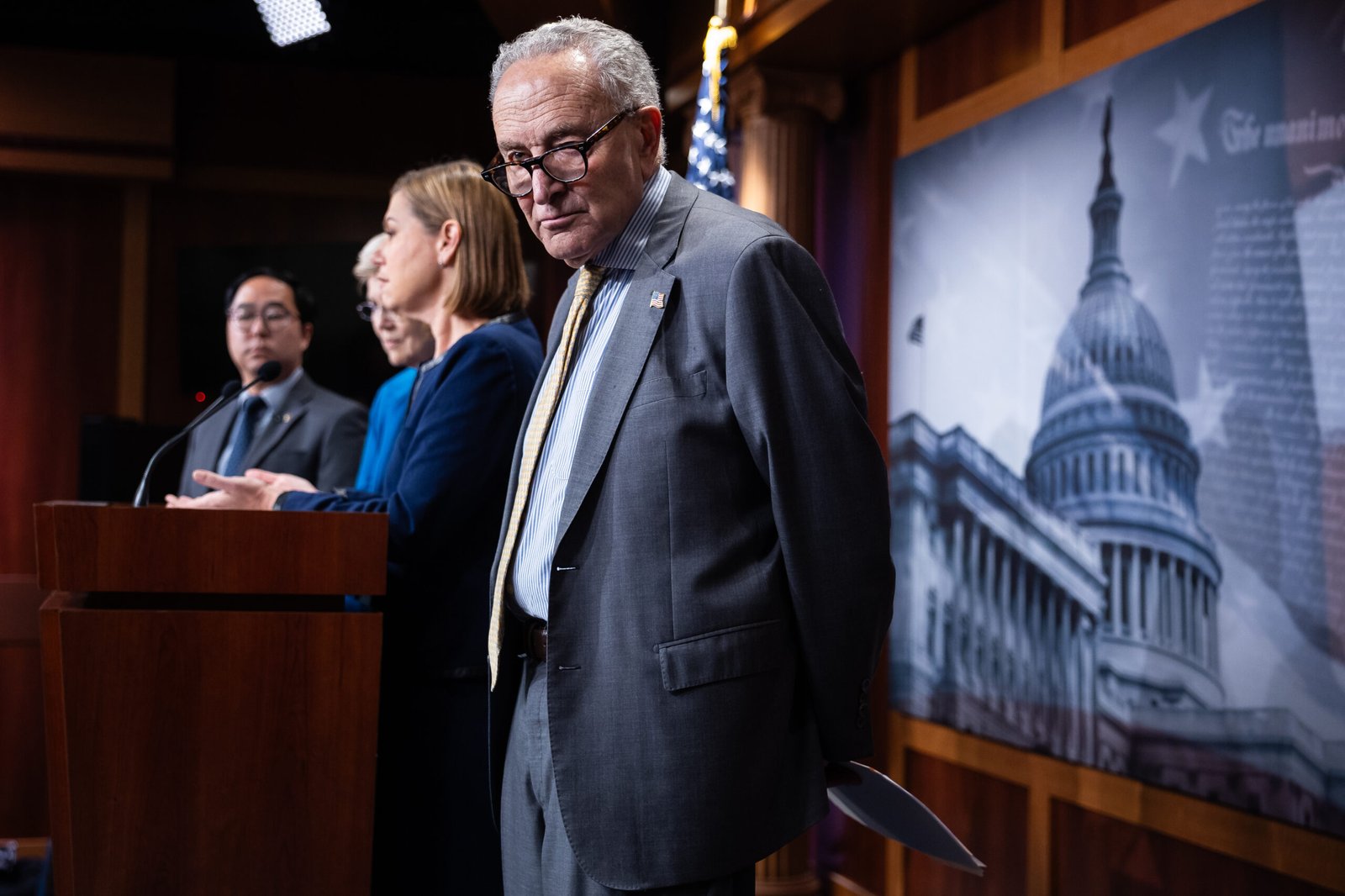
“It’s an effort to rescue Husted’s campaign,” Sen. Dick Durbin, the No. 2 Senate Democrat, said in an interview, even as he acknowledged that he himself hasn’t yet decided how to vote. Senate Minority Leader Chuck Schumer this week dismissed Husted’s bill as a toothless “fraud.”
But there are strategic considerations for Democrats: Voting to start debate on the bill could help keep Republicans off the campaign trail even longer and insulate their own members against charges of politically motivated obstructionism. On the other hand, even a successful procedural vote risks boosting Husted and could kick off an unpredictable amendment process.
The Senate is expected to take an initial vote Wednesday, and at least seven Democratic votes will be needed to advance it. Democrats haven’t yet had a caucuswide discussion about the bill, several senators said in interviews. They could discuss the matter Tuesday at a weekly lunch.
Two GOP senators granted anonymity to describe private conversations said that Republicans privately don’t expect the bill to get the 60 votes needed to ultimately pass.
Publicly, however, Husted is trying to keep the pressure on Democrats, telling reporters Thursday “everybody is going to get a chance to decide whether they’re for the American consumer.”“This would require data centers to pay for their own electricity rather than pass it on to the consumers,” he said. “That’s something the American public wants. That’s something that everybody in Congress says they’re for. They say they’re for more affordability. This is a chance for everybody to prove it.”
Sen. Peter Welch (D-Vt.) is so far the only Democrat to say publicly he will support Husted’s bill — though he added that “the bill didn’t go far enough,” echoing House Democrats who overwhelmingly backed the measure despite similar concerns.
“I’d like to help,” Welch said. “I’d like to protect ratepayers.”
Sen. Chris Van Hollen (D-Md.) said he would support a procedural motion to take up the bill but would then try to attach his own Power for the People Act, a more aggressive effort to address the data center issue.
He said he would support advancing the bill further “only … if they agree to allow amendments.”
Several other Senate Democrats — including in-cycle Jon Ossoff of Georgia and known bipartisan dealmakers such as Jeanne Shaheen of New Hampshire and Mark Warner of Virginia — said Thursday they hadn’t yet made up their minds on the bill.
The Ratepayer Protection Act would require states to “consider” — but not mandate — a framework ensuring data centers pay for all energy costs and grid updates. Senate progressives and Democratic party leaders have spent the past week amplifying concerns that the bill does not go far enough in enforcing protections for ratepayers. Some have pushed a more forceful bill from Sen. Martin Heinrich (D-N.M.).
Husted’s bill is “voluntary,” Schumer told reporters Wednesday. “No company has to do it. The bill we have is mandatory. It is much stronger and is what is needed.”
Sen. Brian Schatz of Hawaii, the Democrats’ deputy whip, said in an interview Thursday that he found the bill “kind of weak” but that he didn’t have an announcement about whether party leaders would whip against it.
The bill has already seen its share of drama in the Senate, when Husted last week tried to follow up a resounding 417-3 House vote on the bill by passing the bill by voice vote on the Senate floor. Heinrich, the ranking member of the Senate Energy and Natural Resources Committee, shot down that request, claiming that the Senate needed to pass legislation with “real teeth.”
Heinrich repeated those concerns Thursday as GOP leaders moved toward a roll call vote on the measure next week. He urged lawmakers to instead pass his own legislation or await a broader energy permitting reform package that could include data center provisions.
“There’s a reason why we’re working on these kinds of issues in permitting reform right now,” he said in an interview. “It’s because we’ve already seen electric rates go up for consumers as a result of the increased demand from data centers. So we should pass something, but it should have teeth in it.”
Anthony Cruz contributed to this report.





Leave a Reply