
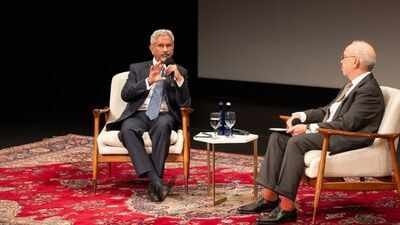
NEW DELHI: External affairs minister S Jaishankar on Tuesday flagged a lack of “understanding or appreciation or empathy” in the US towards India’s concerns over cross-border terrorism, saying the issue has affected bilateral ties.Speaking at the Asia Society in New York after the conclusion of the UN General Assembly’s High-Level Week, Jaishankar said terrorism remains a key concern for India, given its experience of cross-border attacks over several decades.“Terrorism emanating from its neighbour is one of India’s primary concerns, and if this is not fully appreciated by New Delhi’s partners, it impacts bilateral ties,” Jaishankar said, in an apparent reference to India-US relations amid closer engagement between Washington and Islamabad.“What for us in India is particularly important is the issue of terrorism… There are very few countries which have been subjected to the kind of terrorism that we have from a neighbor as part of a deliberate, conscious policy over many decades. It is something which matters so deeply to us. There isn’t enough understanding or appreciation or empathy of that. I think that creates a problem too,” he said.India-US ties: Trade talks remain a key issueJaishankar also discussed the challenges facing India-US relations, including negotiations on a trade agreement. He said the talks were complex because of the fundamental differences between the two economies, including India’s large base of small producers, farmers and factories.“Much of the world has had a more difficult relationship with the US… In our case, one was the trade negotiation. If you look at the stakes involved, the complexity of it involved, bear in mind, India is a society of small producers, small agriculture producers, small factories. Apart from the per capita gap between India and the US, the nature of production and the nature of society are very different. A trade negotiation required a certain amount of patience and detailing to see it through,” he said.Jaishankar said the two sides had reached “more or less an understanding” on the trade agreement, but changes in the US tariff framework had created a new challenge.“We have reached a situation where there is more or less an understanding on the trade agreement. But as my trade minister has said on more than one occasion, the issue is now what has changed on the American side. On the American side, reciprocal tariffs were struck down. So there’s now a new basis for tariff imposition, which is 301. And the 301 process is still in the works… that did create bumps last year for the relationship. If that agreement is closed out, that would be one point which would contribute to a better relationship,” he added.He also highlighted the growing influence of public opinion on diplomacy, particularly in democratic countries, saying social media had added a new dimension to international relations.“Today the economics of mobility and the politics of mobility are at odds with each other…. That certainly, in public perception, is an issue… our diplomacy today is not just conducted by states, leaders, ministers, or even by diplomats. In a social media era, there is a very big public opinion factor, which, particularly in democratic societies, makes itself felt. I think that’s a reality we have to take into account... We would certainly hope for and expect the relationship to move on an upward trajectory. But I have to be real about the issues that we confront. And to the extent we are able to move ahead on some of these issues, I think we’ll have a better relationship. Let’s apply the lens of…”Jaishankar says India-China ties improvingOn India-China relations, Jaishankar said ties were better than they were in 2025 and had improved further compared with 2024, pointing to the easing of the border standoff.“If you asked me, compared to where you were in 2025, is the relationship better today? I would say yes. Compared to 2024, even more so… After what happened in 2020 and the long standoff that we had on the border, the relationship had really been impacted… once the border standoff was resolved, it was natural that this would start to improve,” he said.Jaishankar said India had consistently conveyed to Beijing that a prolonged standoff between the two countries would not benefit either side.“We have long been telling the Chinese, personally at my level, that a standoff between us, a dip in our relationship, doesn’t help either of us. Third parties will take advantage of that… It took a little while for the Chinese side to agree with that, for whatever reason. But I don’t think that long standoff served our interests. It certainly didn’t serve theirs… what we’ve had is that, as the border comes back more towards normalcy, the relationship comes back more towards normalcy... If it happens, it helps both of us,” he said.He said the two countries had arrived at a basic principle that the state of the border determines the broader state of the relationship.“We came down to a very fundamental principle, which is that the state of the border determines the state of the relationship. You can’t have tension…on the border and say the relationship should be normal. So what we’ve had is, as the border comes back more towards normalcy, the relationship comes back more towards normalcy, and if the relationship comes back more towards normalcy, it helps both of us,” Jaishankar said.Ukraine, Iran conflicts pose risks to Global SouthJaishankar also highlighted the economic impact of the Ukraine and Iran-Gulf conflicts on developing economies, particularly through energy and food security.“If you look at these two conflicts, the Ukraine and the Iran-Gulf conflict, they’ve actually had a devastating impact on Global South economies. We are particularly concerned about the energy situation, because the market is very tight. On top of that, if people play politics with it, it adds to the market complications. It will drive up prices at a time when people should be stabilizing prices. A part of it is the security of oil supplies, and another is the politics of oil supplies. They are feeding into each other. They’re creating a double crisis or an aggravated crisis,” he said.“When it comes to food, we are looking at a situation today where some of the major grain exporters will not be able to send out their shipments… We are looking at significant fertilizer shortages… On top of it, we are looking at Super El Niño. There is going to be a major food crisis, probably in the coming months…” he added.‘World moving towards greater multipolarity’Jaishankar said the world was moving “quite visibly” towards greater multipolarity and outlined what he described as a broader approach India could pursue in such an environment.He said countries that were seen as stable, consistent and reliable could become important partners as the global order becomes more competitive.“One, you build a reputation for yourself as stable, consistent, reliable, so that others view you in a very dynamic, volatile world as a steadying factor… Partners tend to gravitate towards you. You’re the good person in the neighborhood. The second would be that the more you diversify and you find common interests, common ground, I think the more of a balancing structure can be created. What we have to do is to take self-interest and temper it with a certain long-term, I would say, predictability and stability, which is also part of intelligent self-interest, and try to create something along those lines...”He said countries, particularly major trading economies, would seek stability rather than prolonged volatility saying, “…not everybody wants the Hobbesian scenario that you painted; it is very volatile. It’s actually very risky in real life. People will not expose their trade accounts to that kind of volatility. For the big trading countries, their economies are exposed to that. Everybody will want to find some accounts of stability.
Share your thoughts in the comments
Be respectful · TOI community guidelines
.. I think the world will go for that kind of mix… The world is more competitive. It’s tough. A new dynamic will come.”“A new culture will come. New negotiations and new bargains will be struck. When the smoke clears at some point in time, you will see the different points joined by lines of different lengths. There will be a new geometry that will come about. I would still count on the self-interest of countries, their sensibilities and their desire ultimately to stabilize their own lives as a driving force. I think that is the direction we are heading. And we can see that in some of our relationships,” he added.






Leave a Reply