
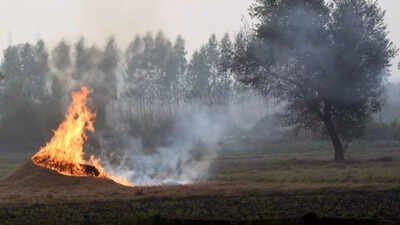
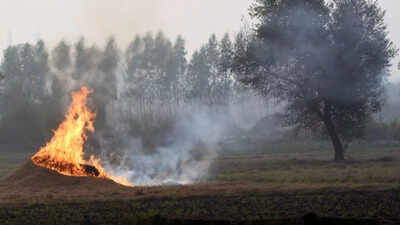
NEW DELHI: The Centre on Tuesday asked Madhya Pradesh, Rajasthan, Punjab, Haryana and Delhi-NCR authorities to work in “mission mode” to prevent stubble burning ahead of the peak crop residue burning season, flagging a sharp rise in farm fires in Madhya Pradesh and Rajasthan.Union agriculture minister Shivraj Singh Chouhan and environment minister Bhupender Yadav chaired a high-level inter-ministerial meeting with state agriculture ministers and officials to review crop residue management and measures to control farm fires.“Very little time remains between the harvesting of the current crop and the sowing of the rabi crop. Therefore, the administrative machinery must step away from paperwork and work directly on the ground on a war footing,” the two ministers said, according to a statement from the agriculture ministry.States have been directed to hold immediate meetings with district magistrates to ensure strict monitoring and implement practical solutions, the ministry said.
Farm fires surge in Madhya Pradesh, Rajasthan
Reviewing data from September 15 to October 12, Chouhan noted that stubble-burning incidents had declined by 53.3% in Haryana and around 32% in Uttar Pradesh compared with the corresponding period last year. Punjab had also recorded a fall.However, the rise in Madhya Pradesh and Rajasthan prompted concern. Madhya Pradesh’s farm-fire count increased from 55 to 277, a jump of 452%, while Rajasthan’s tally rose from 20 to 60, an increase of 200%.Chouhan directed the two states to identify affected districts and villages and immediately prepare special action plans. He also cautioned states reporting fewer incidents against becoming complacent, as a substantial portion of the harvest was still pending.The latest figures reflect the uneven spread of farm fires across northern and central India.Madhya Pradesh recorded 277 incidents by October 11, followed by Uttar Pradesh with 121 and Punjab with 118. Rajasthan reported 45 cases, Haryana seven, Uttarakhand three and Delhi one, taking the total across the seven states to 572.Stubble burning had been detected in 87 districts by October 11, with Amritsar recording 60 incidents, the highest among the seven states covered.
Farmers need affordable alternatives, says Centre
Chouhan said farmers had only 20-25 days between paddy harvesting and wheat sowing, making burning a quick and inexpensive way to clear fields despite its impact on soil nutrients, soil organisms and air quality in Delhi-NCR.“Simply telling farmers not to burn stubble is insufficient; we must provide them with easy, accessible and affordable alternatives,” he said.He said crop residue could be incorporated into the soil to serve as organic manure or removed for use in bio-CNG, bio-ethanol, electricity generation and fodder production.The government also aims to develop a system in which farmers can benefit from environmentally friendly practices, including through carbon credits.Chouhan urged states to promote short-duration crop varieties, including Pusa 2090 and PR126, instead of longer-duration varieties such as Pusa-44, to give farmers sufficient time to clear fields before the next sowing season.
Centre flags idle crop residue machines
The Centre has supplied more than 3.54 lakh crop residue management machines to states, including 26,109 during the current financial year. However, a central survey found that around 40% of older machines in Punjab and 48% in Haryana were idle or non-functional, news agency PTI reported.Chouhan directed states to repair existing machines alongside distributing new ones. He also called for the activation of Custom Hiring Centres to ensure that small and marginal farmers could access machinery at affordable rates.Between 2018-19 and 2025-26, the Centre released Rs 4,266.47 crore to states under the Crop Residue Management scheme. Punjab received Rs 2,056.50 crore, Haryana Rs 1,171.71 crore, Uttar Pradesh Rs 868.67 crore and Madhya Pradesh Rs 59 crore.For 2026-27, Rs 592.57 crore has been allocated, of which Rs 430.87 crore has been released.Chouhan expressed concern over slow utilisation of funds and urged Punjab to submit utilisation certificates for earlier releases so that the next instalment could be cleared without delay.
Monitoring to intensify after 3 pm
Yadav called for stronger enforcement and ground-level monitoring, identifying key districts in Punjab and Haryana for closer scrutiny.In Punjab, these include Sangrur, Tarn Taran, Amritsar, Patiala and Gurdaspur. In Haryana, the focus districts are Kaithal, Karnal, Kurukshetra, Ambala and Fatehabad.He stressed the need to integrate stubble-burning data with the Commission for Air Quality Management and the Central Pollution Control Board, while tracking harvesting schedules and weather conditions that affect air quality in the National Capital Region.
Share your thoughts in the comments
Be respectful · TOI community guidelines
Yadav said monitoring should not rely on satellite data alone. District collectors should conduct ground assessments, while enforcement measures should include patrolling and flying squads, particularly after 3 pm, when satellites do not pass over the region.Chouhan also called for direct supply chains connecting farmers with thermal power plants that use stubble pellets for co-firing, compressed bio-gas plants and second-generation bio-ethanol facilities. He urged states to implement approved supply projects without delay and asked drought-hit regions to store crop residue safely for use as livestock fodder.The ministers said state governments would remain responsible for implementation, with the Centre providing technical, administrative and financial support.






Leave a Reply