
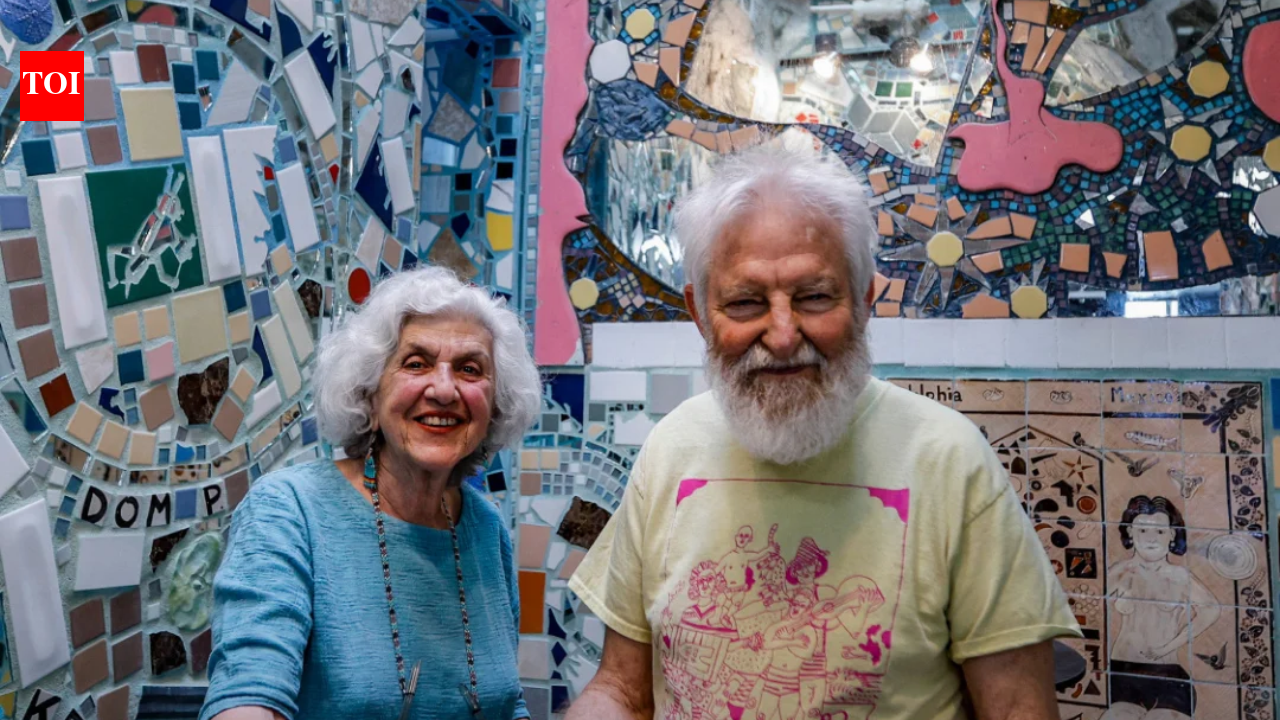

A vacant plot in Philadelphia became the canvas for artist Isaiah Zagar, who spent years transforming discarded bottles, bicycle wheels, ceramic fragments and mirrors into an intricate maze of mosaics. Spread across more than 3,000 square feet, Philadelphia’s Magic Gardens survived a threat of demolition in 2004 after residents and art supporters joined forces to preserve it.The site has since developed into a museum featuring winding passages, tunnels, indoor galleries and a two-level outdoor sculpture garden.Zagar, who died in February 2026, left behind a public artwork shaped by his life, travels and interest in folk art. His creation also reflects how a community can help protect an artistic space that might otherwise have disappeared.
How did Isaiah Zagar create Philadelphia’s Magic Gardens?
Born in Philadelphia in 1939 and raised in Brooklyn, Zagar studied painting and graphics at the Pratt Institute of Art in New York, according to the Magic Gardens website. His interest in large-scale art environments began when he was 19 and encountered the work of artist Clarence Schmidt in Woodstock, New York.Zagar and his wife, Julia Zagar, met in 1963 and married three months later. They later joined the Peace Corps as conscientious objectors to the Vietnam War and worked with local folk artists in Peru. Their time there deepened their interest in handmade art, cultural traditions and community collaboration.After returning to the United States in 1967, Zagar taught himself to create mosaics while recovering from a mental health crisis. Julia opened the Eye’s Gallery on Philadelphia’s South Street, where the couple lived above the shop. Zagar began decorating the building, marking the start of a long period of transforming walls and buildings into art environments.In 1986 and 1995, the couple bought two buildings and a lot to serve as Zagar’s studio. After completing mosaics across those spaces, he began working on neighbouring vacant lots that he did not own. He decorated the fences and gradually built structures using found objects.The resulting installation combined everyday materials with handmade tiles, mirrors, bicycle spokes, bottles and objects collected from different places. Zagar used these pieces to reflect his personal experiences and artistic influences.
Why was the artwork nearly dismantled in 2004?
The future of the installation became uncertain in 2004, when the Boston-based owner of the land discovered the work and decided to sell the property. The owner called for the installation to be dismantled.The prospect of losing the artwork prompted neighbours, lawyers and art supporters to step in. Their efforts helped establish the nonprofit organisation Philadelphia’s Magic Gardens, which purchased the grounds and took responsibility for preserving the site.The campaign turned a privately created art environment into a community-supported cultural attraction. Following the organisation’s formation, Zagar continued expanding the installation, excavating tunnels and grottos and covering additional surfaces with mosaics.The main structures were completed by 2008, although Zagar continued adding elements with the organisation’s preservation team during his lifetime.
What can visitors see at Philadelphia’s Magic Gardens?
The attraction covers indoor and outdoor areas equivalent to roughly half a city block. Its two indoor galleries host changing exhibitions by artists from Philadelphia and elsewhere, while the outdoor garden features winding tiled passages, sculptures and mosaics arranged across two levels.The installation is built from an unusual mix of materials, including cement, ceramic shards, bottles, bicycle wheels and mirrors. These objects form patterns and structures that visitors can explore on foot, with sections running both above and below ground.The museum also organises guided tours, family activities, art workshops and evening events featuring live music. Its programmes extend beyond Zagar’s work by showcasing other artists and offering visitors opportunities to learn about mosaic-making and creative reuse.Philadelphia’s Magic Gardens now operates as an independent nonprofit.
Zagar donated the Magic Gardens Studio
Zagar created art environments across Philadelphia and beyond, producing mosaics on more than 200 public walls over a career spanning more than five decades. His work is held in collections including the Philadelphia Museum of Art and the Pennsylvania Academy of the Fine Arts.In 2023, Isaiah and Julia donated the Magic Gardens Studio, along with artworks stored there, to the nonprofit organisation. The move was intended to help protect their work for future generations.Zagar died in February 2026 from complications arising from heart failure and Parkinson’s disease. Julia continues to live near the museum and runs the Eye’s Gallery.







Leave a Reply