
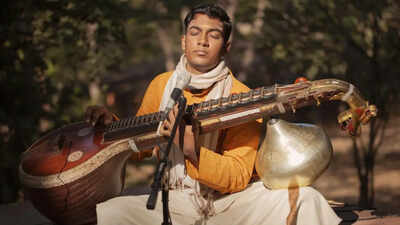
A short veena interlude from the song ‘Phir Se’ in Ranveer Singh’s blockbuster film ‘Dhurandhar’ has unexpectedly become one of the internet’s favourite musical moments. The soulful instrumental segment is now widely used in Instagram Reels, with music lovers praising its emotional depth and unique sound. Behind this now-viral musical hook is Ramana Balachandran, a young Carnatic musician from Tiruvannamalai who has been steadily making a name for himself in the classical music circuit.
How did the viral ‘Dhurandhar’ veena piece happen?
According to The Hindu, Ramana revealed that the opportunity came to him unexpectedly. According to the musician, music director Shashwat had been following his performances on Instagram before they eventually connected through a mutual friend. “It happened quite serendipitously,” Ramana shared. “Shashwat bhai had been following my work on Instagram, and we connected through a common friend.”The team behind ‘Dhurandhar’ reportedly wanted a sound that carried emotional weight and reflected a bittersweet mood. Ramana explained that the famous interlude came together spontaneously during experimentation. “I was randomly playing some stuff, and we chanced upon the interlude. It was nice to get the freedom to express myself musically… but we had no idea that it would blow up so much,” he said.The instrumental piece may be brief, but it has managed to leave a lasting impact on listeners across platforms. The viral popularity has now introduced Ramana to audiences far beyond the Carnatic music world. The musician admitted that seeing such a strong reaction to the piece has been deeply satisfying. “When a piece of work moves people deeply, it is very satisfying. To see such a short interlude resonating with people from a variety of backgrounds gave me joy,” he said.Ramana also opened up about the technical side of recording the now-famous section. “I’m very interested in technical aspects of recording and mixing; in fact, for my veena interlude, the microphone was kept 2.5 feet above the instrument, which gave a different kind of sound that was new to me.”
Ramana Balachandran’s childhood
Ramana’s journey with music began in Bengaluru, where he grew up in a musically inclined family. His father loved singing, while his mother played the veena, creating an atmosphere where music naturally became part of everyday life. Recalling his childhood, Ramana said, “I would watch entire episodes of Super Singer, and have my father sing some Kaapi at home.”Although he initially treated music as just a hobby, a major turning point came when he was nine years old. During one practice session, he noticed a mistake while his mother was playing ‘Saadhinchane’, one of Saint Thyagaraja’s famous Pancharatna kritis. “I kept telling her that she was getting one particular phrase wrong, though I couldn’t play it myself,” he remembered.That observation surprised his mother and eventually led to formal veena training under B Nagalakshmi. Alongside veena lessons, Ramana also balanced vocal music, mridangam practice and academics.
Ramana Balachandran’s move to Tiruvannamalai that changed everything
A major shift happened when Ramana’s family relocated from Bengaluru to Tiruvannamalai. The decision, driven by his father’s desire for a slower and more meaningful lifestyle, deeply influenced Ramana’s musical and spiritual outlook. “My father had had enough of his corporate life and wanted to live the slower life in a smaller town,” Ramana explained.Growing up near one of Tamil Nadu’s most important temples while being home-schooled helped shape his artistic identity. “Here, we see so many people who have renounced luxurious lives and doing such quality work, without making a big fuss about it. Watching all that close quarters deeply inspired me,” he added.
Why films are not Ramana’s main priority?
Even after the success of the ‘Dhurandhar’ track, Ramana says his heart remains rooted in Carnatic music. While he finds film music exciting, he believes classical music still has endless possibilities to explore. “In film music, there is a huge emphasis on emotive appeal,” he said, while also pointing out how modern cinema music now focuses heavily on arrangements and sound design.The 24-year-old musician is currently focused on making classical music more accessible to younger audiences while continuing to celebrate the richness of the veena tradition. “My priority is not films, because I am first and foremost a Carnatic vainika,” Ramana said. “I feel like I have a responsibility as a Carnatic artiste to showcase its beauty, and at the same time, be open to welcome the richness that exists in other forms of music.”



Leave a Reply